wayground logo

Free Printable Worksheets

Font size

S
M
L
XL
Worksheets

DNA, RNA and Genetics

Total questions: 45

Worksheet time: 29mins

Name
Class
Date
1.
In camellia flowers, petal color is controlled by codominance. When a red flower is crossed with a white flower, all of the offspring are covered in both red and white petals.
A scientist crosses a red flower (RR) with a red-and-white (RW) flower.
What are the predicted phenotypes of their offspring?
a)
50% percent of the offspring will be red, and 50% percent of the offspring will be red-and-white
b)
50% percent of the offspring will be RW and 50% percent of the offspring will be RR
c)
50% percent of the offspring will be white and 50% percent of the offspring will be red-and-white
d)
50% percent of the offspring will be RW and 50% percent of the offspring will be WW
2.

A gene for corn has two alleles, one for yellow kernels and one for white kernels.

A farmer mates yellow and white corn. All of the offspring have a nearly even mix of yellow and white kernels.

Which type of inheritance most likely explains the relationship between the two alleles?

a)

sex-linked traits

b)

incomplete dominance

c)

Codominance

d)

polygenic traits

3.

What are non-sex chromosomes called?

a)

karyotype

b)

gametes

c)

autosomes

d)

somatic

4.

When white-coated cattle (W) are mated with red-coated cattle (R), the offspring are roan (WR), meaning their coats contain both white and red hairs. This is an example of codominance.

A farmer breeds two roan cattle with one another.

What is the chance that their offspring will be roan?

a)

0%

b)

25%

c)

50%

d)

100%

5.
Example of a cause of sex chromosome aneuploidy in a human.
a)
A egg with two X chromosomes
b)
An egg with one X chromosome
c)
A sperm with one Y chromosome
d)
apoptosis
6.
Human eye colors are found on a spectrum that ranges from completely pigmented (dark brown eyes) to a complete lack of pigment (light blue eyes).
Which type of non-Mendelian inheritance does human eye color exemplify and why?
a)
polygenic inheritance
b)
Codominance
c)
incomplete dominance
d)
sex-linked traits
7.

A male bird is homozygous recessive for both wacky wings (w) and flashy feathers (f). He is crossed with a female who is homozygous dominant (normal wings and normal feathers) for both traits.

What are the genotypes of these birds? (male; female)

a)

WwFf;WwFf

b)

wwff; WwFf

c)

WWFf; wwFf

d)

wwff; WWFF

8.

Duchenne muscular dystrophy (DMD) is an X-linked recessive condition that causes rapid muscle degeneration. DMD occurs in approximately 1 in every 3500 males, but it rarely affects females.

Explain why DMD affects males more often than females?

a)

Males only have one copy of the Y chromosome

b)

Males only have one copy of the X chromosome

c)

Males have fewer sex chromosomes than females

d)

Males live longer than females

9.

The pedigree below tracks the presence of dimples through a family's generation. Having dimples is an autosomal dominant trait.

What is the phenotype of individual III-4?

a)

one dimple only

b)

no dimples

c)

dimples

d)

need more information

10.
In horses, black coloring (B) is dominant, and chestnut coloring (b) is recessive. A homozygous black horse crosses with a chestnut horse.
What percentage of offspring are expected to be chestnut?
a)
0

4
b)
1

4
c)
2

4
d)
4

4
11.

Some organisms have abnormal sex chromosomes such as X (only have one X chromosome) or XXY (extra X chromosome). What is the most likely cause of the abnormal sex chromosome?

a)

mutagen

b)

meiosis

c)

nondisjunction

d)

polygenic traits

12.

A black sheep is bred with a white sheep. All of their offspring have a phenotype of gray coats.

What is the most likely pattern of inheritance for coat color in sheep?

a)

codominance

b)

polygenic inheritance

c)

incomplete dominance

d)

sex-linked traits

13.

What is a picture of all the chromosomes in a cell arranged in pairs?

a)

Genotype

b)

phenotype

c)

Karyotype

d)

autosome

14.
In genetics, what does a genotype of Hh signify?
a)
Heterozygous; one dominant allele and one recessive allele
b)
Homozygous; one dominant allele and one recessive allele
c)
Homozygous Dominant; Two dominant alleles
d)
Homozygous Recessive; Two recessive alleles
15.
In humans, the ability to taste the bitter chemical PTC is controlled by a single gene. The tasting gene (T) is dominant to the non-tasting gene (t).
What would be the genotypes of a homozygous dominant individual?
a)
TT
b)
Tt
c)
tt
d)
XTY
16.

Which type of non-Mendelian inheritance is depicted based on this Punnett square?

a)

polygenic traits

b)

Codominance

c)

incomplete dominance

d)

sex-linked trait

17.
A woman who has a sex-linked recessive trait has a son with a man who does not have that trait.
What is the probability that their son WILL BE affected?
a)
4

4
b)
1

4
c)
2

4
d)
3

4
18.

An allele that masks the expression of a recessive allele

a)

recessive allele

b)

dominant allele

c)

Codominant allele

d)

heterozyous allele

19.

In humans, three alleles affect blood type. The A and B alleles are codominant, and the O allele is recessive. An AB blood type father has children with an A blood type mother (genotype AO). An AB blood type father has children with an A blood type mother (genotype AO).

What are the chances that their children will have AB type blood?

a)

25%

b)

50%

c)

100%

d)

0%

20.

In genetics, what does a genotype of hh signify?

a)

Heterozygous; one dominant allele and one recessive allele

b)

Homozygous; one dominant allele and one recessive allele

c)

Homozygous Dominant; Two dominant alleles

d)

Homozygous Recessive; Two recessive alleles

21.
Which sequence of DNA bases would pair with this partial strand
CAT TCA CTG
a)
ATG TGA CAG
b)
TAC ACT GTC
c)
GTA AGT GAC
d)
CAT TCA CTG
22.
Which of the following units are repeatedly joined together to form a strand of DNA?
a)
amino acids
b)
nucleotides
c)
fatty acids
d)
polysaccharides
23.
DNA replication results in two DNA molecules,
a)
each one with two original strands
b)
each one with two new strands
c)
each one with one new strand and one original strand
d)
one with two new strands and the other with two original strands
24.
A process in which DNA has the unique ability to make an exact copy of itself.
a)
Replication
b)
Translation
c)
Transcription
25.
Which enzyme is responsible for adding nucleotides?
a)
Topoisomerase
b)
DNA Polymerase
c)
Ligase
d)
Primase
26.
The enzyme that unwinds the DNA to prepare for replication
a)
helicase
b)
replicase
c)
polymerase
d)
synthase
27.
The process of DNA replication is called semi conservative because it results in
a)
none of these
b)
Two DNA molecules.  One original molecule and one with two new strands
c)
two exact copies with new strands
d)
two identical molecules, each with 1 original strand and one new.
28.
Meiosis makes sperm and egg cells. In humans, sperm and egg cells each have _____ chromosomes. Therefore a fertilized human egg cell (sperm and egg cell combined) would create a cell with _____ chromosomes.
a)
23, 46
b)
46, 23
c)
2, 4
d)
50, 100
29.

The following DNA strand is used as a template for transcription:


3′ GGCACTCATTCAA 5′


Which of the following RNA strands will be produced?


Choose 1 answer:

a)

5′ CCGUGAGUAAGUU 3′

b)

5′ CCGTCAGTAAGTT 3′

c)

5′ GGCACTCATTCAA 3′

d)

5′ UUACAGACGGACC 3′

30.
Daughter cells are genetically identical to the parent and each other. 
a)
mitosis
b)
meiosis
c)
both
31.

Another name for a sex cell is a: (NOTE: Choose all that apply.)

a)

gamete

b)

egg

c)

sperm

d)

autosome

32.
Which of the following best describes a DNA molecule?
a)
double helix
b)
contains ribose
c)
made of amino acids
d)
contains Uracil
33.
Which organelle is DNA usually found in?
a)
cell membrane
b)
vacuole
c)
chloroplast
d)
nucleus
34.

Through this scientist's work on pea plants, the fundamental laws of inheritance were discovered. He deduced that genes come in pairs and are inherited as distinct units, one from each parent. He is often called the Father of Genetics.

a)

James Watson

b)

Gregor Mendel

c)

Francis Crick

d)

Hermann Joseph Muller

35.
Would a mutation in the DNA of a skin cell be passed on to an organism's offspring?
a)
Yes, because any change to the DNA is passed on to the offspring
b)
Maybe. Sex cells only use half of the body's genetic code. It might get the copy of a gene that wasn't mutated.
c)
No. Only mutations that occur in the gametes (sex cells) are passed on to the offspring
d)
Without knowing the animal, it would be hard to tell whether or not the mutation would be passed on.
36.
Transcription is a process that in eukaryotic cells takes place in the:
a)
Nucleus
b)
Cytoplasm
c)
Golgi Apparatus
d)
Rough E.R.
37.
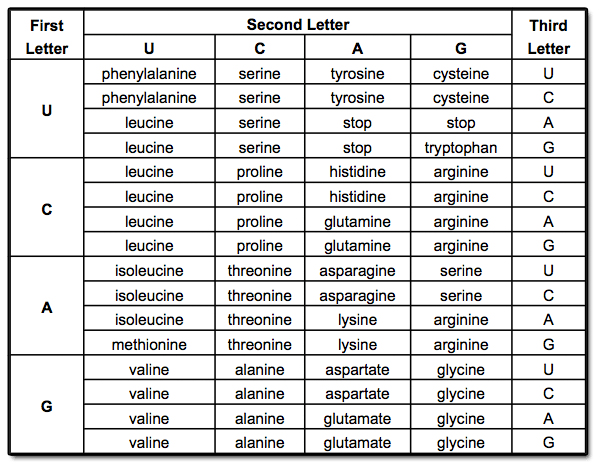
What amino acid is represented by the codon UUA?
a)
Phenylalanine
b)
Tyrosine
c)
Leucine
d)
Stop codon
38.
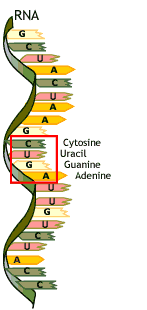
What process is going on in this photo? 
a)
Transcription 
b)
Translation 
c)
Replication 
d)
All the above 
39.
In RNA, Uracil pairs with ______. 
a)
cytosine
b)
adenine
c)
guanine
d)
thymine
40.
The process to go from DNA to mRNA is _______
a)
translation
b)
transcription
c)
replication
41.
The process to go from mRNA to a protein is called ____
a)
transcription
b)
rRNA
c)
replication
d)
translation
42.
Choose the nucleotide sequence of the RNA strand that would be complementary to the following strand: 
GTAGTCA
a)
UATUAGA
b)
ACGACTG
c)
CAUCAGU
d)
CATCAGT
43.

How many amino acids are coded for by this sequence of nucleotides:

ATGGGAACTCCA

a)

4

b)

2

c)

6

d)

12

44.

Mutations are (NOTE: Choose all that apply.)

a)

source of genetic variation

b)

are always harmful

c)

are always helpful

d)

can be helpful if trait helps organism survive

e)

can be harmful if mutation caused by radiation or chemicals

45.

Which statement best describes the process by which the millions of body cells that form a housefly can all contain the same genetic information?

a)

Original DNA is duplicated during replication and then distributed into two new cells.

b)

Original RNA is duplicated during replication and then distributed into two new cells.

c)

Original DNA is duplicated during replication and then distributed into four new cells.

d)

Original RNA is duplicated during replication and then distributed into four new cells.