wayground logo

Free Printable Worksheets

NEW

Font size

S
M
L
XL
Worksheets

Light, Color, Eye

Total questions: 50

Worksheet time: 37mins

Name
Class
Date
1.
EM waves  
a)
Must travel through a vacuum
b)
Can travel through a medium or a vacuum
c)
Are the same type of wave as mechanical waves
d)
Can only travel through a vacuum
2.
_____?______ materials do not allow light waves to pass through.
a)
Opaque
b)
Transparent
c)
Translucent
3.
_____?_____ materials allow some light to partially pass through, but not in a straight path.
a)
Opaque
b)
Transparent
c)
Translucent
4.
_____?_____ materials allow light waves to pass through easily.
a)
Opaque
b)
Transparent
c)
Translucent
5.
Which objects on the table are "Opaque"?
a)
Pitcher; Supply Box; Pencil
b)
Book; Pencil; Rock
c)
Pencil; Book; Goggles
6.
Which objects on the table are "Translucent"?
a)
Fish Bowl; Supply Box; Goggles
b)
Pencil; Fish Bowl; Cup
c)
Fish Bowl; Supply Box; Pitcher
7.
Which objects on the table are "Transparent"?
a)
Rock; Pencil
b)
Cup; Goggles
c)
Supply Box; Fish Bowl
8.
Light bending as it passes from one medium (object) to another is...
a)
Refraction
b)
Reflection
9.
We see the color _______ when a material absorbs all visible light.
a)
white
b)
black
10.
Which color travels the quickest and has the shortest wavelength?
a)
Red
b)
Violet
11.
Light bouncing off a mirror is an example of...
a)
Refraction
b)
Reflection
12.
The distance between two crests or two troughs is the...
a)
Crest/Peak
b)
Trough
c)
Wavelength
13.
A prism separating white light is an example of...
a)
Refraction
b)
Reflection
14.
We see the color _______ when all visible light is reflected off an object.
a)
White
b)
Black
15.
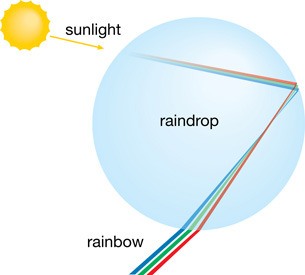
Light bending as it passes through a rain drop is an example of...
a)
Refraction
b)
Reflection
16.
Which part of the eye is the place where images are inverted?  
a)
Retina
b)
Cornea
c)
Lens
d)
Iris
17.

Regulates the amount of light entering the eye and gives the eye its color.

a)

Iris

b)

Lens

c)

Pupil

d)

Retina

18.
The clear tissue that covers the front of the eye.
a)
Lens
b)
Pupil
c)
Iris
d)
Cornea
19.
The eyeball is too long
a)
Nearsightedness
b)
Farsightedness
c)
Both answers
d)
Neither answer
20.
Can not see things far away without corrective lenses.
a)
Retina damaged
b)
Pupil damaged
c)
Farsightedness
d)
Nearsightedness
21.
What is letter B
a)
Optic nerve
b)
Lens
c)
Cornea
d)
Retina
22.
What is letter E?
a)
Vitreous humor
b)
Retina
c)
Cornea
d)
Optic nerve
23.
What is letter F?
a)
Retina
b)
Pupil
c)
Vitreous humor
d)
Iris
24.
The part of the electromagnetic spectrum that humans can easily see is called _____________.
a)
visible light
b)
gamma rays
c)
microwaves
d)
eye waves
25.
These types of cells tell us how bright or dark something is
a)
Rods
b)
Cones
c)
Color
d)
Cornea
26.
These types of cells are sensitive to red, green, and blue
a)
rods
b)
cones
c)
optics
d)
cornea
27.
When no light is present, we see
a)
black
b)
gray
c)
white
28.
The transparent covering of the eye is called the 
a)
Cornea
b)
Pupil
c)
Retina
d)
Optic Nerve
29.
Why does a purple shirt appear purple?
a)
the shirt material REFLECTS all wavelengths of color 
b)
the shirt material transmits all wavelengths of color except the purple
c)
the material absorbs all wavelengths of color except the purple wavelength
30.
Which best explains what happens to light when it shines on a green snake?
a)
Red and Green are absorbed
b)
Red and green are reflected
c)
Green is absorbed, Red is reflected
d)
Green is reflected, Red is absorbed
31.
Does the scarf reflect or absorb yellow?
a)
Reflect
b)
Absorb
32.
Why does a straw look broken when you put it in a cup of water?
a)
It is being reflected.
b)
It is being refracted.
c)
It is broken.
d)
The colors are being separated.
33.
If you look at a yellow banana through a red filter, what color will the banana be?
a)
Red
b)
Yellow
c)
Blue
d)
Green
34.
What is the correct order of the colors of the rainbow?
a)
Red, orange, yellow, green, blue, indigo, violet
b)
red, orange, yellow, blue, green, indigo, violet
c)
orange, yellow, red, blue, purple, indigo
d)
red, orange, yellow, green, indigo
35.
Which is true of a mechanical wave?
a)
It must have a medium
b)
It must travel in empty space.
c)
It can travel in a vacuum.
d)
Both sound and light are examples.
36.
a)
Amplitude
b)
Crest
c)
Trough
d)
Wavelength
37.
a)
Trough
b)
Crest
c)
Amplitude
d)
Wavelength
38.
a)
Frequency
b)
Amplitude
c)
Wavelength
d)
Trough
39.
a)
Crest
b)
Trough
c)
Height
d)
Frequency
40.
What do waves transfer?
a)
energy
b)
matter
c)
work
d)
power
41.
All EM waves travel at  
a)
different speeds
b)
the speed of sound
c)
the speed of light
d)
the speed of a vacuum
42.
EM waves travel the speed of light which is..
a)
3000 miles/sec
b)
300,000 km/sec
c)
3000 miles/hour
d)
30 miles per hour
43.
Is a convex lens thicker or thinner in the middle?
a)
Thicker 
b)
Thinner 
44.

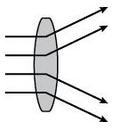
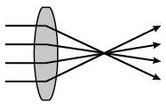
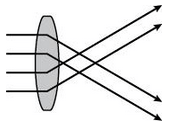
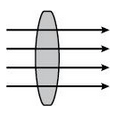
Which figure represents the path light takes through a convex lens?
a)
b)
c)
d)
45.

Which lens represents the path light takes through a concave lens?

a)
b)
c)
d)
46.

What type of interference is represented in this diagram?

a)

Constructive

b)

Destructive

47.

What type of interference is represented in the diagram?

a)

Constructive

b)

Destructive

48.

What's happening at A?

a)

Two crests are combining to create constructive interference.

b)

A crest and a trough are combining to create destructive interference.

c)

Two crests are combining to create destructive interference.

d)

A crest and trough are combining to create constructive interference.

49.

What is happening at B?

a)

Two crests are combining to create constructive interference.

b)

A crest and a trough are combining to create destructive interference.

c)

Two crests are combining to create destructive interference.

d)

A crest and a trough are combining to create constructive interference.

50.
This image is representing what wave interaction?
a)
Refraction
b)
Diffraction
c)
Reflection
d)
Interference