Wayground logo

Free Printable Worksheets

Font size

S
M
L
XL
Worksheets

3) Cells

Total questions: 98

Worksheet time: 1hrs 21mins

Name
Class
Date
1.
Which of the following are NOT found in animal cells
a)
chloroplasts and cytoplasm
b)
chloroplasts and cell wall
c)
cell wall and cell membrane
d)
mitochondria and nucleus
2.
The nucleus is like the ____________ of the cell.
a)
foot
b)
hand
c)
stomach
d)
brain
3.

Which of the following converts food into energy for the cell?

a)

vacuole

b)

mitochondria

c)

cytoplasm

d)

cell membrane

4.

The fluid that surrounds the organelles is... (hint... "Try to pull a fast one and..."

a)

chloroplast

b)

cytoplasm

c)

vacuole

d)

cell wall

5.
What do vacuoles do? 
a)
They actually do not have an important role
b)
They protect the cell
c)
They are the brain of the cell
d)
storage area for cells; water storage in plants 
6.

Which organelle takes in "sun showers" and helps plants with the process or photosynthesis?

a)

Vacuole

b)

Mitochondria

c)

Cytoplasm

d)

Chloroplast

7.
If you were some bad guy trying to sneak into an animal cell, who would be there to stop you?
a)
nucleus
b)
mitochondria
c)
cell membrane
d)
cell wall
8.
Which of the following, found ONLY in plant cells, provides structure?
a)
cell wall
b)
chloroplast
c)
mitochondria
d)
vacuole
9.
Which of the following, found ONLY in plant cells, provides structure?
a)
cell wall
b)
chloroplast
c)
mitochondria
d)
vacuole
10.
Which structures are found in every living cell?
a)
cell membrane and cytoplasm
b)
chloroplasts and mitochondria
c)
a cell wall and nucleus
d)
chloroplasts and cell wall
11.
Which cell structure is found in plant and animals cells and controls what can come into or leave a cell?
a)
cell membrane
b)
cytoplasm
c)
nucleus
d)
vacuole
12.
What is the function of the cell nucleus found in both plant and animal cells?
a)
to produce energy
b)
to control cell activity
c)
to remove waste products
d)
to allow molecules to enter the cell
13.
What is one basic function of the vacuoles?
a)
circulating oxygen
b)
producing food
c)
controlling cell processes
d)
storing water
14.
Chloroplasts in plant cells allow the plant to perform a function that animal cells cannot do.  What is the main function of the chloroplasts found in plant cells?
a)
to absorb light energy and manufacture food
b)
to remove waste materials by active transport
c)
to manufacture chemical energy from food
d)
to control the shape of the cell
15.
All cells need energy to function.  Which cell organelle is responsible for producing energy in the cell?
a)
chloroplasts
b)
mitochondria
c)
nucleus
d)
vacuoles
16.
In what part of the plant cell does the process of photosynthesis take place?
a)
nucleus
b)
mitochondria
c)
chloroplasts
d)
vacuoles
17.
Cells with a nucleus and membrane-bound organelles are called ____________________.
a)
prokaryotes
b)
eukaryotes
c)
bacteria
d)
protists
18.
Who was the first  person to see cells under the microscope and give them their name?
a)
Mattias Schleiden
b)
Robert Hooke
c)
Theordor Schwann
d)
Anton van Leeuwenhoek
19.

Which part of the cell is considered to be "selectively permeable" because it allows certain things to enter or leave the cell?

a)

Cell Membrane

b)

Nucleus

c)

Lysosome

d)

Cytoplasm

20.

Which structures are unique only to plant cells?

a)

Cell Membrane

b)

Cell Wall

c)

Mitochondria

d)

Chloroplast

21.

The jelly like substance in the cell is called --

a)

cytoplasm

b)

lysosomes

c)

chromosomes

d)

cytokinesis

22.

What are organelles?

a)

Parts that come together to make an organ system.

b)

A group of similar cells that perform similar functions.

c)

A group of organs that perform similar functions

d)

Tiny structures within a cell that allow the cell to live, grow, and reproduce.

23.

When compared to a prokaryotic cell, a eukaryotic cell ...

a)

does not have a nucleus

b)

has DNA that is circular

c)

has more types of organelles

d)

stores it's DNA in a nucleus rather than in the cytoplasm

24.

A plant's green color is due to the presence of which organelle?

a)

Nucleus

b)

Chloroplast

c)

Vacuole

d)

Mitochondrion

25.

There are 3 main differences between a plant and an animal cell. Plant cells contain .....

a)

a cell membrane

b)

a cell wall

c)

a nucleus

d)

a larger vacuole

e)

chloroplasts

26.

Why do plants need mitochondria when they already have chloroplasts?

a)

Plant cells do not have mitochondria.

b)

Mitochondria produce food for the cell.

c)

Mitochondria break down food into energy.
27.
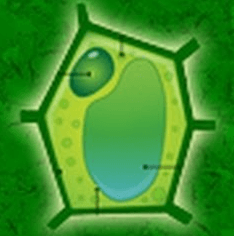
Animal cells have_______________.
a)
cell walls
b)
chloroplasts
c)
cytoplasm
d)
large vacuoles
28.
Michael looked at a cell through a microscope.  He identified a nucleus, chloroplast, and cytoplasm.  What kind of cell did Michael observe?
a)
animal
b)
plant
c)
vertebrate
d)
bacteria
29.
Which piece of equipment is the best to use to observe the structure of a cell?
a)
magnifying glass
b)
binoculars
c)
telescope
d)
microscope
30.
Which of the following is found in plant cells but not in animal cells?
a)
nucleus
b)
cell membrane
c)
vacuoles
d)
chloroplasts
31.
A rigid layer that lies outside the cell's  membrane is...
a)
Cytoplasm
b)
Cell membrane
c)
Cell Wall
d)
Flagella
32.
surrounds the cell; regulates what enters/leaves cell: holds the cell together
a)
vacuole
b)
cell wall
c)
cell membrane
d)
lysosome
33.
Which of these are characteristics of most cells?
a)
make their own food
b)
can only be seen using a microscope
c)
they all have a cell wall
d)
they are found only in humans
34.

Which organelle contains DNA and controls the cell?

a)

Endoplasmic Reticulum

b)

Golgi Apparatus

c)

Nucleus

d)

Vesicles

35.

The nucleus is only found in the animal cell

a)

True

b)

False

36.

Ribosomes are only in plant cells

a)

True

b)

False

37.

The cell wall is found only in plant cells

a)

True

b)

False

38.

Mitochondria are found in plant AND animal cells

a)

True

b)

False

39.

What do vacuoles do?

a)

store water, food, and waste

b)

create energy

c)

nothing

d)

give the cell its shape

40.
Which level of organization is in order from smallest to largest?
a)
Cells, organs, tissues,organ systems
b)
Tissues, cells, organ systems, organs
c)
Organ system, organs, tissues, cells
d)
cells, tissues,organs, organ systems
41.
What is a group of organs working together is called?
a)
Tissue system
b)
organ system
c)
An organism
d)
cell system
42.
Which organelle acts as the"construction worker" because it assembles amino acids?
a)
Golgi bodies
b)
ribosomes
c)
Chloroplasts
d)
Mitochondria
43.
Which term refers to groups of different tissues that have combined to form a single structure?
a)
Cells
b)
Organs
c)
organ system
d)
Organisms
44.
The main function of the cell wall is to direct the activities of the cell.
a)
True
b)
False
45.
Plant cells are the same as animal cells.
a)
True
b)
False
46.
Plant cells ......
a)
are called Prokaryotic cells.
b)
have a cell wall and chloroplast.
c)
are usually circular in shape
d)
All choices are correct.
47.
I produce the energy a cell needs.  I am a mighty power house.  Who am I?
a)
Mitochondria
b)
Nucleus
c)
Lysosome
d)
Cell Membrane
48.
Plant cells have these but animal cells do not. 
a)
Nucleus and cell mem
b)
cell membrane and cell wa
c)
chloroplast and cell wall
d)
Chloroplasts and mitochondria
49.
What is the gel like substance that holds organelles in cells?
a)
Cytoplasm
b)
Chloroplast
c)
Nucleus
d)
Mitochondria
50.

What is one way in which all living things on Earth are alike?

a)

All living things have hair.

b)

All living things are made of cells.

c)

The cells of all living things have chloroplast.

d)

All living things can move.

51.

When cells are damaged, new cells are created by cell division. How does the cell theory explain this fact?

a)

It states that all cells have a nucleus which divides.

b)

It states that all living things are made up of one or more cells.

c)

It states that cells come from previously existing cells.

d)

It states that the basic units of structure and function are cells.

52.
An organelle that captures energy from the sunlight in order to use it to produce food in plant cells is ______________.
a)
Chromatin
b)
Chloroplast
c)
Cytoplasm
d)
Cell Membrane
53.

The _____________ holds the DNA, and controls the functions of eukaryotic cells.

a)

Nucleus

b)

Nuclear Membrane

c)

Mitochondria

d)

Chloroplast

54.

What is found in both plant and animal cells but is much larger in plant cells because it helps to provide structure and support?

a)

Nucleus

b)

Mitochondrion

c)

Chloroplast

d)

Vacuole

55.

What is the main difference between prokaryotic and eukaryotic cells?

a)

Prokaryotic cells are found only in multicellular organisms

b)

Eukaryotic cells are found only in unicellular organisms

c)

Eukaryotic cells have a nucleus and prokaryotic cells do not

d)

Prokaryotic cells have DNA and eukaryotic cells do not

56.

When we exercise we use a lot more energy than when we are at rest. How to our cells help to maintain homeostasis during periods of exercise?

a)

The cells will die from using too much energy.

b)

The cells won't be able to keep up so they will multiply and create new cells.

c)

The cells will slowly die from using too much energy.

d)

The cells will create more mitochondria over time to produce more energy.

57.

Different cell organelles perform different functions. Which cells would most likely have the largest vacuoles?

a)

Cells found in a fox

b)

Cells found in a maple tree

c)

Cells found in a desk

d)

Cells found in a butterfly

58.

A vacuole is a membrane-bound sac that plays a role in the storage and the release of cellular products. How do the vacuoles in animal cells differ from vacuoles in a plant cell?

a)

Plant cell vacuoles are usually smaller because plants can make their own food.

b)

Animal cells usually contain less vacuoles because they have an excretory system to eliminate waste.

c)

Plant cell vacuoles are usually larger because they also provide structural support for the plant tissues.

d)

Animal cell vacuoles are usually larger because they have to store a lot of glucose from the food they eat for later use

59.
1.What cells have fine hairs?
a)
Ciliated cells
b)
Root cells
c)
mouth cells
d)
red blood cells
60.
1.What cells carry electrical signals?
a)
Red blood cells
b)
Nerve cells
c)
Sperm cells
61.
What cells have NO nucleus?
a)
Leaf cells
b)
Animal cells
c)
Red blood cells
d)
egg cells
62.
 What is another name for a palisade cell?
a)
Egg cell
b)
Sperm Cell
c)
Leaf cell
d)
Animal cell
63.
The nucleus 
a)
contains genetic material
b)
is for respiration
c)
is for photosynthesis
d)
is for movement
64.
What cell is much larger than other animal cells?
a)
Egg cell
b)
Sperm cell
c)
Leaf cell
d)
Root hair cell
65.
If the eyepiece lens magnification is 10 and the objective lens magnification is 40 what is the total magnification?
a)
10
b)
40
c)
400
66.
Which of these is not a unicellular organism?
a)
Amoeba
b)
Euglena
c)
Protozoa
d)
Red blood cells
67.
An independent variable is
a)
What I change
b)
What stays the same
c)
is the control
68.
Specialized cells that absorb water by osmosis
a)
Nerve Cell
b)
Xylem
c)
Palisade Cell
d)
Root Hair Cell
69.
controls the opening or closing of pores to allow gas exchange
a)
chloroplasts
b)
guard cells
c)
xylem
d)
phloem
70.
This specialized cell does not contain a nucleus to allow for transport of oxygen
a)
Nerve Cell
b)
Red Blood Cell
c)
White Blood Cell
d)
Palisade cell
71.
The role of these specialized cells is to help fight off infection and foreign bodies.
a)
Palisade Cells
b)
Nerve Cells
c)
White Blood Cells
d)
Red Blood Cells
72.
Which of the following is a plant cell?
a)
A
b)
B
c)
C
d)
D
73.
This cell can swim to find the  female egg cell
a)
sperm
b)
ciliated cell
c)
red blood cell
d)
nerve cell
74.
All our cells, except sex cells like eggs or sperm, have ___________ DNA
a)
different
b)
similar
c)
exactly the same
d)
half the amount of 
75.

What type of cells contain a nucleus?

a)

Just plant cells

b)

Just bacteria cells

c)

Only animal cells

d)

Both animal and plant cells

76.

Which type of cells are able to make their own food?

a)

Animal cells only

b)

Plant cells only

c)

Both animal and plant cells

d)

Fungi cells

77.

Why do very active cells have lots of mitochondria?

a)

Mitochondria release energy to power cells

b)

Mitochondria help cells to divide in two

c)

Mitochondria help give the cell their shape

d)

Mitochondria make hormones

78.

Palisade cells are found in...

a)

human hearts

b)

paliotic cells in the kidney

c)

the surface of leaves to carry out photosynthesis

d)

viruses that cause disease

79.

Which type of cells have cilia?

a)

Only plant cells do

b)

Animal cells only

c)

Both animal and plant cells can have them

d)

Cilia don't exist, it's a made up word!

80.

Red blood cells...

a)

Are the only plant cells with a nucleus

b)

Are the only animal cell without a nucleus

c)

Are the only animal cells without a cell membrane

d)

Are the only animal cells with chloroplasts

81.

Ciliated cells...

a)

in the lungs help to trap and remove dust and germs

b)

in the lungs kill viruses

c)

are found in the human brain

d)

have a double membrane around their cell

82.

What adaptation does a root hair cell have

a)

Lots of chloroplasts for photosynthesis

b)

It has animal cell parts

c)

It can eat worms

d)

Long extension of the cell wall to absorb water and nutrients

83.

Human egg cells contain a...

a)

yolky cytoplasm to act as a food reserve for the fertilised egg

b)

No DNA at all

c)

Watery cytoplasm to keep it healthy

d)

Lots of mitochondria for energy

84.

What is the function of the STOMATA in plants?

a)

Allows water to enter the plant

b)

Provides food to enter the plant

c)

Allows for gas exchange

d)

Site of photosynthesis

85.

What is the function of GUARD cells in plants?

a)

Allow gas exchange

b)

Control the opening & closing of the stomata

c)

Contain DNA

d)

Nucleus

86.

Everything in your body is controlled by....

a)

Chloroplasts

b)

DNA

c)

Cancer

d)

Mitosis

87.
This type of cell is found in females and is needed for reproduction.
a)
egg cell
b)
sperm cell
c)
fertilization cell
d)
yolk cell
88.
Controls the cell and contains DNA
a)
Nucleus
b)
Mitochondria
c)
Chloroplast
d)
Cell Wall
89.
what is the function of cuticle?
a)
protects the underlying tissues
b)
transport water
c)
transport mineral and nutrients
d)
reduce loss of water through transpiration
90.
what is the function of xylem tissue?
a)
transports water and minerals salt 
b)
control the opening and closing of stoma
c)
carry out photosynthesis
d)
provide support for young plant
91.
what is the function of phloem tissue?
a)
transport water and minerals
b)
support plants
c)
photosynthesis process occur
d)
transport organic nutrients
92.
Which plant structure is the primary site of photosynthesis?
a)
Root
b)
Stem
c)
Leaf
d)
Flower
93.

What process do plants go through to create glucose

a)

Cellular Respiration

b)

Photosynthesis

c)

Light Reaction

d)

Calvin Cycle

94.
The function of a ___ is to absorb water, store food, and anchor plants. 
a)
phloem
b)
tissue
c)
xylem
d)
root
95.
Its job is to support the plant and hold its leaves up to the sun.
a)
root
b)
stem
c)
flower
d)
leaf
96.
The main source of energy for all life comes from ____.
a)
the Earth
b)
the moon
c)
the sun
d)
the food we eat/make
97.

Which of the following is not a function of plant roots

a)

anchor the plant to the ground

b)

absorb water

c)

perform photosynthesis

d)

stores food

98.

What are the 3 main plant organs?

a)

dermal, vascular, ground

b)

roots, stems, leaves

c)

roots, stems, flowers

d)

roots, ground, vascular