wayground logo

Free Printable Worksheets

NEW

Font size

S
M
L
XL
Worksheets

Judicial Branch Quiz

Total questions: 28

Worksheet time: 16mins
Name
Class
Date
1.
Role of the judicial branch
a)
make laws
b)
interpret laws
c)
enforce laws
d)
impeach a president
2.

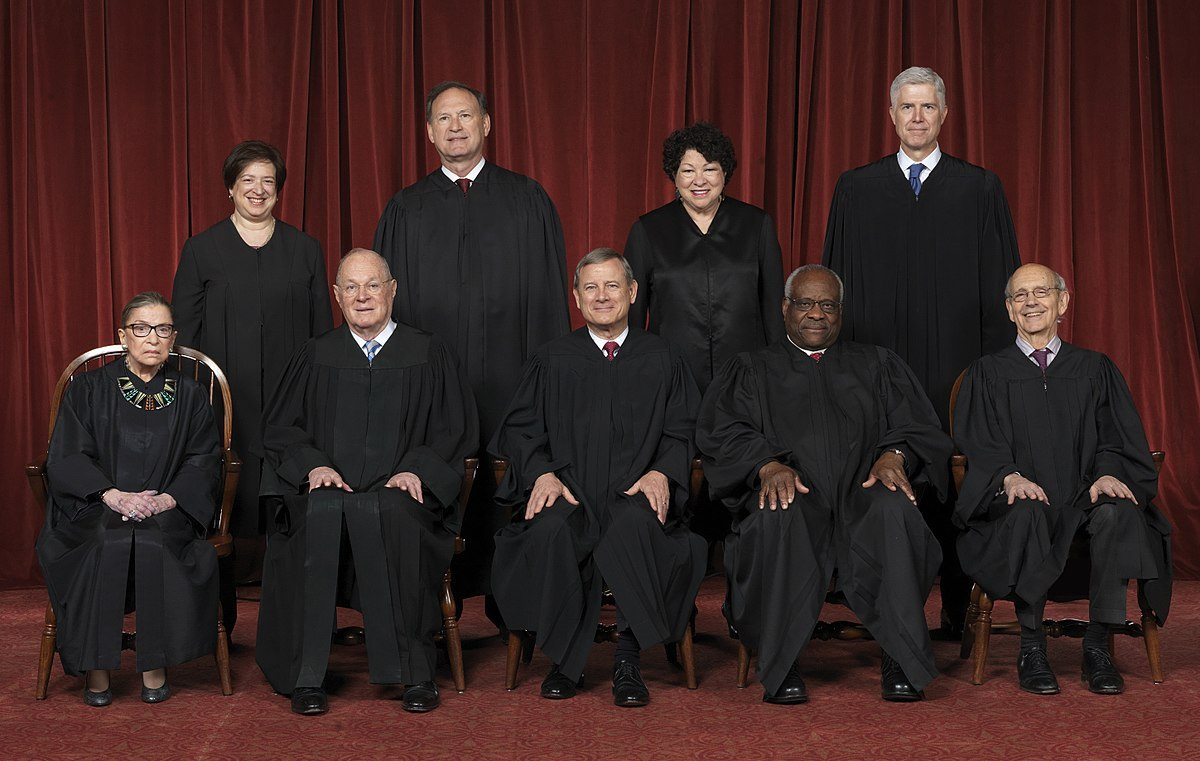
How many Supreme Court Justices sit on the Supreme Court?

a)

7

b)

9

c)

5

d)

12

3.

How are federal judges selected?

a)

Named by the President, confirmed by the Senate.

b)

Named by the President.

c)

They are elected.

d)

Named by the previous judge.

4.
When a Supreme Court justice agrees with the decision reached by the Court in a case, but not with the reasons why the Court made that decision, he or she may choose to write a
a)
concurring opinion.
b)
dissenting opinion.
c)
majority opinion.
d)
unanimous opinion.
5.

The Supreme Court ruling a State law unconstitutional is an example of what?

a)

Judicial Review

b)

Judicial Restraint

c)

Judicial Activism

d)

Jurisdiction

6.

Original Jurisdiction is when:

a)

a court is the first to hear a case

b)

a court has the authority to hear a case

c)

a court reviews the decision of a lower court

d)

power is shared between the Federal and State courts to hear a certain case
7.

Appellate Jurisdiction is when:

a)

a court is the first to hear a case

b)

a court has the authority to hear a case

c)

a court reviews the decision of a lower court

d)

power is shared between the Federal and State courts to hear a certain case

8.
What is the age requirement for the Supreme Court Justices?
a)
50
b)
45
c)
40
d)
No age requirement
9.

The ability of one branch of government to limit the power of the other branches of government is known as what?

a)

Executive Order

b)

Checks and Balances

c)

Amendment Process

d)

Superpowers

10.

The first ten amendments to the Constitution are collectively known as the:

a)

Bill of Rights

b)

English Bill of Rights

c)

Bill of Sale

d)

First Ten

11.
What was the reason from adding the Bill of Rights?
a)
to end the American Revolution
b)
to equalize individual rights
c)
to protect individual rights
d)
to protect the Federalists
12.

The first ten amendments are called the ----

a)

Articles of the Constitution

b)

Bill of Rights

c)

Rights to Appeal

d)

Laws of the Land

13.
Rights that are not written in the U.S. Constitution are reserved to the people --
a)
10 amendment
b)
4th amendment
c)
6th amendment
d)
9th amendment
14.
What does double jeopardy mean?
a)
you can be tried again in court for the same crime
b)
you can NOT be tried again in court for the same crime
15.
These amendments will protect your rights if you are ever charged with a crime.
a)
Amendments 1, 3, 9
b)
Amendments 2, 4, 10
c)
Amendments 4, 5, 6, 8
d)
Amendments 1, 2, 3
16.
Guarantees freedom from testifying against yourself
a)
1st Amendment
b)
3rd Amendment
c)
5th Amendment
d)
7th Amendment
17.
Guarantees a trial by jury in a civil lawsuit of more than $20
a)
1st Amendment
b)
3rd Amendment
c)
5th Amendment
d)
7th Amendment
18.
Forbids cruel and unusual punishment
a)
2nd Amendment
b)
4th Amendment
c)
6th Amendment
d)
8th Amendment
19.
Guarantees your right to confront your accuser and call witnesses 
a)
10th Amendment
b)
4th Amendment
c)
6th Amendment
d)
8th Amendment
20.
Protects people from having the military stay in their homes.
a)
Second Amendment
b)
Third Amendment
c)
Fouth Amendment
d)
Fifth Amendment
21.
Offices usually need a _______ to search you or your property
a)
Baton
b)
Firearm
c)
Warrant
d)
Bible
22.

Cases that are about money, property and are not criminal are

a)

civil

b)

silly

c)

criminal

d)

appeal

23.
What case held that a woman's right to privacy protected her right to have an abortion in the 1st 3 months of her pregnancy?
a)
Roe v. Wade
b)
Webster v. Reproductive Health Services
c)
Griswold v. Connecticut
d)
Planned Parenthood v. U.S.
24.

Which case ESTABLISHED the principle of "separate but equal?"

a)

Brown v. Board

b)

Plessy v. Ferguson

c)

Dred Scott v. Sandford

d)

Marbury v. Madison

25.

This ruling held that schools can search students with reasonable cause. This case lessens the Tinker doctrine and gives school officials greater latitude in disciplining students

a)

New Jersey v. TLO, 1985

b)

Plessy v. Ferguson, 1896

c)

Regents of California v. Bakke, 1978

d)

Roe v. Wade, 1973

26.

The Supreme Court ruled that the "separate but equal" provision of the Louisiana law was constitutional. The case established this principle of segregation until it was overturned in 1954.

a)

Regents of California v. Bakke, 1978

b)

Roe v. Wade, 1973

c)

Plessy v. Ferguson, 1896

d)

Tinker v. Des Moines School District, 1969

27.
What does the word "amend" mean?
a)
add to
b)
change
c)
make better
d)
make worse
28.

When was the BIll of Rights written?

a)

Before the Constitution

b)

After the Constitution

c)

During the Constitution

d)

100 yrs after the Constitution