wayground logo

Free Printable Worksheets

Font size

S
M
L
XL
Worksheets

5th Grade Weather-Conley

Total questions: 48

Worksheet time: 12hrs 0mins

Name
Class
Date
1.

A severe storm that involves strong winds and forms over warm water is:

a)

tornado

b)

thunderstorm

c)

hurricane

d)

blizzard

2.
A severe storm which involves a funnel cloud forming from a cumulonimbus cloud:
a)
hurricane
b)
tornado
c)
thunderstorm
d)
blizzard
3.
This severe weather involves lightning, rain, and forms from a cumulonimbus cloud.
a)
thunderstorm
b)
tornado
c)
hurricane
d)
blizzard
4.
This weather tool measures wind speed 
a)
thermometer
b)
barometer
c)
anemometer
d)
psychrometer
5.
Which weather tool measures air pressure?
a)
thermometer
b)
barometer
c)
anemometer
d)
psychrometer
6.
Humidity is the...
a)
Amount of Water Vapor in the Air
b)
Amount of Wind in the Air
c)
Amount of Precipitation in the Air
d)
Amount of Pressure in the Air
7.
What kind of weather is usually associated with a low pressure system?
a)
Sunny weather
b)
Precipitation (rain, snow, etc.)
8.
What kind of weather is usually associated with a high pressure system?
a)
Sunny weather
b)
Precipitation (rain, snow, etc.)
9.
In what direction do winds always blow?
a)
From areas of high pressure to areas of low pressure
b)
From areas of low pressure to areas of high pressure
10.
What measures temperature?
a)
barometer
b)
anemometer
c)
thermometer
d)
psychrometer
11.
What type of cloud looks like cotton and is in the lower altitudes?
a)
Cumulus
b)
Stratus
c)
Cirrus
12.
A front is
a)
where warm air is cooling at earth's surface
b)
a line where hot and cold air are separating
c)
a line where two different air masses meet
d)
where cold air is rising and forming rain clouds
13.

What type of cloud is shown?

a)

nimbostratus cloud

b)

cumulonimbus cloud

c)

cirrus cloud

d)

altostratus cloud

14.
what type of cloud is shown?
a)
cumulus
b)
cirrus
c)
stratus
15.
what type of cloud is shown?
a)
cumulus
b)
cirrus
c)
stratus
16.
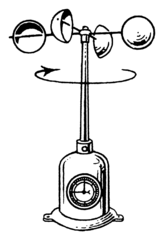
This weather instrument is a...
a)
anemometer
b)
Christmas ornament
c)
wind vane
d)
barometer
17.
This weather instrument is an...
a)
wind vane
b)
anemometer
c)
barometer
d)
thermometer
18.
Someone who studies the weather.
a)
rain gauge
b)
taxonomists
c)
meterologist
d)
satellites
19.
At which humidity is it more likely to rain?
a)
50%
b)
20%
c)
77%
d)
99%
20.
What are the yearly conditions of temperature, precipitation and humidity?
a)
weather
b)
climate
21.

As you move towards the poles, what happens to temperature?

a)

temperature becomes hotter

b)

temperature becomes colder

22.
What part of the water cycle includes rain, sleet and snow?
a)
condensation
b)
precipitation
23.
What are the daily conditions of temperature, humidity and precipitation?
a)
weather
b)
climate
24.

Where do warm ocean currents come from?

a)

warm ocean currents come from the southern hemisphere

b)

warm ocean currents come from the equator

c)

Warm ocean currents come from the poles

d)

Warm ocean currents come from the beach

25.

Where do cold ocean currents come from?

a)

cold ocean currents come from the southern hemisphere

b)

cold ocean currents come from the equator

c)

cold ocean currents come from the poles

d)

cold ocean currents come from the beach

26.
Water from rain or snow that flows over the surface of the land into streams, rivers, and lakes is called...
a)
accumulation
b)
runoff
c)
ground water
d)
surface water
27.
The process by which plants release water through the pores in their leaves is called...
a)
accumulation
b)
dormancy 
c)
photosynthesis 
d)
transpiration
28.
The transformation of water vapor back into liquid water by cooling is called...
a)
condensation
b)
evaporation
29.
Water vapor is the _______ form of water.
a)
solid
b)
liquid
c)
gaseous
30.
Any form of water that falls from clouds and reaches Earth's surface as rain, snow, sleet, or hail is called...
a)
surface water
b)
precipitation 
c)
ground water
d)
runoff
31.
The energy that drives the water cycle comes from the...
a)
Sun
b)
Moon
c)
Clouds
32.
El Nino occurs when the tropical ocean waters are warmer in which ocean?
a)
Atlantic
b)
Indian
c)
Pacific
d)
Arctic
33.

During a(n) ____ event, trade winds are much stronger than usual.

a)

El Nino

b)

La Nina

c)

Normal

d)

Partly sunny

34.

During an El Nino, it rains

a)

in the central Pacific

b)

in the FAR western Pacific

c)

in the western Pacific

d)

In all of the Pacific

35.

Both El Nino and La Nina have this in common

a)

Influence birds that migrate over the ocean

b)

Influence rainy / dry weather world wide

c)

The weather at the polar regions

d)

The directions that ships travel in the oceans

36.

During an El Nino, trade winds are typically...

a)

about average

b)

stronger

c)

weaker

37.
Do sea breezes typically happen during the day or night?
a)
Day
b)
Night
38.
Do land breezes typically happen during the day or night?
a)
Day
b)
Night
39.
During a land breeze which way does the wind blow?
a)
from the sea to the land
b)
from the land to the sea
40.
During a sea breeze which way does the wind blow?
a)
from the land to the sea
b)
from the sea to the land
41.
The strength of a sea breeze depends on
a)
the heat of the day
b)
the difference between the temperature of the sea and the land
c)
the wind speed
d)
the amount of precipitation that day
42.

Tsunamis and Hurricanes are the same thing

a)

True

b)

False

c)

I don't know

d)

I thought this was math class

43.

What is the difference between a tornado watch and a tornado warning?

a)

A tornado warning is when a tornado is on the ground at that very moment. A tornado watch is when the weather conditions show that it is possible for a tornado to form

b)

A tornado watch is when a tornado is on the ground at that very moment. A tornado warning is when the weather conditions show that it is possible for a tornado to form

44.

What is a Tsunami?

a)

Its the same thing as a hurricane

b)

Its a massive wave that are most often formed by underwater earthquakes.

c)

Its a flood

d)

Its a massive electrical discharge that comes from clouds

45.
Which has the greatest effect on the movement of the jet stream? 
a)
size of clouds
b)
amount of precipitation
c)
differences in air temperatures
46.

Which best describes a characteristic of the jet stream?

a)

It forms a boundary between a cold air mass and a warm air mass.

b)

It creates the high winds around the eye of a hurricane.

c)

It forces the hot air along the equator to rise to areas in North

America.

d)

It causes high pressure air masses to rotate clockwise.

47.
Why do most storms move from the west coast of America to the east coast?
a)
el nino
b)
the jet stream
c)
la nina
d)
sea breezes
48.
What tool measures humidity in the air? 
a)
anemometer
b)
water gauge
c)
hygrometer
d)
barometer