wayground logo

Free Printable Worksheets

NEW

Font size

S
M
L
XL
Worksheets

Rotational Dynamics

Total questions: 30

Worksheet time: 1hrs 16mins

Name
Class
Date
1.
Which has greater angular speed, a horse near the outside rail of a merry-go-round or a horse near the inside rail?
a)
The inside horse
b)
The outside horse
c)
Neither - they both have the same angular speed
2.
Is torque independent of the location of the origin?
a)
Yes, always.
b)
Yes, as long as the origin is either in the center or on one end.
c)
No, you always need to specify the origin.
3.

Torques cause changes in _______.

a)

velocity

b)

moment of inertia

c)

lever arm

d)

angular velocity

4.

The lever arm is the ________ distance from the axis of rotation to the point where the force is exerted.

a)

angular

b)

displaced

c)

perpendicular

d)

none of these

5.

Suppose a doorknob is placed at the center of a door. Compared with a door whose knob is located at the edge, what amount of force must be applied to this door to produce the torque needed to open it?

a)

1/4 as much

b)

1/2 as much

c)

Twice as much

d)

Four times as much

6.

What is the point at which all of the mass of the body and be considered to be concentrated?

a)

Center of Mass

b)

Moment of Inertia

c)

Rotational Equilibrium

d)

Torque

7.

An ice skater is spinning in a circle with his arms extended out. He then brings his arms in, what happens to his rotational velocity?

a)

It increases

b)

It decreases

c)

It stays the same

d)

He stops spinning immediately

8.
Question 12: What is the net torque about the center of mass of the object? 
a)
a) 0
b)
b) Fd, clockwise
c)
c) Fd, counterclockwise
d)
d) 2Fd, clockwise or e) 2Fd, counterclockwise
9.
A wrench is used to tighten a nut. A 15N perpendicular force is applied 50cm away from the axis of rotation, and moves a distance of 10 cm as it turns. What is the torque applied to the wrench?
a)
7.5 Nm
b)
1.5 Nm
c)
750 Nm
d)
150 Nm
10.
The easiest way to open a heavy door  is by applying the force
a)
Near the hinges
b)
In the middle of the door
c)
At the edge of the door far from the hinges
d)
At the top of the door
11.
A 800N man is playing on a seesaw with son who has a weight of 200N. If the child is sitting 3 meters away, how far will the man have to sit to balance the seesaw?
a)
0.75m
b)
3m
c)
1.5m
d)
1m
12.
Torque is the product of a force exerted on an object times the lever arm.
a)
True 
b)
False
13.

What force does not cause any torque?

a)

Force perpendicular to the fulcrum.

b)

Force horizontal to the planck.

c)

Force slightly off center of the fulcrum

d)

Forces at a 45 degree angle to the fulcrum, and not on the fulcrum

14.
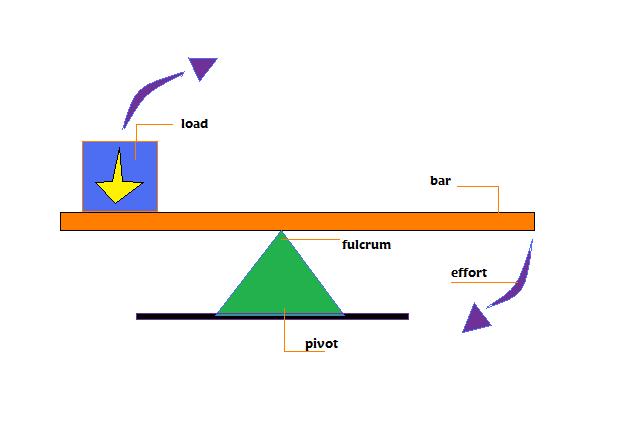
In the diagram above, two masses, one with mass m, the other with mass M = 2m are resting on a uniform plank of length L that pivots at its midpoint. If the mass m is at the far end of the plank, how far away from the pivot should the mass M be to balance the plank in a horizontal position shown?
a)
L/2
b)
L/3
c)
L/4
d)
L/6
15.
If the torque required to loosen a nut on the wheel of a car has a magnitude of 60.0 N• m, what minimum perpendicular force must be exerted by a mechanic at the end of a 45.0 cm wrench to loosen the nut?
a)
.666 Nm
b)
 133.3 N
c)
66.7 N
d)
13.3 Nm
16.
What is the distance the masses on the right of the fulcrum need to be to balance with the two masses on the left?
a)
.65 m
b)
.56 m
c)
.79 m
d)
.39 m
17.
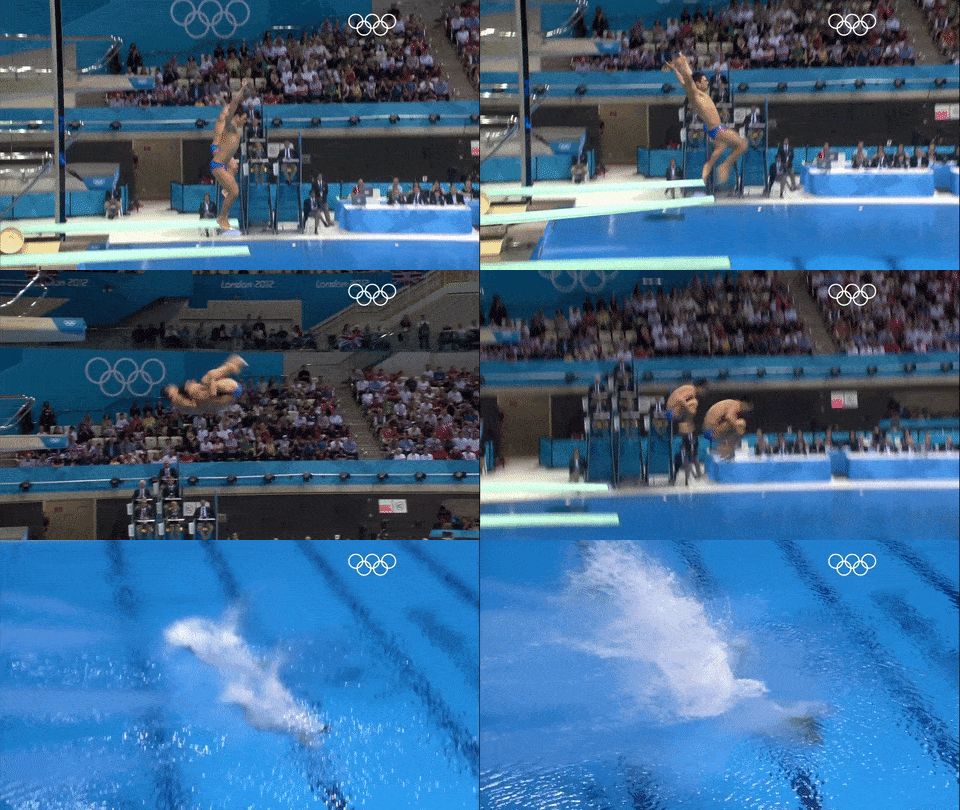
What direction is the torque acting with respect to post A?
a)
clockwise
b)
Counter clockwise
c)
Neither Direction
d)
Depends on the mass of the diver
18.
Find the magnitude of the torque produced by a 22.0 N force applied to a door at a 30 degree from the perpendicular distance of  .005 km from the hinge.
a)
55 Nm
b)
.015 Nm
c)
6.3 Nm
d)
8.75 Nm
19.
A person sits on a freely spinning lab stool that has no friction in its axle. When this person extends her arms,
a)
her moment of inertia increases and her angular speed decreases.
b)
her moment of inertia decreases and her angular speed increases.
c)
her moment of inertia increases and her angular speed increases.
d)
her moment of inertia increases and her angular speed remains the same.
20.
In order to do a lot of flips an Olympic diver would want:
a)
A high rotational inertia
b)
A low rotational inertia
c)
A low linear acceleration
d)
A low angular velocity
21.
What happens to his rotational inertia when a figure skater brings in his arms?
a)
Increase his rotational inertia
b)
Decrease his rotational inertia
c)
has no affect
22.
Because of inertia, a moving object will keep ________.
a)
at rest
b)
moving
c)
in one spot
d)
inertia 
23.
Because of inertia, a resting object will remain at ________.
a)
rest
b)
a constant speed
c)
school
d)
inertia 
24.
You push on a car and it does not move.  What is true about the inertia?
a)
The inertia is changing
b)
The inertia of the car is too great 
c)
The inertia of the person is equal to the car
d)
There is not inertia because of no movement
25.
Because a hollow ball has a higher moment of inertia than a solid ball...
a)
The solid ball rolls faster
b)
The solid ball weighs more.
c)
The solid ball weighs less.
d)
They both accelerate at the same rate.
26.
If a ball moves with slipping down a ramp
a)
it goes slower than if it had rolled down
b)
it moves faster than if it had rolled down.
c)
It doesn't make a difference about friction or not friction.
d)
Friction slows it down.
27.

What is the total kinetic energy of a 3 kg solid disk (I = 1/2mr2) with a diameter of 80 cm rolling at 4 m/s?

a)

12 J

b)

24 J

c)

36 J

d)

48 J

28.
A cylinder (I=1/2mr2) and a hoop (I=mr2) of the same radius and same mass are traveling at the same angular velocity (ω).  What is the ratio of the rotational kinetic energy of the cylinder to the rotational kinetic energy of the hoop?
a)
1:1
b)
1:2
c)
2:1
d)
1:4
29.
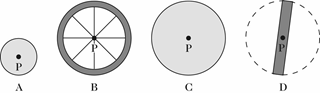
The figure shows scale drawings of four objects, each of the same mass and uniform thickness, with the mass distributed uniformly. Which one has the greatest moment of inertia when rotated about an axis perpendicular to the plane of the drawing at point P?
a)
A
b)
B
c)
C
d)
D
30.
Three homogeneous ridged bodies -- a solid shere, a solid cylinder, and a hollow cylinder -- are placed at the top of an incline.  If all are released from rest at the same elevation and rolls without slipping, which reaches the bottom first?
a)
The solid sphere.
b)
The solid cylinder.
c)
The hollow cylinder.
d)
They will all arrive at the same time.