
 Worksheets
Colonization, Revolution, Constitution, Industrialization, Civil War and Reconstruction STAAR Review
Total questions: 125
Worksheet time: 1hrs 23mins
This infrastructure allowed New York City to become a vital commercial center seaport and decreased the prices of shipping goods to the Midwest
Mississippi River
Transcontinental Railroad
Erie Canal
Golden Gate Bridge
The rise in _____________ was caused by new jobs in factories
urbanization
prices of goods
Some environmental modifications to build this infrastructure included blasting tunnels and building bridges. It also allowed for new markets and a population increase in the west.
textile mills
interchangeable parts
transcontinental railroad
national road
This was an environmental result of decades of cotton farming
soil exhaustion
soil fertility
This region focused on agriculture and mining metal due to abundant land and resources
North
South
West
East
This region was focused on trade and manufacturing
Midwest
North
South
West
This region was shaped by "King Cotton" and the growth of slavery on plantations
Midwest
North
South
West
This immigrant group was pulled by the economic boom in the west, the opportunity to find gold in California, building of the Transcontinental Railroad, and experienced extreme nativism.
Chinese
Irish
German
Dutch
This immigrant group settled in the Midwest to establish small farms. They brought the idea of kindergartens, bowling and polka music.
Chinese
Irish
German
Dutch
This group was pushed from their homeland because of a potato famine. They found work in Northeastern factories, the railroad, and building the Erie Canal.
Chinese
Irish
German
Dutch
The invention of the cotton gin, demand for cheap labor, and opening of land past the Mississippi River led to the expansion of this institution in newly acquired territories
urban centers
slavery
immigration
labor unions
These type of factories in the north were dependent upon southern cotton and employed young, single women to work long hours.
textile mills
iron working
gun manufacturing
furniture manufacturing
New technology, available laborers and immigrants, new transportation systems, and the availability of capital (money) all led to the transformation of America's economy to be more _______________.
agriculutral
industrialized
The government invested in internal improvements such as building new roads to support this type of economic system characterized by competition and choice
command
free enterprise
socialism
traditional
This innovation increased the profitability of slavery and led to its growth
steamboat
railroads
interchangeable parts
cotton gin
This innovation by Samuel Morse led to instantaneous long distance communication
Railroads
Steamboats
Interchangeable Parts
Telegraph
This innovation caused lower fares, decreased cost of shipping goods on water, efficient movement of goods and the tourism industry increased.
Railroads
Steamboats
Interchangeable Parts
Cotton Gin
The introduction of this innovation by Eli Whitney led to the mass production of goods, making manufacturing in factories more efficient.
Cotton Gin
Steamboat
Interchangeable Parts
Telegraph
Because of job opportunities in cities, families moved from rural to more urban communities.
True
False
This agreement temporarily relieved sectional tensions when Maine was entered as a free state and Missouri was entered as a slave state to keep the balance in the Senate.
Compromise of 1850
Missouri Compromise
Kansas Nebraska Act
Nullification Crisis
The passage of the Fugitive Slave Act under this agreement led to the capture of both freedmen and escaped slaves, which led to further momentum in the abolitionist movement.
Compromise of 1850
Missouri Compromise
Kansas Nebraska Act
Nullification Crisis
Bloody fighting started between pro and anti-slavery groups in a new territory because of this legislation proposed by Stephen Douglas.
Bleeding Kansas
Kansas Nebraska Act
Missouri Compromise
Compromise of 1850
The Compromise of 1850, the Missouri Compromise, and the Kansas Nebraska Act all dealt with whether or not to extend this institution into new territories.
factories
abolitionism
socialism
slavery
This decision declared the Missouri Compromise unconstitutional and that slavery was allowed to spread to any territory. African Americans were also denied citizenship rights.
Gibbons v. Ogden
Dred Scott v. Sandford
Marbury v. Madison
McCulloch v. Maryland
This amendment reversed the decision in Dred Scott v. Sandford.
12th
13th
14th
15th
As cotton became more profitable, slaves were moved from plantations in the __________ south (like Virginia) to the ____________ south (like Mississippi).
upper, lower
middle, lower
upper, middle
lower, upper
Which differences between the North and South had the greatest impact on the outcome of the Civil War?
geographic
economic
political
social
What tactic did the Union use during the Civil War to prevent the South from making revenue through trade of its agricultural goods?
Blockade/Anaconda Plan
Guerrilla Warfare
Protests
Civil Disobedience
This fearless military leader fought at the First Battle of Bull Run and achieved a Confederate victory at Fredericksburg.
Sherman
Grant
Lee
Stonewall Jackson
This man was appointed General in Chief of the Union Army by Lincoln
Lee
Davis
Grant
Jackson
This knowledge was the main advantage of the Confederate army
terrain/land
economic
social
political
This battle initiated the Civil War after South Carolina seceded from the Union
Fort Sumter
Antietam
Fredericksburg
Bull Run
This speech declared that no state could legally secede from the Union and stressed the importance of staying united.
Gettysburg Address
Emancipation Proclamation
Lincoln's First Inaugural Address
Davis' Inaugural Address
In this speech, Lincoln cited slavery as the cause of the Civil War.
Gettysburg Address
First Inaugural Address
Second Inaugural Address
Emancipation Proclamation
This declaration freed slaves in Confederate states, encouraged African Americans to fight for the Union, and shifted the focus of the war to freedom.
Gettysburg Address
Emancipation Proclamation
First Inaugural Address
Second Inaugural Address
This battle divided the Confederacy in half at the Mississippi River.
Fort Sumter
Shiloh
Appomattox
Vicksburg
General Lee surrendered to General Grant at this location; then plans would need to be made to bring the Union back together.
Antietam
Gettysburg
Appomattox
Vicksburg
This event led to Andrew Johnson becoming president and the Radical Republicans taking control of Congress to determine the path of Reconstruction.
Lincoln's Assassination
Lee's surrender
Sherman's march to the sea
Gettysburg Address
Division of the South into military districts, impeachment of President Johnson, ratification of 14th and 15th amendments, and carpetbaggers moving to the South represents this era
Civil War
Rebuilding
Reconstruction
Revolution
This law established all people born in the US as citizens (except American Indians) and granted citizens certain rights under the law. This was the first time Congress passed a law protecting minorities.
Civil Rights Act of 1866
Civil Rights Act of 1965
Freedman's Bureau
Civil Rights Act of 1865
This organization assisted Reconstruction efforts the most by providing legal services, food and shelter, and public schooling to former slaves.
Civil Rights Act of 1866
Black Codes
Jim Crow Laws
Freedman's Bureau
He was the first African American to serve in the US Senate.
Frederick Douglass
Frederick Tucker
Hiram Rhodes Revels
Jim Morrill
These laws were passed in the South to limit the impact of the 13th amendment on society. These Jim Crow Laws required segregation and limited right of African Americans.
Black Codes
KKK
Dawes Act
Morrill Act
As a result of this economic system in the South, many former slaves were trapped in debt and couldn't save enough to own their own land.
Black Codes
Sharecropping
Mercantilism
Free Enterprise
As a result of the Civil War, this region had destroyed farms and buildings, crop failures, bankrupt businesses and bank failures.
North
South
East
West
Because President Johnson was opposed to Radical Republican policies in formerly Confederate states, he faced _______________, but he was not officially removed from office.
re-election
impeachment
arrest
This amendment was passed in an attempt to protect civil freedoms of newly freed slaves who were discriminated against in the South's Black Codes.
12th
13th
14th
15th
Lincoln help permanently to abolish slavery through encouraging the passage of this amendment. As a result of its passage, African Americans could travel freely.
12th
13th
14th
15th
As a result of this amendment, African American men voted in the presidential election. However, the South reacted with poll taxes, literacy tests, and grandfather clauses to limit the effects of this amendment.
12th
13th
14th
15th
This act harmed the communal structure of American Indian society, and promoted individual land ownership among American Indians.
Homestead Act
Dawes Act
Morrill Act
Indian Removal Act
This act set aside government land for the building of agricultural universities, including Texas A&M.
Dawes Act
Morrill Act
Homestead Act
Black Codes
I was elected President in 1860. I issued the Emancipation Proclamation and Gettysburg Address. Who am I?
Abraham Davis
Abraham Lincoln
William Carney
Jefferson Davis
Which of the following reversed the Supreme Court ruling in Dred Scott v. Sandford?
The Dawes Act
The Fourteenth Amendment
The Compromise of 1877
The Kansas Nebraska Act

Which idea does President Lincoln express in this excerpt?
The Union exists only through the consent of the sovereign states.
The Union requires a nationwide decision on slavery.
The Union matters more than current disagreements between states.
The Union will be preserved through military force if necessary.
I. Passage of the Thirteenth Amendment
II. Emancipation Proclamation
III. Election of Abraham Lincoln
IV. Missouri Compromise
V. Dred Scott Decision
Which of the following is the correct sequence of the events shown above?
V, I, IV, III, II
I, III, V, II, IV
III, II, I, IV, V
IV, V, III, II, I
Which set of words BEST completes the following passage?
The Kansas-Nebraska Act, passed in 1854. Following the passage of this law, fighting broke out in Kansas over ________. The conflict came to be known as _________________.
slavery; Bleeding Kansas
suffrage; Votes for Kansas
home rule; Kansas Burning
land claims; Kansas Land Rush
A major effect of early 19th century tariffs was to ----
help Northern industries.
punish British merchants.
encourage trade with France.
discourage Southern manufacturing.
How was the Battle of Vicksburg a turning point in the Civil War?
It shattered the will of the North to fight.
It concentrated Southern forces around New Orleans.
It encouraged Britain to resupply the South.
It isolated the western part of the Confederacy.
Who was the supreme military commander of the Confederate Army during the Civil War?
Jefferson Davis
Ulysses S. Grant
George McClellan
Robert E. Lee
The dispute over protective tariffs added to the differences in the goals and interests of various regions of the country. The word used to describe these differences is
federalism
mercantilism
sectionalism
nationalism
Before the Civil War, slavery expanded more in the South than in the North because
Southern landowners invested in agriculture rather than in new industry.
Congress outlawed slavery in the Northern states.
there were few abolitionists in the South.
state governments in Northern states were more powerful.
The president of the Confederacy during the Civil War was
Stonewall Jackson
Robert E. Lee
Jefferson Davis
Abraham Lincoln
Sectionalism, states' rights and slavery led to which event in American history?
the Reform Movement
the Civil War
the War of 1812
Reconstruction
A biography on the military career of General Thomas "Stonewall" Jackson would include his involvement in which Civil War events?
The First Battle of Bull Run and the Confederate victory at Fredericksburg
The Union capture of Atlanta and the March to the Sea through Georgia
The Virginia Peninsula campaign and the Union victory at Gettysburg
The campaigns in northern Virginia and the Confederate surrender at Appomattox Court House
The abolitionist movement achieved its goal with the passage of which amendment?
Twelfth Amendment
Thirteenth Amendment
Fourteenth Amendment
Fifteenth Amendment
The election of Hiram Rhodes Revels in 1870 was significant because he was the first African American to --
win an election as a member of the Democratic Party.
win a majority of the popular vote in Mississippi.
serve as a member of the U.S. Senate.
run for public office in the South.
One advantage the Confederacy had over the Union during the Civil War was that Confederate forces had --
numerous factories for producing weapons and ammunition.
a larger number of military troops in reserve.
an extensive railroad system for moving troops and supplies.
knowledge of the terrain where most battles were fought.
After General Robert E. Lee's surrender at Appomattox Court House, the main priority of the United States was to --
elect a new president and vice president
complete construction of the Capitol
establish Union forts in the former Confederate states
implement a plan to bring the Confederate states back into the Union
Which of these occurred as a result of the Fifteenth Amendment?
African American families divided by slavery were reunited
Newly free men and women moved west to claim land
African American men voted in the 1872 presidential election
Newly free men and women were allowed to apply for U.S. citizenship
Which of these correctly describes an effect of the Compromise of 1850 on escaped slaves and freemen?
Members of both groups were captured under the Fugitive Slave Law.
Unlike Freedmen, escaped slaves were welcome in the gold mines in California.
Members of both groups could be sold in Washinton, D.C., slave markets.
Unlike escaped slaves, freedmen could vote in the territories of the Mexican Cession
How did the loss of its control of the Mississippi River contribute to the defeat of the Confederacy?
The river had provided direct access to the Union's base of military operations.
Losing control of the river removed the physical barrier between slave and free states.
The river had provided the Confederacy with a power source for factories and mills.
Losing control of the river divided the Confederacy in two and cut off its supplies.
Which of the following occurred at the Appomattox Court House?
The Emancipation Proclamation was issued.
The Dred Scott decision was announced.
The Confederate Army surrendered.
The Civil War started.
I was the first African American awarded the Medal of Honor for my role in the attack on Fort Wagner. Who am I?
William Carney
Philip Bazzar
Frederick Douglass
James Armistead
I was the first Hispanic American to be awarded the Medal of Honor. Who am I?
William Carney
Philip Bazaar
Jefferson Davis
Antonio Lopez
I partnered with Dorothea Dix to help train nurses during the Civil War and created the American Red Cross. Who am I?
Susan B. Anthony
Elizabeth Cady Stanton
Clara Barton
Harriet Tubman

Confederate states were unable to collect tariffs on manufactured goods.
Union forces were able to use the blockade to gain international support.
Confederate states were unable to use agricultural exports as a source of revenue.
Union forces were unable to earn money for supplies for selling confiscated bales of cotton.
How did the Dred Scott v. Sandford decision impact slavery in the United States?
It granted freedom to former slaves who lived in free states.
It allowed former slaves to become citizens.
It stated that slavery was protected by the Constitution.
It led to the abolition of slavery in the Southern states.
Which statement best describes the economic differences between the North and the South in the period prior to the Civil War?
The Northern economy had significant manufacturing, while the Southern economy was almost exclusively agricultural.
Jobs on plantations attracted more European immigrants to the South than the North.
Transportation systems were less developed in the North than in the South.
The Southern economy was more diversified than the Northern economy.
Which issue did the Missouri Compromise, the Compromise of 1850, and the Kansas-Nebraska Act all concern?
The extension of slavery in the western territories
The placement of tariffs on foreign imports
The need for internal improvements in transportation
The distribution of frontier lands to small farm owners
What warning did Abraham Lincoln give the South in his First Inaugural Address?
He would act to end slavery.
He would act to keep the South dependent on the North.
He would act to preserve the Union.
He would act to protect the freedom of the seas.
"This war is not being waged on our part...for the purpose of conquest or interfering with the rights of established institutions of the states, but to defend and maintain the supremacy of the Constitution, and to preserve the Union."
Which individual held the beliefs expressed in this quotation?
John Brown
Abraham Lincoln
Jefferson Davis
Robert E Lee
How did the Middle Colonies' geography affect its economy?
The cold temperatures pushed colonists to resort to fishing and shipbuilding.
The abundant trees provided excellent shade for livestock so they wouldn't overheat.
The fertile soil made it possible to grow an abundance of grains.
The hot, humid climate allowed for the growth of many cash crops.
What was the name agreement which bonded Pilgrims together?
Mayflower Compact
Declaration of Independence
Napoleonic Code
US Constitution
What did the Mayflower Compact establish?
a dinner menu
a travel pattern
a form of self-government
a confirmed religion
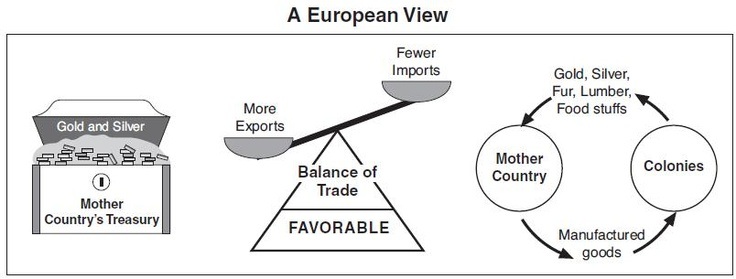
What is mercantilism?
A system where a mother countries gains money and power from natural resources that come from its colonies.
where colonies trade gold and silver with each other.
Wars that start over money.
Plantation colonies trading slaves for money.
What was the main purpose of the Proclamation of 1763?
To prevent colonist from talking about the King
To help colonist trap fur in the Ohio River Valley
To forbid colonist from moving across the Appalachian Mountains
To give all colonist born in 1763 a free birthday dessert at their favorite restaurant
The British levied punishments against the the colonist after the Boston Tea what were these punishments called
The Townshend Acts
The Tea Act
The Punitive Acts
The Intolerable Acts
What three "unalienable rights" were given by the Declaration of Independence?
Life, Liberty, and Religion
Guns, Religion, and Property
Life, Liberty, and the Pursuit of Happiness
Liberty, Life, and Fraternity
Who was named commander in chief of the Continental Army (the Colonial Army)?
Benjamin Franklin
George Washington
King George III
Thomas Jefferson

Which battle is known as the “turning point of the war?”
Bunker Hill
Yorktown
Cowpens
Saratoga
What was the purpose of the House of Burgesses?
The House of Burgesses was the name of the Church of Jamestown
The House of Burgesses was the group of miners who found gold in Jamestown
The House of Burgesses made laws for the Jamestown Colony
The House of Burgesses was the location of tobacco storage in Jamestown
Why is the House of Burgesses significant in American history?
The House of Burgesses was the first representative form of government in America
The House of Burgesses was the first Church in Jamestown
The House of Burgesses was the location where King James would visit the colony
The House of Burgesses was the location of gold storage in Jamestown
Describe William Penn’s relationship with the Native Americans.
Penn was nice to the Natives and paid them for land
Penn was terrible to the Natives and killed many
Penn stole all the Natives’ gold
Penn converted the Natives to Christianity and they became Dutch citizens
What was England’s main purpose for establishing the Georgia colony?
Georgia would serve as a “buffer colony” to keep the Spanish and French out of the wealthy Carolinas
Georgia would be the main place where gold was found in America
Georgia would serve as the political headquarters for English control in the colonies
Georgia would become a haven for those seeking religious freedom in America
What was the main reason why people settled in the New England colonies?
Religious freedom
Excellent fertile soil in the region
Gold was found in the region
To expand England’s political dominance
What was the main reason why people settled in the New England colonies?
Religious freedom
Excellent fertile soil in the region
Gold was found in the region
To expand England’s political dominance
What types of economic activities did people do in the Middle Colonies?
Gold and silver mining
Fishing and whale hunting
Iron working and blacksmithing
Farming, trade, logging, ship-building
What was the main economic activity in the Southern colonies?
Gold mining
Fishing and hunting
Agriculture (farming)
Logging and ship-building
Why was the Great Awakening a significant event in colonial history?
It unified the colonies with a similar experience and grew religious tolerance in the colonies
It allowed the colonists to see past their racism and befriend all the Natives and free the slaves
It showed the colonists that the New World was not meant for them, and they all left.
It was a time when all the great American documents were written, like the Declaration of Independence
Why is James Madison called the “Father of the US Constitution”?
He organized the Convention, arrived early to set up, wrote down every speech, etc.
He was the main author and creator of ideas in the Constitution
He was President of the Convention
He created the name “Constitution”
Name the three branches of government created at the Constitutional Convention.
Parliament, Prime Minister, and High Court
Legislative, Executive, and Judicial
Representatives, Senators, and Speaker of the House
Senate, President, and Circuit Court
The Great Compromise proposed a legislative branch with two groups of representatives in Congress—the ________________ and ___________________________________.
House of Burgesses and Parliament
Senate and House of Representatives
Town Hall and Fundamental House of Connecticut
Virginia House and New Jersey Senate
*First Continental Congress Convened
*Thomas Paine's Common Sense Published
All the events listed above occurred during...
The Revolutionary Era
*Quartering Act
*Stamp Act
These acts contributed to the start of the Revolutionary War by...
"A Crucial American Victory," U.S. National Park Service,
Which of the following best competes this excerpt?

