wayground logo

Free Printable Worksheets

Font size

S
M
L
XL
Worksheets

SS SC READY

Total questions: 171

Worksheet time: 2hrs 40mins

Name
Class
Date
1.
Whose actions in the early 1800s seemed to have started Nationalism in both Germany and Italy along with the rest of Europe?
a)
Bismarck 
b)
Cavuor
c)
Napoleon
d)
Robespierre
2.
Which of the following was the major player behind German unification?
a)
Austria 
b)
Prussia
c)
France
d)
Switzerland
3.
Which leader used the "blood and iron" technique to unify Germany? 
a)
Cavour 
b)
Bismarck
c)
Garibaldi
d)
Victor Emmanuel 
4.
During this time period what nation had to lose land/power for Germany and Italy to become unified?
a)
Russia 
b)
Ottoman Empire 
c)
Austrian Empire 
d)
England
5.
With which of the following country's defeat at the hands of Bismarck and his forces  did the final unification of Germany and Italy finally take place?
a)
France
b)
Prussia 
c)
Italy
d)
Austria
6.

Who led captured Sicily in southern Italy and was a master of guerrilla warfare?

a)

Bismarck

b)

Wilhelm I

c)

Cavour

d)

Garibaldi

7.
What was the effect of the Congress of Vienna's decision to reinstate the monarchy?
a)
It led to smaller kingdoms being formed.
b)
It led to equal rights for all people.
c)
The people accepted the monarchs
d)
It led to nationalist unification movements.
8.
In the mid-1800's __________ united their small, independent states to become two new countries.
a)
Austria and Prussia
b)
Denmark and France 
c)
Italy and Germany 
d)
Piedmont and Sicily
9.
What is nationalism? 
a)
The belief that one should be loyal to the ruler of a country.
b)
The belief that one should be loyal to the country, not the ruler.
c)
The process of gaining new colonies.
d)
The process of uniting separate areas into one country.
10.

Who is the first kaiser (ruler) of unified Germany?

a)

Victor Emmanuel

b)

Otto von Bismarck

c)

Wilhelm I

d)

Garibaldi

11.
This nation took the lead in the unification of Germany.
a)
France 
b)
Prussia
c)
Russia
d)
Austria
12.
Giuseppe Garibaldi played a major role in the —
a)
destruction of Italy
b)
unification of Italy 
c)
unification of Germany
d)
strengthening the powers of the pope
13.
Both Count Cavour and Giuseppe Garibaldi were 
a)
German nationalists
b)
Italian nationalists
c)
British industrialists
d)
French imperialists
14.
What two men led the unification of Germany?
a)
Wilehm I & Otto Von Bismarck
b)
Louis Napoleon & Wilehm I
c)
Victor Emmanuel & Otto Von Bismarck
d)
Cavour & Napoleon
15.
The Heart of Italian Unification: Starts the Young Italy Movement
a)
Garibaldi
b)
Manzinni
c)
Cavour
d)
Bismarck
16.
When did Rome join the unified Italy? 
a)
1860
b)
1890
c)
1871
d)
1851
17.
When did Germany unite?
a)
1830
b)
1870
c)
1890
d)
1840
18.
The systematic collection and articulation of natural laws, such as gravity and motion, was done by 
a)
Galileo
b)
Isaac Newton
c)
Kepler
d)
van Leeuwenhock
19.
What was one effect of Copernicus' a theory of sun-centered solar system? 
a)
It required a revision of the Christian calendar 
b)
It disputed Church teachings regarding the universe 
c)
It allowed sailors to predict tides more accurately.
d)
It resulted in a decline in pagan religions.
20.
A system in which power is unrestricted by the ruler.
a)
Limited government
b)
Unlimited government 
c)
Constitutional monarchy 
d)
Magna Carta
21.
A council of state representatives.
a)
Bill of Rights
b)
Parliament
c)
Unlimited government
d)
Divine Right
22.
Document given which took power away from King John and gave it to land owning nobles.
a)
Divine Right
b)
Magna Carta
c)
Humans Rights 
d)
Absolutism 
23.
The ruler believes there were given the power to rule by God
a)
Magna Carta
b)
Divine Right 
c)
Democracy 
d)
Parliament 
24.
A monarchy under which kings and queens rule only according to the limits of basic laws
a)
Constitutional Monarchy
b)
Unlimited Government 
c)
Absolutism 
d)
Totalitarianism 
25.
a sweeping change
a)
Science 
b)
Government
c)
Revolution 
d)
Excommunication
26.
earth-centered universe
a)
Geocentric
b)
Heliocentric 
c)
Astronomer 
d)
Revolution
27.
exiled, or thrown out of the (Catholic) church
a)
Heresy 
b)
Rationalism 
c)
Revolution 
d)
Excommunication
28.
sun-centered universe
a)
Geocentric 
b)
Heliocentric 
c)
Rationalism 
d)
Scientific Method
29.
anti-Church teachings
a)
Heresy
b)
Heliocentric 
c)
Rationalism
d)
Geocentric
30.
knowledge is based on reason (thinking)
a)
Revolution 
b)
Excommunication
c)
Rationalism 
d)
Scientific Method
31.
scientist who studies the motion of stars and planets
a)
Biologist 
b)
Chemist 
c)
Astronomer 
d)
Mathematician 
32.
a systematic way to find proof using reason: includes a question, forming a hypothesis, testing the hypothesis, and reaching a conclusion
a)
Rationalism 
b)
Newton's Laws 
c)
Geocentric 
d)
Scientific Method
33.
Which scientist discovered the heliocentric theory? 
a)
Galileo 
b)
Copernicus 
c)
Newton 
d)
Bacon
34.
The English Bill of Rights gave more power to 
a)
Parliament 
b)
King and queen 
c)
foreign countries 
d)
Both A and B 
35.
Which scientist developed the Scientific Method?
a)
Nicolaus Copernicus 
b)
Galileo Galilei
c)
Isaac Newton 
d)
Francis Bacon 
36.
Which scientist was placed on house arrest because he challenged the authority of the church? 
a)
Isaac Newton 
b)
Galileo Galileo
c)
Francis Bacon 
d)
Nicolaus Copernicus
37.
The Glorious Revolution turned England's government from a(n) _______ to a(n) ___________.
a)
Constitutional Monarchy; Democracy 
b)
Monarchy; Democracy
c)
Democracy; Absolute Monarchy
d)
Absolute Monarchy; Constitutional Monarchy
38.
Imperialism is __________.
a)
when a powerful nation uses its resources to help a weaker nation
b)
when a weaker nation invites a powerful nation to help it industrialize
c)
when a powerful nation takes control of the economy and government of a weaker nation
d)
when weak nations join together to fight a strong nation
39.
Economic motives for imperialism include _________.
a)
a desire to spread Christianity
b)
a need for military bases around the world
c)
a need for raw materials to be used in factories
d)
a desire to gain glory
40.
What countries imperialized?  (Did the taking over)
a)
England, France, Japan and the US
b)
Italy, Cuba, India and Australia
c)
Haiti, Cuba, Japan and the Philippines
d)
England, Australia, Europe and Africa
41.
The race for European countries to claim land in Africa was called the _________.
a)
Scramble for Africa
b)
African Marathon
c)
Great Competition
d)
Monopoly
42.
Why were European countries interested in colonizing Africa during the Age of Imperialism?
a)
They wanted Africa's natural resources
b)
They wanted land to develop new types of ships
c)
They wanted to create a perfect society
d)
They wanted to learn new languages
43.

What was the Berlin Conference?

a)

A meeting of European nations to declare war

b)

A meeting of the European nations to partition African lands

c)

A meeting of Germans to create a plan for German unification

d)

A meeting of Africans to develop a plan to keep European nations out of Africa

44.
Who was excluded from the Berlin Conference?
a)
representatives for the US
b)
representatives of European countries
c)
representatives of African countries
d)
representatives of the 3rd Estate
45.
What natural resources did Great Britain gain in India?
a)
rubber, ivory and timber
b)
coal, iron and diamonds
c)
cotton, tea, spices and opium
d)
fur, wool and flax
46.
Why were the Sepoys offended by the new weapons that used animal fat to grease the gun cartridges?
a)
Most Sepoys were Muslim or Hindu and their religions had specific rules about cows and pigs
b)
The grease stained their uniforms, which were expensive to replace
c)
The Sepoys were pacifists and did not believe in war
d)
The Sepoys invented the new weapons and were not paid for their use
47.
What rebellion led to the end of indirect rule and the beginning of direct rule in India?
a)
The Boxer Rebellion
b)
The Zulu War
c)
The Sepoy Rebellion
d)
The Boer Rebellion
48.
the use of machines instead of human or animal power
a)
expansionism
b)
industrialization
c)
militarism
d)
sovereignty
49.
The Sepoy Rebellion occurred in
a)
India
b)
China
c)
Cuba
d)
South Africa
50.

What does the phrase "the sun never sets over the British Empire" mean?

a)

it's always sunny in Britain

b)

it shows how large their empire was

c)

it shows how dangerous they were

d)

is a reference to the shiny money they had

51.
Which of the following was the most important motivation for imperialism? 
a)
Economic reasons due to the Industrial Revolution
b)
 Social and cultural reasons 
c)
Military reasons
d)
The desire for glory and power
52.
Why was Africa called the “Dark Continent?” 
a)
It had many thick jungles.
b)
The people of Africa did not travel to Europe often.
c)
The interior of the continent was unexplored. 
d)
It was completely controlled by European countries.
53.
Nationalism in European nations led to imperialism because  
a)
the nations wanted fueling stations for their naval ships.
b)
 the people of Africa and Asia were poor and in need of help.
c)
the countries of Europe were competing to become the strongest in power. 
d)
because the Europeans wanted a market for goods made in factories
54.
What two European countries had the most colonies in Africa?
a)
Great Britain and France 
b)
Germany and Italy
c)
 France and Italy
d)
 Germany and Great Britain 
55.

The Berlin Conference

a)

was a meeting of African leaders to discuss the division of Africa.

b)

was a meeting of European countries to discuss the slave trade in Africa.

c)

was a meeting of European countries to discuss the division of colonies in Africa.

d)

was a meeting of European countries to discuss the division of the colonies in southern Asia.

56.
The Sepoy Rebellion was an example of  
a)
the United States  setting up colonies.
b)
a successful rebellion against imperialism. 
c)
a nation attempting to practice isolationism. 
d)
a nation fighting against imperialism. 
57.
European imperialism was beneficial (helpful) because 
a)
 the natives of the imperialized countries were given equal rights with the Europeans.
b)
the imperial countries thought they were superior to the colonies.
c)
the imperial countries built schools and hospitals and developed new industries.  
d)
the natives of the colonized regions could not hold high government jobs
58.
A belief that a country should have a strong military and use it to gain power
a)
Imperialism
b)
Nationalism
c)
Isolationism
d)
Militarism
59.
The spark that ignited World War 1 
a)
The assassination of Archduke Franz Ferdinand
b)
Germany attacking Belgium
c)
Russian support of Serbia
d)
The sinking of the Lusitania
60.
More land, more money, more power
a)
Nationalism
b)
Isolationism
c)
Imperialism
d)
Militarism
61.
Gavrilo Prinicip
a)
Was a German commander in the Battle of the Somme
b)
Was the Archduke of Austria-Hungary
c)
Was a Russian spy
d)
Was a Serbian Nationalist who assassinated the Archduke of Austria-Hungary
62.
Nationalism is best described as
a)
the desire for more land and power
b)
extreme or intense patriotism
c)
the build up of a large military force
d)
the desire to team up with other nations
63.
The U.S.'s policy regarding the war in 1914 
a)
Imperialism
b)
Isolationism
c)
Militarism
d)
None of these
64.
Which continent did World War 1 take place on?
a)
Africa
b)
North America
c)
Europe
d)
Asia
65.
Which of the following events helped change the U.S.'s policy on World War 1?
a)
French armies defeated Germany's forces in Belgium
b)
Italy joined the side of the Allies
c)
Great Britain asked the U.S. to help
d)
German u-boats sank three U.S. trade ships
66.

Which country did Germany secretly ask to attack the U.S. during WWI?

a)

Canada

b)

Mexico

c)

Spain

d)

Russia

67.
The discovery of this document helped change the U.S. policy on WW1 in 1917.
a)
Declaration of Independence
b)
Zorich Paper
c)
Zimmerman Telegram
d)
Schifflein Plan
68.
Which of the following are responsible for World War 1?
a)
Imperialism
b)
Nationalism
c)
Alliances
d)
All of these
69.
World War 1 officially began in 
a)
1914
b)
1915
c)
1916
d)
1917
70.
Which of the following belong to the Central Powers?
a)
Russia
b)
France
c)
Belgium
d)
Austria-Hungary
71.
Which of the following is not a member of the Allied Powers?
a)
Russia
b)
France
c)
Italy
d)
Germany
72.
The two opposing sides in World War 1 
a)
Axis and Allies
b)
Central and Allied
c)
East and West
d)
Good and Bad
73.

What kind of warfare was used on the western front in World War 1?

a)

gorilla

b)

trench

c)

old school

d)

naval

74.
The Zimmerman Telegram can best be described by which of the following?
a)
Great Britain promised the U.S. that they would help them gain territories in Europe
b)
Mexico vowed to help the U.S.  and the Allies in World War I
c)
Germany asked Mexico to declare war on the U.S. to regain lost territories
d)
Russia withdrew from the war due to the revolution that was occurring in the country
75.
What was the name of the British passenger boat that was sunk by German U-Boats?
a)
U.S.S. Maine
b)
Lusitania
c)
U.S.S. Admiral
d)
the Titanic
76.
Which of the following is a reason why the U.S. did not want to join the League of Nations?
a)
There was fear that it would get the U.S. involved in another war
b)
Germany  was allowed into the League of Nations
c)
The League of Nations would be too costly for Americans
d)
The U.S. was pre-occupied with difficulties at home.
77.
An agreement between two or more countries to give other people help if needed is 
a)
a treaty
b)
an alliance
c)
a partnership
d)
a friendship
78.

When World War I began, the official United States policy was

a)

to enter on the side of the Allied Powers

b)

to remain militarily and politically neutral

c)

the enter on the side of the Central Powers

d)

to support the Central Powers by providing war materials

79.

What action on November 11, 1918, brought World War I to and end?

a)

An armistice was signed

b)

A propaganda campaign was waged.

c)

A surrender was given

d)

The allies won a major battle.

80.

Payments for war damages were known as

a)

nationalism

b)

reparations.

c)

separatism.

d)

retaliations.

81.
What is significant about D-Day?
a)
It was the Allied invasion of France, the largest land-sea-air operation in army history, and the turning point of the war.
b)
Thousands of Nazi soldiers froze or starved to death after they were trapped by the Soviets.
c)
The Allies discovered concentration camps where Jews and others had been murdered.
d)
The British stopped the German advance and were able to gain control of the Suez Canal.
82.
Where were the atomic bombs dropped? 
a)
Hiroshima/Nagasaki
b)
China
c)
Tokyokawa
d)
Okinawa
83.

Which dictator(s) helped cause World War II?

a)

Mussolini, Hitler, and Tojo

b)

Tojo, and Mussolini

c)

Hitler

d)

Mussolini, and Hitler

84.
Which is an example of the British and French policy of appeasement?
a)
Hitler's attack on Austria
b)
The Nazi Party
c)
The War Production Board
d)
The Munich Agreement
85.
What event led Great Britain and France to declare war on Germany?
a)
Germany invaded Poland.
b)
Germany and Italy formed the Rome-Berlin Axis.
c)
Germany invaded Sudetenland.
d)
Germany and the Soviet Union agreed not to attack each other.
86.
What was the main group of people killed in the Holocaust?
a)
The Jewish People
b)
The German People
c)
The Italian People
d)
The Christian People
87.
The Nazi program of exterminating Jews under Hitler
a)
Holocaust
b)
Fascism
c)
Rationing
d)
Nazism
88.
A political system based on extreme national loyalty where the government controls the economy, culture, and all parts of people's lives. Usually the government is controlled by a dictator.
a)
Nazism
b)
Fascism
c)
Rationing
d)
Holocaust
89.
A form of government in which the ruler is an absolute dictator
a)
totalitarianism
b)
holocaust
c)
fascism
d)
rationing
90.
Alliance of Great Britain, Soviet Union, United States, and France during World War II
a)
axis powers
b)
rationing
c)
Japanese internment
d)
allied powers
91.
Prime minister of Japan during World War II. He gave his approval for the attack on Pearl Harbor and played a major role in Japan's military decisions until he resigned
a)
Cornelia Fort
b)
holocaust
c)
fascism
d)
Hideki Tojo
92.
a symbol of American women who went to work in factories during the war
a)
Pearl Harbor
b)
Rosie the Riveter
c)
Cornelia Fort
d)
Axis Powers
93.
Alliance of Germany, Italy, and Japan during WWII
a)
Axis Powers
b)
Allied Powers
c)
Nazism
d)
Fascism
94.
December 7, 1941 - a surprise attack by the Japanese on the main US Pacific Fleet in Hawaii. The US decalred war on Japan and Germany, entering the war after this event
a)
holocaust
b)
USS Arizona
c)
Pearl Harbor
d)
Cornelia Fort
95.

The day that Japan officially surrendered is called?

a)

Victory Day

b)

V-E Day

c)

D Day

d)

V-J Day

96.

Which of these was the most notorious concentration camp during World War II?

a)

Dachau

b)

Flossenburg

c)

Auschwitz

d)

Belzec

97.

What event marked the beginning of The Great Depression?

a)

Banks closing

b)

Stock Market Crash of 1929

c)

Black Friday

d)

Unemployment rates rising

98.
The act of the USSR blocking itself off from trading with non-communist countries after WWII. This act was called
a)
The Great Blockage
b)
The Iron Curtain
c)
The Soviet Union
d)
Capitalism
99.
What is the name of the system where the government owns the stores, factories, banks, and all means of economic production?
a)
Monarchy
b)
Dictatorship
c)
Democracy
d)
Communism
100.
German leader who led the Nazi Party
a)
Joseph Stalin
b)
Adolf Hitler
c)
Benito Mussolini
d)
Hirohito
101.
Who can be described as the leader of USSR from 1953- 1964 and a brutal dictator who took power after the death of Joseph Stalin
a)
Adolf Hitler
b)
Nikita Khrushchev
c)
Joseph Stalin
d)
Benito Mussolini
102.
Leader of Italy
a)
Adolf Hitler
b)
Benito Mussolini
c)
Emperor Hirohito
d)
Dwight Eisenhower
103.
Prime Minister of England/Great Britain
a)
Winston Churchill
b)
Franklin Roosevelt
c)
Benito Mussolini
d)
Dwight Eisenhower
104.
In October 1962, the USSR was building and arming secret nuclear missile bases in Cuba.  The missiles could reach the US from Cuba. This was called
a)
The Great Blockade
b)
Cuban Missile Crisis
c)
Cold War
105.
The nuclear arms race was between
a)
The United States and the Soviet Union
b)
United States and Korea
c)
United States and Japan
d)
United States and Germany
106.
When Germany surrendered  and the war ended in Europe, this was known
a)
V-E Day
b)
V-J Day
c)
D-Day
107.
The Nazi government began to systematically kill Jews, gypsies, and the disabled.  This was know as the
a)

V- J Day

b)
V- E Day
c)
Holocaust
d)
Korean War
108.

German word meaning "lightning war"

a)

Blitzkrieg

b)

Nein

c)

Guten Morgen

d)

Guten Tag

109.

Communist dictator of the Soviet Union during WW II

a)

Hideki Tojo

b)

Adolf Hitler

c)

Joseph Stalin

d)

Harry Truman

110.
What two nations were in competition with each other during the Cold War?
a)
Spain and Portugal
b)
England and France
c)
Germany and Italy
d)
United States and Soviet Union
111.
President Truman adopted a new foreign policy during the Cold War know as the Truman Doctrine. What was the main goal of the Truman Doctrine?
a)
To expand trade with Europe
b)
To limit the build up of nuclear weapons
c)
To stop the spread of communism
d)
to send financial aid to Europe
112.
The United States got involved in conflicts like Korea and Vietnam because they were afraid of the domino theory. What is the domino theory?
a)
If one country fell to democracy, others would follow
b)
If one country fell to communism, others would follow
113.
How did the Marshall plan try to stop the spread of communism in Western Europe after WWII?
a)
by providing government housing for refugees
b)
by providing military assistance to Vietnam
c)
by providing money to stop poverty
114.
Why was the United States involved in the Berlin Airlift?
a)
to airlift food to the people of West Berlin
b)
to bomb East Berlin
c)
to demolish the Berlin Wall
d)
to transport people out of East Berlin
115.
Why did the United States become involved in the Korean War?
a)
to contain communism
b)
to colonize Korea
c)
to spread communism
d)
to Christianize Koreans
116.
Where was Korea divided?
a)
18 parallel
b)
34 parallel
c)
38 parallel
d)
15 parallel
117.
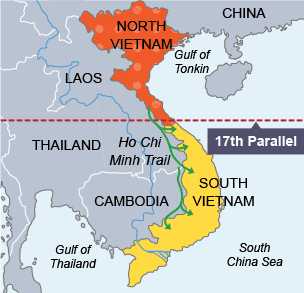
In the 1950s, the United States became involved in the Vietnam War. Why did the United States become involved in this war?
a)
to prevent the collapse of the government of North Vietnam
b)
to stop Vietnam from taking over Hong Kong
c)
to stop the spread of communism to South Vietnam
d)
to prevent attacks against United States shipping
118.
Where was Vietnam divided? 
a)
17th Parellel
b)
20thParellel
c)
38th Parellel
d)
34th Parellel
119.
How did the US respond to finding out that the Soviets had missiles in Cuba?
a)
They sent the Air Force to bomb Cuba
b)
They began placing missiles in the Soviet Union.
c)
They placed a naval blockade around Cuba.
d)
They invaded Cuba and the Soviet Union.
120.
What was the name of the first satellite in space launched by the Soviet Union?
a)
Gagarin
b)
Apollo 11
c)
Sputnik
d)
Apollo 13
121.
What did Americans fear most about the Cuban Missile Crisis?
a)
The Soviets invading Cuba
b)
The spread of communism
c)
A nuclear war
d)
WWIII
122.
Who were the leaders of the United States and the Soviet Union during the Cuban Missile Crisis?
a)
John F Kennedy & Nikita Khrushchev
b)
Nixon & Stalin
c)
John F. Kennedy & Mussolini
d)
Truman & Nikita Khrushchev
123.
What were the results of the Korean War?
a)
The two sections of Korea reunited
b)
North Korea & South Korea remained divided
c)
The Soviet Union took control of both sections of Korea
d)
China set up a communist government
124.
What were the opposing forms of government during the Cold War?
a)
communism & dictatorship
b)
democracy & capitalism
c)

communism & socialism

d)
capitalism & communism
125.
Why was the North Atlantic Treaty Organization (NATO) formed in 1949?
a)
To end the Cold War
b)
To fly supplies to West Berlin
c)
To stop the spread of communism
d)
To set up capitalist economic systems
126.
How were the Korean War and Vietnam War similar?
a)
both were fought in Eastern Europe
b)
Both were fought to stop the Soviet Union from taking over
c)
Both were fought to stop the spread of communism
d)
Both were fought between the east and the west
127.
During the Berlin Blockade, the U.S. flew supplies to west Berlin. This was called the __________________________.
a)
Berlin Rescue Mission
b)
NATO
c)
Berlin Airlift
d)
United Nations
128.
An alliance formed to stop the spread of communism is called ___________.
a)
NATO
b)
UN
c)
Axis Powers
d)
Allied Powers
129.
A competition between nations to build powerful weapons is called ___________.
a)
Arms Race
b)
Blockade
c)
Space Race
d)
Atomic Bomb
130.
A competition between the Soviet Union and The United States to send people to space was called the __________________.
a)
Arms Race
b)
Space Race
c)
Snail Race
d)
Atomic Race
131.
The idea that reason should guide society rather than tradition helped cause the revolution and came from
a)
the Declaration of Independence
b)
the Scientific Revolution
c)
the Enlightenment
d)
all of the above
132.
The French Revolution began when King Louis XVI
a)
was executed
b)
had his troops attack Paris
c)
called the Estates General together
d)
abdicated
133.
The Second Estate was composed of 
a)
Church leaders
b)
Nobility
c)
Peasants
d)
none of the above
134.
Most of the people of France belonged to the 
a)
1st 
Estate
b)
2nd Estate
c)
3rd Estate
d)
4th Estate
135.
Why was voting in the Estates General unfair
a)
votes were not secret
b)
each estate voted by how many members there were
c)
each estate got the same number of votes
d)
the King got two votes
136.
When the other estates refused to change voting rules the 3rd Estate 
a)
met separately
b)
declared themselves the new government
c)
Created the National Assembly
d)
all of the above
137.
The National Assembly set down the ideas of the Revolution in 
a)
the Declaration of Independence
b)
the Declaration of the Rights of Man
c)
the US Constitution
d)
The Edict of Nantes
138.
The First Estate was made up of this group.
a)

clergy

b)
common people
c)
nobles
d)
kings and queens
139.
What was the Divine Right of Kings?
a)
right to not pay taxes
b)
God given right to rule
c)
predetermined rise to power
d)
enlightenment of kings
140.
What do these pie charts reveal about the causes of the French Revolution?
a)
all the estates were taxed equally
b)
the upper classes paid the most taxes
c)
the poorest classes paid all the taxes
d)
the third estate was the wealthiest
141.
What is the significance of the Tennis Court Oath?
a)
it led to a new constitution for France
b)
it started the French Revolution
c)
it was the beginning of the Reign of Terror
d)
it marked the beginning of the rule of Napoleon
142.
How did the Enlightenment and the American Revolution influence the French Revolution?
a)
the people of France overthrew their absolute monarchy
b)
absolute monarchy was strengthened
c)
support for absolute monarchy increased
d)
France was divided into three estates
143.
Before the French Revolution, why did the representatives of the Third Estate form the National Assembly?
a)
voting in the Estates General was not fair
b)
the king had ordered them to do so
c)
they wanted an end to the Reign of Terror
d)
they demanded that the king be put on trial and executed
144.
Who was Louis XVI?
a)
Leader of Reign of Terror. 
b)
King of France when the French Revolution begins. 
c)
Became Emperor of France. 
d)
The Sun King. 
145.
What happened at the Storming of the Bastille? 
a)
When French women stormed the palace. 
b)
A period of mass executions. 
c)
Storming of the French prison.End of the French Revolution. 
d)
Peasants storm a French prison. Beginning of French Rev. 
146.
What was the National Assembly? 
a)
Group of 5 men who ran France after the Reign of Terror
b)
Led the Reign of Terror. 
c)
Representatives from all 3 estates. 
d)
3rd estate after they broke away from Estates-General
147.
Which of the following is a cause of the French Revolution?
a)
Louis XVI was a strong and dedicated leader
b)
The election for the new king was rigged
c)
There was social imbalance within the country
d)
The king was unhappy and led a revolut in France
148.
The Bastile was
a)
A fortified fort in Paris for the kids to play in
b)
A prison that also held weapons and gun powder
c)
A new place for Marie and Louis to go to have dinner
d)
Where King Louis XVI and Marie Antoinette lived
149.
Only this group paid taxes in pre-revolutionary France.
a)
1st Estate
b)
2nd Estate
c)
3rd Estate
d)
1st and 3rd Estates
150.
This happened to Napoleon after his last defeat at Waterloo.
a)
he was exiled to British-held island of Saint Helena
b)
he was executed by the National Assembly
c)
he died in the Battle of Waterloo
d)
he became emperor of France
151.
 How could the absolute monarchy of Louis XVI best be described? 
a)
democracy
b)
constitutional government
c)
limited government
d)
unlimited government
152.
 All of the following fueled French desires to revolt against the monarchy except the __________.
a)
American Revolution
b)
Reign of Terror
c)
Declaration of Independence
d)
ideas of the Enlightenment 
153.
Which of the following was an underlying, or deep-­rooted, cause of the French Revolution? 
a)
unequal tax burdens
b)
equal land ownership
c)
a law granting peasants more freedom 
d)
a growing French empire
154.
The Declaration of the Rights of Man and of the Citizen stated the powers of government came from the people, not the king. What Enlightenment thinker also shared this idea?
a)
Napoleon Bonaparte
b)
Maximilien Robespierre
c)
Thomas Jefferson
d)
John Locke 
155.
What was the final outcome of the French Revolution? 
a)
the declaration of the Edict of Nantes
b)
Napoleon naming himself Emperor of France
c)
unification of French city­ states
d)
the restoration of Louis XVI 
156.
Napoleon Bonaparte used his power to change France into an empire. What other change did he bring to France? 
a)
He created a bureaucracy based on social class or birth.
b)
He devised a new legal code for France.
c)
He ended European wars.
d)
He raised taxes. 
157.
The English legislative government is called. 
a)
Congress
b)
Parliament
c)
Monarchial
d)
Patrilineal
158.
The first document that limited the power of the English King, written in 1215
a)
Constitution
b)
Articles of Confederation
c)
Social Contract
d)
Magna Carta
159.
This unpopular monarch was the reason for the English Civil War
a)
Edward I
b)
Charles I
c)
Charles II
d)
James I
160.
King Charles I locked Parliament out of their meeting place, this was known as (the) 
a)
War of the Roses
b)
Mercantilism
c)
Eleven Year Tyranny
d)
A Bad Idea
161.
William and Mary came to power during a period known as the
a)
Holy Restoration
b)
Glorious Revolution
c)
Graceful Transition
d)
Hostile Takeover
162.
Before restoration, this parliamentarian took control with a "New Model Army"
a)
Benjamin Banneker
b)
Prince Charles II
c)
Oliver Cromwell
d)
Pippi Livingstone
163.
Two sides fighting in the English Civil War were the
a)
Brits vs Scots
b)
Broncos vs Stallions
c)
Squarepants vs Colts
d)
Cavaliers vs Roundheads
164.
Who was the leader that wanted to make Russia more like Western Europe by modernizing its education, military, and agricultural expertise?
a)
Ivan the Terrible
b)
Peter the Great
c)
Louis XIV
d)
Catherine the Great
165.
What was King Louis XIV's nickname because he believed he was the source of light for all of his people?
a)
Intendants
b)
Sun King
c)
Louis the Great
d)
Charles the Great
166.
What was the name of Charles II's return to Britain as King, after Cromwell's death?
a)
Restoration
b)
Glorious Revolution
c)
Isolationist
d)
Bloody Sunday
167.

The astrolabe (pictured above) was a new technology during Exploration used for ___?

a)

Navigation

b)

Protection

c)

Cartography

d)

Conquering

168.

What was the Communist alliance during the Cold War?

a)

N.A.T.O.

b)

Munich Pact

c)

Warsaw Pact

d)

Axis Powers

169.

The War on Terror by the United States began as a response to what event?

a)

September 11th terrorist attacks

b)

Iraqi invasion of Kuwait

c)

United States invasion of Afganistan

d)

election of President George W. Bush

170.
What is a colony?
a)
A land controlled by a more powerful country
b)
A land that is independent
c)
A land uninhabited by anybody
171.
What was the Portuguese plantation colony in the New World?
a)
Florida
b)
Brazil
c)
Mexico
d)
South Carolina