Worksheets
Natural Selection, Evolution, and Taxonomy Test Prep
Total questions: 14
Worksheet time: 28mins
Which of the following organisms are LEAST closely related?
Organisms that share a kingdom
Organisms that share a family
Organisms that share a genus
Organisms that share a species
The scientific name for an organism is made from the:
Class and family name
Genus and species name
Order and kingdom name
Kingdom and phylum name
The 7 levels of classification, most general to most specific.
Genus, Family, Order, Class, Phylum, Kingdom, Species
Species, Genus, Family, Order, Class, Phylum, Kingdom
Kingdom, Phylum, Class, Order, Family, Genus, Species
Order, Kingdom, Species, Phylum, Family, Class, Genus
Who first proposed binomial nomenclature as a way of classifying organisms?
Carl Linnaeus
Carl's Jr.
Charles Darwin
King Phillip
Term given to describe the 2 name naming system is:
Dichotmous key
Binomial nomenclature
Basic names
Natural selection
Which organisms are most closely related?
Equus caballas (Horse) & Equus burchellii (Zebra)
Cyanea artica (Jellyfish) &
Ctenodiscus crispatus (Mud Starfish)
Naja naja (cobra) & Glycine max (soya bean)
Ophiocomina nigra (black brittle star) & Brassica nigra (black mustard)
The science of describing, classifying, and naming living things is called:
Natural Selection
Biology
Taxonomy
Evolution
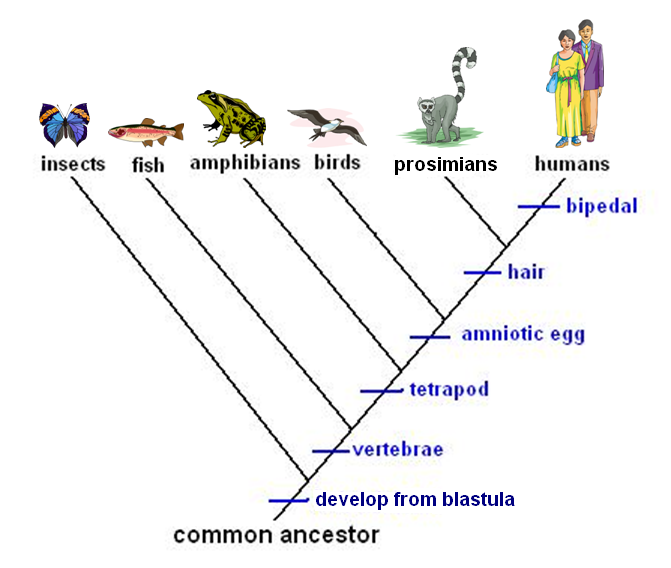
Which organisms pictured on the cladogram have hair?
Prosimians only
Prosimians and humans
Humans only
Prosimians and birds


Adaptations are:
physical or behavioral tendencies.
physical or behavioral characteristics that help an organisms survive and reproduce.
physical or behavioral characteristics that do not help the organism in any way.
genetic mutations that have gone wrong.