wayground logo

Free Printable Worksheets

Font size

S
M
L
XL
Worksheets

7-3 PASS Review

Total questions: 84

Worksheet time: 53mins

Name
Class
Date
1.

Underlying causes of the French Revolution included all of the following, EXCEPT: (7-3.1)

a)

Financial crisis

b)

Weak leadership

c)

The rise of Napoleon

d)

Unfair taxation

2.

The flow chart above shows how events inspired and influenced one another. Which event should most likely go in the first box? (7-3.1)

a)

American Civil War

b)

English Restoration

c)

Industrial Revolution

d)

The Enlightenment

3.

How did Napoleon Bonaparte gain enough support to crown himself emperor of France?

a)

He restored order, restored the Catholic Church, and brought military victory to France

b)

He weakened the Catholic Church, restored order, and brought military victory to France.

c)

He continued the Reign of Terror, restored order, and brought military victory to France.

d)

He reinstated the three estates, restored order, and brought military victory to France.

4.

All of the following were major goals of the French Revolution, except _____________. (7-3.1)

a)

The French people wanted to replace King Louis XVI with a different absolute monarch.

b)

The French people wanted French society to become more balanced and equal.

c)

The French people wanted more rights and freedoms.

d)

The French people wanted to change a government that had failed them.

5.

Which of the following social classes included the Catholic clergy? (7-3.1)

a)

First Estate

b)

Second Estate

c)

Third Estate

d)

Both A and B

6.

Which of the following social classes did NOT pay taxes in pre-revolutionary France? (7-3.1)

a)

Both First & Second

b)

Third Estate

c)

Second Estate

d)

First Estate

7.

Which of the following social classes in France included 98% of the population? (7-3.1)

a)

Both First & Second Estate

b)

Third Estate

c)

Second Estate

d)

First Estate

8.

The violent event that kick-started revolution in France, was ___________. (7-3.1)

a)

The Reign of Terror

b)

The storming of the Bastille

c)

The execution of Robespierre

d)

The Tennis Court Oath

9.

Given what you already know about the French Revolution, what is being depicted in this illustration?

a)

European Monarchies during the Napoleonic Wars

b)

France’s social classes in the Old Regime

c)

European Balance of Power in 1812

d)

France’s Military under Napoleon

10.

In the illustration, which of the following is best represented by Character X?

a)

The second estate

b)

The first estate

c)

The monarchy

d)

The third estate

11.

In the illustration, which of the following is best represented by Character Y?

a)

The clergy

b)

The nobility

c)

The fourth estate

d)

The bourgeoisie

12.

In the illustration, which of the following is best represented by Character Z?

a)

The clergy

b)

The nobility

c)

the first estate

d)

The third estate

13.

The Third Estate broke away to form its own government when Louis XVI did not meet their demands. They made a declaration that they would write France a constitution. This event was _________________.(7-3.1)

a)

The Napoleonic Code

b)

The Tennis Court Oath

c)

The storming of the Bastille

d)

The Reign of Terror

14.

Which of the following was an ECONOMIC cause of the French Revolution? (7-3.1)

a)

The rise of Napoleon as an empire.

b)

King Louis XVI was weak ruler of France who could not be a leader.

c)

The First Estate had the largest number of people but the clergy still had very little power.

d)

Massive debt due to wars and lavish spending.

15.

Which of the following was a SOCIAL cause of the French Revolution? (7-3.1)

a)

The First Estate had the largest number of people, but the clergy still had very little power.

b)

France’s economy was highly unstable due to massive debt.

c)

King Louis XVI was a weak ruler of France who could not be a leader.

d)

There was an imbalance of power between the 1st estate, 2nd estate, and the 3rd estate.

16.
What was "sparked" or ignited as a result of the Napoleonic Wars?
a)
socialist ideas
b)
nationalist ideas
c)
imperialistic ideas
d)
religious ideas
17.
What is the belief that one's greatest loyalty is to a shared culture, rather than to a leader or border?
a)
nationalism
b)
militarism
c)
imperialism
d)
rationalism
18.
Who practiced his realpolitik theory and unified Germany?
a)
Wilhelm I
b)
Giuseppe Garibaldi
c)
Count Camillo di Cavour
d)
Otto Von Bismark
19.
Which European ruler conquered the dark shaded areas on this map in the early 1800s?
a)
King Louis XVI
b)
Simon Bolivar
c)
Otto von Bismarck
d)
Napoleon Bonaparte
20.
How did the event depicted in this picture impact the course of the Napoleonic Wars?
a)
Napoleon defeated Austria and Prussia
b)
Napoleon invaded Britain but was defeated
c)
Napoleon successfully invaded Russia
d)
Napoleon invaded Russia but lost most of his men
21.
How did the battle of Waterloo impact the course of the Napoleonic Wars?
a)
Napoleon was inspired to invade Russia
b)
Napoleon was defeated but escaped and returned to power
c)
Napoleon was defeated and sent into exile for good
d)
Napoleon was crowned emperor after a major victory
22.
Napoleon forced French culture on conquered territories. What was the impact of this?
a)
Trade increased
b)
Nationalism developed and spread
c)
Peace and prosperity spread across Europe
d)
All of Europe started speaking the same language
23.
How did the development and spread of nationalism impact Europe in the 1800s?
a)
Countries with a shared culture were united as one nation
b)
Absolute monarchs increased their power
c)
Napoleon conquered most of Europe
d)
The Catholic Church was abolished
24.
How did the Congress of Vienna inspire nationalist movements across Europe in the revolutions of 1830 and 1848?
a)
They imposed British rule on Europe
b)
They put absolute monarchs back in power
c)
They established the nations of Germany and Italy
d)
They established democratic governments across Europe
25.
Why did the Congress of Vienna return absolute monarchs to power in Europe after the Napoleonic Wars?
a)
to restore order and the balance of power
b)
to encourage the spread of nationalism
c)
to promote the spread of Enlightenment ideas
d)
to protect the power of the Catholic Church
26.
Why were the revolutions of 1830 and 1848 so widespread?
a)
People opposed nationalism
b)
People supported absolute monarchs
c)
Trade increased and united Europe into a market economy
d)
Enlightenment ideas and nationalism had spread across Europe
27.
What political idea inspired the events that caused the change in these two maps?
a)
nationalism
b)
mercantilism
c)
imperialism
d)
capitalism
28.
What leaders are most responsible for the changes in these two maps?
a)
Bismarck and Wilhelm I
b)
Cavour and Garibaldi
c)
Napoleon and Wellington
d)
Washington and Jefferson
29.
How did Camillo di Cavour unite the states of northern Italy?
a)
He conquered it by leading his army of Red Shirts
b)
He allied with France to defeat Austria in a war
c)
He provoked and won wars with Denmark, Austria and France
d)
He was crowned the first king of Italy
30.
Which social class mainly benefitted from independence from Spanish rule?
a)
peninsulares
b)
creoles
c)
mestizos
d)
Native Americans
31.
What was the name of this country that was led by Simon Bolivar for ten years before separating into three independent states?
a)
Peru
b)
Bolivia
c)
Venezuela
d)
Gran Columbia
32.
Who helped to free the nations of Argentina, Chile and Peru from Spanish rule?
a)
Father Miguel Hidalgo
b)
Agustin de Iturbide
c)
Jose de San Martin
d)
Simon Bolivar
33.
Which historical figure best completes this chart comparing revolutionary leaders?
a)
Father Miguel Hidalgo
b)
Agustin de Iturbide
c)
Jose de San Martin
d)
Simon Bolivar
34.
What social class led the fight for independence from Spanish rule in South America?
a)
peninsulares
b)
creoles
c)
mestizos
d)
Native Americans
35.
Who became emperor of Mexico after they won independence from Spain?
a)
Agustin de Iturbide
b)
Father Miguel Hidalgo
c)
Simon Bolivar
d)
Jose de San Martin
36.
Why is Father Miguel Hidalgo called the Father of the Nation of Mexico?
a)
he led the conquistadors who conquered Mexico
b)
he was the first ruler of independent Mexico
c)
he defeated the Spanish forces and won independence
d)
he inspired a revolution by giving the Grito
37.
What event during the Haitian Revolution inspired Toussaint L'Ouverture to say this?
a)
the French crushed the revolution
b)
Haitian leaders betrayed him to the French
c)
the French bribed him to stop the revolution
d)
the French captured and imprisoned him
38.
What influenced Toussaint L'Ouverture to say this and lead a slave rebellion in Haiti?
a)
absolutism
b)
Enlightenment ideas
c)
international trade
d)
the scientific method
39.
How did Napoleon's conquest of Europe impact European colonies in Latin America?
a)
slavery became illegal
b)
new leaders bankrupted the colonies
c)
nationalism increased and inspired revolutions
d)
people fled the colonies for Europe
40.
Why did many people in colonial Latin America dislike the peninsulares?
a)
they had most of the wealth and power
b)
they refused to participate in politics
c)
they refused to give jobs to Europeans
d)
they kept Europeans out of the military
41.
What caused the differences between these two maps?
a)
the English Civil War
b)
the Napoleonic Wars
c)
revolutions against colonial rule
d)
the Spanish conquest of the Americas
42.
What caused the differences between these two maps?
a)
the English Civil War
b)
the Napoleonic Wars
c)
revolutions against colonial rule
d)
the Spanish conquest of the Americas
43.
What was the main factor in determining a person's social status in Spain's colonies in Latin America?
a)
race
b)
wealth
c)
politics
d)
religion
44.
Where did the Industrial Revolution begin?
a)
Mexico
b)
Haiti
c)
Great Britain
d)
France
45.
What word means the change from farming to factories in a society?
a)
capitalism
b)
agriculture
c)
industrialization
d)
factors of production
46.
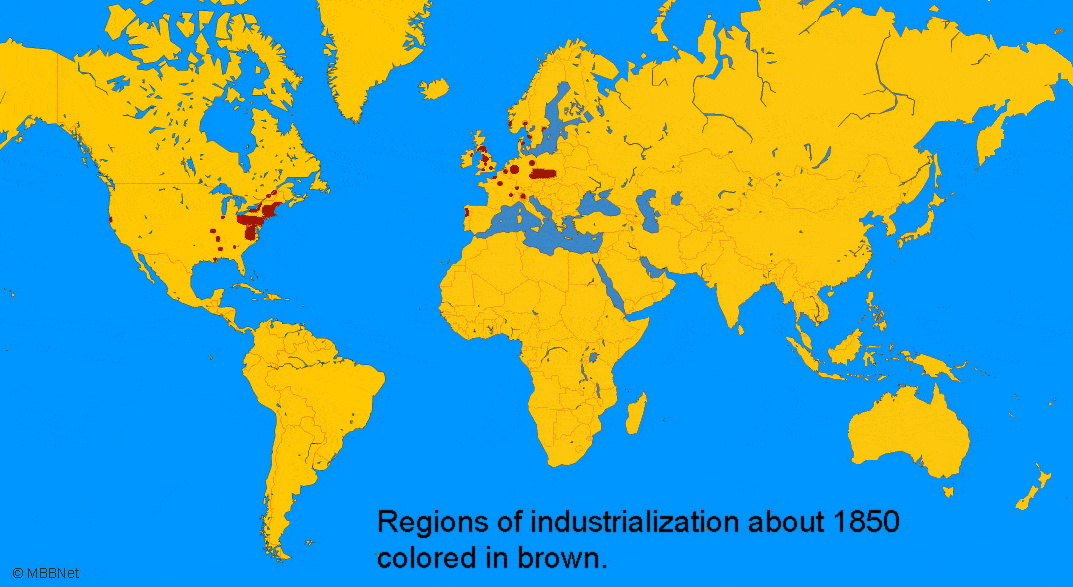
According to this map, which areas of the world industrialized during the 1800s?
a)
Asia
b)
Africa
c)
Latin America
d)
Europe and the US
47.
What is the best title for this diagram?
a)
effects of industrialization
b)
factors of production
c)
improvements in agriculture
d)
new textile machinery
48.
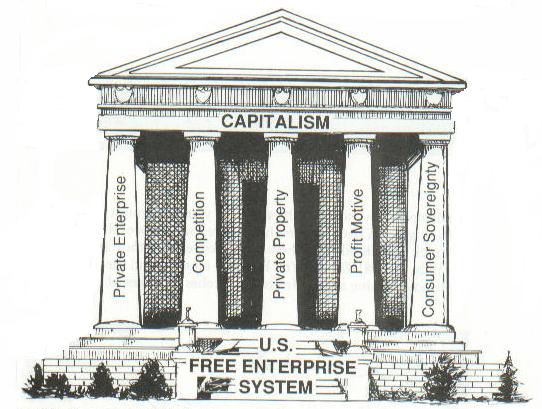
Capitalism led more people to start new businesses, which increased which one of the factors of production?
a)
land
b)
labor
c)
capital
d)
entrepreneurs
49.
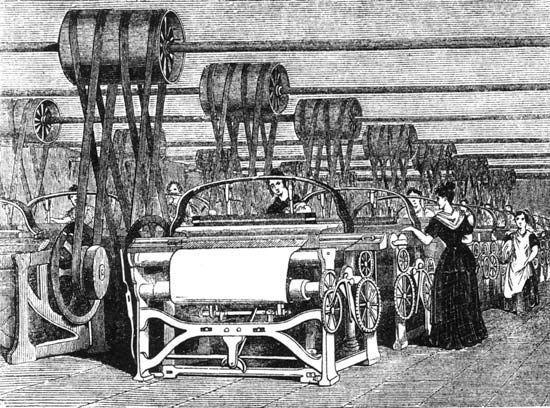
The mechanization of what industry sparked the growth of the factory system?
a)
oil
b)
steel
c)
textiles
d)
automobiles
50.
How did mass production lead to an increase in the size of the middle class?
a)
it made the population grow
b)
many poor workers died from overwork
c)
assembly line workers gained more skills and higher pay
d)
goods became more plentiful and more affordable
51.
Why did cities grow larger in Europe and the US during the Industrial Revolution?
a)
people moved from rural to urban areas to work in factories
b)
people moved to the cities to become farmers
c)
governments forced people to move to cities to make it easier to control them
d)
people sought better protection from roving bands of marauders
52.
Why did support for socialism grow in Europe and the US in the 1800s?
a)
to protect workers from abuses
b)
to lower taxes on businesses
c)
to abolish labor unions
d)
to encourage more entrepreneurs
53.
What tactic was most commonly used by labor unions to pressure owners to improve pay and working conditions?
a)
strikes
b)
terrorism
c)
assassinations
d)
revolution
54.
A place where people and machines join together to mass produce goods.
a)
Cartel
b)
Corporation
c)
Factory
d)
Urbanization
55.
What is the movement from rural to urban areas called?
a)
Moving
b)
colonization
c)
inflation
d)
urbanization
56.
This machine allowed factories to be built anywhere, powered by coal.
a)
flying shuttle
b)
steam engine
c)
spinning jenny
d)
cotton gin
57.
What had to occur before the Industrial Revolution could take place?
a)
The Economic Revolution
b)
The Glorious Revolution
c)
The Agricultural Revolution
d)
The French Revolution
58.
What impact did the Agricultural Revolution have on the population of England?
a)
The population increased a little.
b)
The population declined steeply.
c)
The population increased dramatically.
d)
The population stayed the same.
59.
Which innovation  allowed factories to be built anywhere?
a)
flying shuttle
b)
spinning jenny
c)
cotton gin
d)
steam engine
60.
Why did "cottage industry" come to an end?
a)
Too many people moved to the city.
b)
It was replaced by the factory system.
c)
The need for textiles decreased.
d)
Women who worked in cottage industries went on strike.
61.
The system in which the government owns and controls the means of production, such as mines and factories, is called?
a)
fascism
b)
socialism
c)
capitalism
d)
mercantilism
62.
Which of the following was NOT associated with early factory working conditions?
a)
Low wages
b)
Safe working conditions
c)
Dangerous working conditions
d)
Widespread pollution
63.
Which of the following would NOT be associated with mass production?
a)
Interchangeable parts
b)
division of labor
c)
unique, hand made goods
d)
assembly line
64.
What are identical components that can be used in place of each other?
a)
Interchangeable parts
b)
Factories
c)
Dynamos
d)
Assembly Lines
65.
Laissez-faire means...
a)
natural rights
b)
iron law of wages
c)
let it happen
d)
tabula rasa
66.
What is the flying shuttle?  
a)
The ability to communicate 
b)
an agricultural revolution to mankind
c)
weaving device that carries thread quickly back and forth across the piece being woven.
d)
new type of steam engine
67.
What are these?
Land, labor, capital, and entrepreneurship
a)
Economy
b)
Infrastructure
c)
Factors of production
d)
Opportunity Cost
68.
This economic system was developed by Karl Marx and said that the "proletariat" worker class should overthrow the "bourgeoisie" owner class.
a)
Market economy
b)
Communism
c)
Mercantilism
d)
Fascism 
69.
How did industrialism lead to imperialism?
a)
Industrialized nations wanted new technology
b)
Industrialized nations wanted natural resources and markets
c)
Industrialized nations wanted a cheap source of labor
d)
Industrialized nations wanted to spread their culture
70.
How did nationalism support the drive for imperialism?
a)
Competition for colonies created a sense of national pride
b)
Europeans wanted to establish new nations in Africa and Asia
c)
European nations sought raw materials and new markets
d)
Europeans wanted to spread their culture to Africa and Asia
71.
What idea is supported by the message in this poem?
a)
imperialism
b)
industrialism
c)
federalism
d)
racial equality
72.
How did Social Darwinism impact Europe's relationship with Africa and Asia?
a)
It caused Europeans to oppose imperial expansion
b)
It caused Europeans to support imperial expansion
c)
It inspired charity missions to Africa and Asia
d)
It influenced Europe to isolate itself from Africa and Asia
73.
How did the British Empire improve living conditions in India?
a)
They defended India from Chinese invasion
b)
They built railroads and schools in India
c)
They introduced democracy to India
d)
They improved India's farming ability
74.
How did British colonization impact the economy of India?
a)
The British industrialized India
b)
The Indian economy grew rapidly
c)
India supplied manufactured goods to Britain
d)
Indian businesses could not compete with British industry
75.
Why was India known as the "Jewel of the Crown" of the British Empire?
a)
India supplied most of the soldiers of the British army
b)
India supplied raw materials and a large market
c)
India provided gemstones and precious metals
d)
India was the first colony to become a democracy
76.
What sparked the Sepoy Rebellion in India?
a)
The British made no improvements to India
b)
British soldiers occupied Indian cities and towns
c)
The British offended Hindu and Muslim religious beliefs
d)
The British tried to install a democratic government
77.
The conditions described in this quote reflect what change in China?
a)
China sold opium to British merchants
b)
China was conquered by Japan
c)
China defeated Britain and forced them out of India
d)
Britain forced China to open to trade
78.
How the loss of the Opium War impact China?
a)
It allowed foreign countries to imperialize China
b)
It caused Chinese peasants to rebel against their govt.
c)
China modernized and became an imperialist power
d)
China returned to isolationism from trade with the West
79.
What event in world history is illustrated by this political cartoon?
a)
the Sepoy Rebellion
b)
the Opium War
c)
the French Revolution
d)
the Enlightenment
80.
What is the best interpretation of this political cartoon?
a)
China successfully resisted imperialism
b)
Chine modernized and became imperialist
c)
China was divided into spheres of influence by imperialist powers
d)
China isolated itself from trade with other nations
81.
How did the United States' Open Door Policy impact China?
a)
It prevented Europe from opening China to trade 
b)
It ended all foreign control or influence over China
c)
It allowed Chinese immigrants to enter the United States
d)
It allowed all nations to trade with China
82.
The passing of what piece of United States legislation sparked the Boxer Rebellion?
a)
the Emancipation Proclamation
b)
the Monroe Doctrine
c)
the Open Door Policy
d)
the Quota System
83.
What is the similarity between the Sepoy Rebellion of India and the Boxer Rebellion of China?
a)
Both were led by rich, upper class citizens
b)
Both were led by the government
c)
Both resisted foreign influence over their nation
d)
Both welcomed foreign control by the West
84.
What was the result of the Boxer Rebellion?
a)
an alliance of imperialist nations suppressed the rebels
b)
imperialist nations were forced to withdraw from China
c)
imperialist nations fought each other over control of China
d)
China became a territory of the United States