
 Worksheets
5th Science STAAR Review: Reporting Category 3 (Earth and Space)
Total questions: 48
Worksheet time: 2hrs 39mins

buried by sediment for millions of years.



Some scientists measured and recorded local rainfall amounts and water levels at several local lakes over the summer. They compared their measurements with data from the past 30 years. What characteristic of the area are the scientists studying?
Climate, because they are making more than one type of measurement
Climate, because they are comparing rainfall amounts over a long period of time
Weather, because they are tracking changes only to their local environment
Weather, because they expect rainfall amounts and water levels to continue to decrease
Each school year for 30 years, the amount of rain that fell at a school was measured and recorded. Tracking rainfall over a long period provides the most information about which characteristic of an area?
Climate
Temperature of one day
Weather
Type of soil
Which of these best describes climate rather than weather?
Wind speed is changing as a storm moves through an area.
The temperature is decreasing in a slow-moving cold front.
Annual high temperatures in the summer have increased over many decades.
The rainfall during one year was greater than the rainfall during the following year.
Which of the following is a description of climate?
Today it is hot and sunny in Phoenix, Arizona.
Summers are usually mild in Lansing, Michigan.
Last week it rained every day in San Antonio, Texas.
Yesterday was cold and windy in Anchorage, Alaska.

The boundary between two air masses is known as:
front
storm
climate
flood

Based on the weather map, what can you predict the weather in Florida?
It is storming today and tomorrow.
It is most likely going to rain there tomorrow.
The air temperature will be getting warmer and dry.
You cannot predict the weather from a weather map.


Bob notices that the shadow of the tree outside his house is changing through the day. Why?
Earth rotating on its axis
Moon revolving around the Earth
Earth revolving around the Sun

Bree and her mother are outside looking at the stars on a dark night. Where is Bree located in relation to the Sun during the night hours?
At the closest point to the Sun in Earth's orbit
At the furthest point from the Sun in Earth's orbit
On the side of Earth that has rotated away from the Sun
On the side of Earth that has rotated toward the Sun
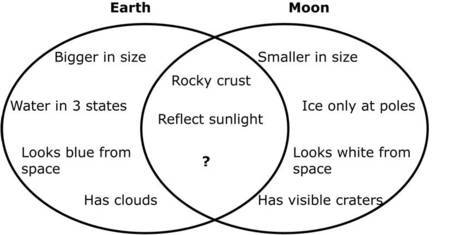
Which of the following characteristics could be placed in the center part of the diagram?
Alyssa is studying the texture of the particles in different types of soil. She is comparing soils with clay, sand, gravel, and silt in order to determine which soil has the largest particles.
Which ones list the soils in decreasing order?
sand, gravel, clay, silt
gravel, sand, silt, clay
sand, gravel, silt, clay
gravel, sand, clay, silt

In some areas of Texas, solid layers of rock called bedrock are beneath a thin layer of soil.
Trees need to grow long, deep roots to get lots of water and hold the tree in place. Based on the information above, are the areas in Texas with bedrock beneath the soil a good place for trees to grow?
Trees will grow well with bedrock because the roots can wrap around the rock.
Trees will not grow well with bedrock because the roots will not grow deep
Trees will grow well with bedrock because the roots can grow sideways instead of down.
Trees will not grow well because the roots will break the rock.

A student designs an experiment to see how the school garden soil retains water. She measures 200 grams of the soil and places it in the can with holes. She pours 50 mL of water into the can.
Refer to the soil experiment above. If the soil stops most of the water from flowing deeper, how much water would the student expect to measure at the end of the experiment?
5 mL
25 mL
45 mL
50 mL
All the following is classified as a nonrenewable resource, BUT...
oil
natural gas
water
coal
All the following is classified as a renewable resource, BUT...
oil
solar
water
wind
A resource is nonrenewable because...
it cannot be replaced as fast as people use it.
it can be recycled.
it can easily be replaced as it is used.
it is available in limited supplies.




What causes tides?
Gravity of the Earth
Gravity of the Moon
Wind from the Earth
Wind from the Moon
How many times a day to we experience a change in tidal levels?
1
2
3
4
Glaciers are masses of ice that move slowly on land. Which of these features was most likely formed by a glacier? (5.7B)
A wide valley
A deep ocean
A lava flow
A mountain range

The photograph shows a canyon in northern Arizona. Which of these describes how this canyon was most likely formed? (5.7B)
Floods eroded the sandstone away from the canyon walls.
Glaciers eroded the canyon rock as they melted and moved.
Ice wedged into cracks in the rock and weathered the canyon walls.
Wind blew large rocks that smashed against the canyon walls.

A wide U-shaped valley is shown in the photograph. This valley was most likely formed by-- (5.7B)
flash flooding
a glacier
a hurricane
melting snow

The size and shape of a delta can change over time. The size and shape of this delta over time are NOT likely to be changed by----- (5.7B)
the number and height of tides along the shore
the amount and size of sediments carried by the river and streams
the amount of hunting and fishing in the delta
the number and size of waves from the ocean that reach the shore
One of the brightest objects in the night sky is a planet that is closer to the sun than Earth is. What is the name of the planet? (3.8D)
Mars
Saturn
Jupiter
Venus

Asteroids are large bodies of rock that are too small to be planets. An asteroid belt has many asteroids. The diagram shows the asteroid belt located between Mars and the first outer planet. Which outer planet is closest to this asteroid belt? (3.8D)
Uranus
Neptune
Saturn
Jupiter
One of the brightest objects in the night sky is a planet that is closer to the sun than Earth is. What is the name of the planet? (3.8D)
Mars
Saturn
Jupiter
Venus

