
NEW
Font size
S
M
L
XL
 Worksheets
Unit 6: Reactions Review
Total questions: 20
Worksheet time: 19mins
Name
Class
Date
1.
3Ca + 2AlCl3 --> 3CaCl2 + 2Al
a)
Synthesis
b)
Decomposition
c)
Single diplacement
d)
Double displacement
2.
3KOH + H3PO4 --> K3PO4 + 3H2O
a)
Synthesis
b)
Decomposition
c)
Single displacement
d)
Double displacement
3.
Which reaction type is the following: C5H10O4 + O2 --> CO2 + H2O
a)
Decomposition
b)
Single Replacement
c)
Combustion
d)
Double Replacement
4.
When balancing equations a ____ can be placed to the left of a formula of a substance to make the equations balanced
a)
charge
b)
subscript
c)
random number
d)
coefficient
5.
Balance this equation:
__Li + __Cl2 -> __LiCl
__Li + __Cl2 -> __LiCl
a)
2Li + Cl2 -> 4LiCl2
b)
2Li + Cl2 -> LiCl2
c)
2Li + Cl2 -> 2LiCl
6.
At the end of chemical reactions, what is the total mass of the reactants compared to the total mass of the products?
a)
the product is doubled
b)
the product is half the mass of the reactants
c)
the mass is the same
d)
the mass changes depending on the reaction
7.
The number of atoms you begin with in a chemical reaction ...
a)
must be the same as the number of atoms you end with
b)
must be an even number
c)
can be different to the number you finish with
d)
changes depending on how much energy is formed
8.
Balancing the following:
____ Al + ____ HCl → ____ AlCl3 + ____ H2
a)
1,3,1,2
b)
2,3,2,3
c)
2,6,2,3
d)
3,2,6,2
9.
Balance the following: Fluorine and Aluminum oxide react to produce Aluminum fluoride and Oxygen
a)
6,2,4,3
b)
3,4,2,6
c)
5,1,3,2
d)
3,2,4,3
10.
Which of the following is an example of a chemical change?
a)
melting a stick of butter
b)
dissolving salt in water
c)
using magnesium to displace hydrogen gas from water
11.
When iron nails get rusty, heat is released. What process is this?
a)
Exothermic
b)
Endothermic
12.
During an endothermic reaction in a beaker if we are part of the surroundings and touched the beaker, it would feel _______.
a)
Warm
b)
Cold
13.
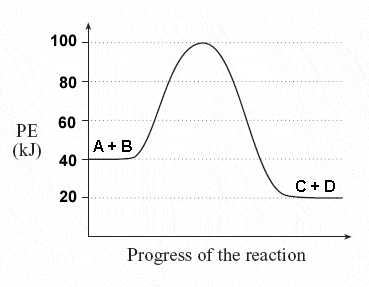
Based on the energy diagram below, what type of reaction is this?
a)
Endothermic
b)
Exothermic
c)
Caroussothermic
d)
Nonthermic
14.
Based on the activity series, will this reaction occur?
Br2 (l) + KI (aq) →
Br2 (l) + KI (aq) →
a)
Yes
b)
No
15.
Predict the product(s) of this reaction (don't worry about balancing):
Mg + HCl →
a)
MgHCl
b)
MgCl2 + H2
c)
MgCl2 + H
d)
MgCl + H2
16.
Predict the product(s) of this reaction (don't worry about balancing):
C12H22O11 + O2 →
C12H22O11 + O2 →
a)
CO + HO
b)
CO2
c)
CO2 + H2O
d)
H2O
17.
Predict the product(s) of this reaction (Don't worry about balancing)
Pb(NO3)2 + KI →
Pb(NO3)2 + KI →
a)
PbK + I NO3
b)
not possible
c)
PbI2 + KNO3
d)
PbI + KNO3
18.
Predict the products for the following reactants.
Al + O2 -->
Al + O2 -->
a)
AlO
b)
AlO2
c)
Al2O3
d)
Al2O
19.
Identify the limiting reactant when 0.20 moles of HCl combines with 0.12 moles of Mg to form MgCl2.
Mg + 2HCl --> MgCl2 + H2
a)
Mg
b)
H2
c)
MgCl2
d)
HCl
20.
Using the following equation:
Fe2O3(s) + 3H2(g) → 2Fe(s) + 3H2O(l)
How many moles of iron can be made from 6 moles H2?
Fe2O3(s) + 3H2(g) → 2Fe(s) + 3H2O(l)
How many moles of iron can be made from 6 moles H2?
a)
4 moles Fe
b)
6 moles Fe
c)
9 moles Fe
d)
2 moles Fe
Reset

