wayground logo

Free Printable Worksheets

NEW

Font size

S
M
L
XL
Worksheets

Biology (swq1)

Total questions: 67

Worksheet time: 2hrs 36mins
Name
Class
Date
1.
A large ecosystem is called a ______
a)
Ecosystem
b)
Habitat
c)
Biome
d)
Niche
2.

What are the living and nonliving things in an environment or area?

a)

predator

b)

producer

c)

ecosystem

d)

abiotic factor

3.

An organism that can make its own food

a)

decomposer

b)

producer

c)

consumer

4.

Breaks down and feeds on the remains of other organisms

a)

decomposer

b)

consumer

c)

producer

5.

Small consumers that are hunted and eaten by larger consumers

a)

producer

b)

prey

c)

predator

6.

Interacting food chains found in an ecosystem

a)

food web

b)

food chain

c)

predator

7.

An animal that hunts and eats other animals for energy

a)

prey

b)

predator

c)

decomposer

8.

These organisms cannot make their own food; they must eat something for energy

a)

decomposer

b)

consumer

c)

producer

9.

NON-living things found in an ecosystem

a)

biotic

b)

abiotc

c)

habitat

10.

LIVING things in an ecosystem

a)

biotic

b)

abiotic

c)

ecosystem

11.

Choose the producer.

a)

rock

b)

tree

c)

cow

d)

bird

12.

Choose the decomposer.

a)

grass

b)

elephant

c)

bacteria

d)

bird

13.

Choose the consumer.

a)

mushroom

b)

horse

c)

tree

d)

grass

14.

Choose the abiotic factor.

a)

sunflower

b)

dog

c)

cat

d)

table

15.

Where does the food chain START?

a)

with consumers that eat grass

b)

with the sun giving energy to producers

c)

with the sun giving energy to consumers

d)

with consumers eating other consumers

16.

A decomposer is also a producer.

a)

True

b)

False

17.

Which of these living things is a producer?

a)

horse

b)

cow

c)

fly

d)

grass

18.

Mice and grasshoppers are examples of prey.

a)

True

b)

False

19.

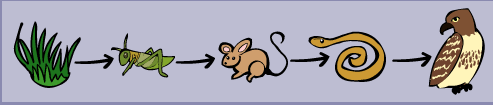
Explain the flow of energy in this food chain (who passes energy to who).

a)

The hawk gives energy to the snake. The snake gives energy to the mouse. The mouse gives energy to the grasshopper who gives energy to the grass.

b)

The mouse gives energy to the hawk. The snake gives energy to the grasshopper. The grass gives energy to the snake.

c)

The grass gives energy to the grasshopper. The grasshopper gives energy to the mouse. The mouse gives energy to the snake who gives energy to the hawk.

20.
An ______ is an independent living thing.
a)
consumer
b)
producer
c)
organism
d)
herbivore
21.
All organisms need _____ to survive.
a)
Environment
b)
energy
c)
sun
d)
plants
22.
_________ cannot make their own food, so they need to consume (eat) plants or animals.
a)
consumers
b)
producers
c)
decomposers
23.
The  ____________ provides all the initial energy to plants.
a)
sun
b)
moon
c)
environment
d)
water
24.
____ make their own food through photosynthesis. 
a)
consumer
b)
decomposer
c)
producer
25.
What does a food chain contain? Choose ALL correct answers.
a)
consumer
b)
producer
c)
decomposer
d)
all of the above
26.
__________ eat decaying matter, dead plants and animals and in the process they break them down. 
a)
consumer
b)
producer
c)
decomposer
27.
_______are animals that eat only plants.
a)
herbivore
b)
carnivore
c)
omnivore
28.
_______ are animals that eat only animals (meat).
a)
herbivore
b)
omnivore
c)
carnivore
29.
_________ are animals that eat BOTH plants and animals. 
a)
omnivore
b)
carnivore
c)
herbivore
30.
a _______ shows how each living thing gets food and how nutrients and energy are passed from organism to organism. 
a)
ecosystem
b)
food chain
31.
what consumer group do YOU fit in?
a)
herbivore
b)
carnivore
c)
omnivore
32.
What is a daisy considered?
a)
producer
b)
consumer
c)
decomposer
33.
what is bacteria or fungi considered?
a)
producer
b)
consumer
c)
decomposer
34.
what is a human considered?
a)
producer
b)
consumer
c)
decomposer
35.
what is grass considered?
a)
producer
b)
consumer
c)
decomposer
36.

What is the definition of symbiotic relationships?

a)

A relationship between two organisms that are the same.

b)

A relationship between two different organisms.

c)

A relationship between one plant and one animal.

d)

You know, I am really not sure even though we have talked about it before.

37.

Which relationship includes organisms where both benefit?

a)

Mutualism

b)

Commensalism

c)

Parasitism

38.

Which relationship includes one organism that benefits and the other organism is not affected?

a)

Mutualism

b)

Commensalism

c)

Parasitism

39.

Which relationship includes an organism that benefits while the other organism is harmed?

a)

Mutualism

b)

Commensalism

c)

Parasitism

40.

The arrows in a food chain represent which of the following?

a)

Predators

b)

Energy being transferred

c)

Nutrients being added to the soil

d)

They do not represent anything

41.

This type of organism only eats dead plants and animals.

a)

Carnivore

b)

Herbivore

c)

Omnivore

d)

Scavanger

42.

When a bird lands in a crocodiles mouth to clean the teeth, what type of relationship is this?

a)

mutualism

b)

parasitism

c)

commensalism

43.

A pilot fish eats the remains from a shark kill. What relationship is this?

a)

Mutualism

b)

Commensalism

c)

Parasitism

44.

When a tick lands on a dog, and bites her, what type of relationship is this?

a)

mutualism

b)

commensalism

c)

parasitism

45.
Which is NOT a process of the water cycle?
a)
precipitation
b)
freezing
c)
transpiration
d)
evaporation
46.
What is the most abundant gas in the atmosphere?
a)
hydrogen
b)
oxygen
c)
helium
d)
nitrogen
47.
Why do living things need nitrogen?
a)
To get energy
b)
To make amino acids
c)
To make proteins
d)
To make proteins AND amino acids
48.
Where are denitrifying bacteria found?
a)
In the soil
b)
Root nodules
c)
In dead things
d)
In the atmosphere
49.
Where are nitrogen-fixing bacteria found?
a)
In the soil
b)
Root nodules
c)
In dead things
d)
In the atmosphere
50.
What happens during the process of nitrogen-fixation?
a)
Nitrogen compounds turn into free nitrogen
b)
Free nitrogen turns into nitrogen compounds
51.
What is this a picture of?
a)
Nitrogen cycle
b)
carbon cycle
c)
water cycle
d)
plant cycle
52.
How does carbon dioxide leave the atmosphere?
a)
Through transpiration
b)
Through photosynthesis
c)
Through factory emission
d)
Sunlight
53.
Respiration is the process by which ____________ is consumed and _______________ is produced.
a)
Carbon, Oxygen
b)
Oxygen, Carbon dioxide
c)
H20, oxygen
d)
Carbon, H2O
54.
Organisms use nitrogen to form
a)
carbohydrates and lipids
b)
proteins and lipids
c)
lipids and nucleic acids
d)
proteins and nucleic acids
55.

Elements like carbon and nitrogen are cycled through __________.

a)

cells

b)

species

c)

organisms

d)

ecosystems

56.

What cycle does not has a gas phase?

a)

carbon

b)

nitrogen

c)

phosphorus

d)

water

57.

What is the role of bacteria in the nitrogen cycle?

a)

convert nitrogen

b)

produce sugars

c)

burn carbon dioxide

d)

decay organisms

58.
Which of the following is the correct order in a food chain?
a)
Sun --> producer --> herbivores --> carnivores --> scavengers --> carnivores
b)
Sun --> producer --> scavengers --> carnivores
c)
Sun --> consumers --> predators --> parasites --> hosts
d)
Sun --> producer --> herbivores --> carnivores --> scavengers
59.
An organism's ? is defined as the environment in which it lives.
a)
Habitat
b)
Niche
c)
Social Structure
d)
Ecology
60.
Herbivores, Carnivores, and Scavengers all belong to which niche below?
a)
Consumers
b)
Producers
c)
Decomposers
d)
Predators
61.
The ? part of the environment includes all the physical factors -- such as water, soil, light, temperature -- that affect organisms living in a particular area.
a)
abiotic
b)
biotic
c)
interdependent
d)
community
62.
Which of the following is an abiotic part of the desert biome?
a)
both temperature and sand
b)
sand
c)
temperature
d)
cactus
63.
? is the source of energy for almost all living things on the planet.
a)
Sun
b)
Water
c)
Soil
d)
Fod
64.
Organisms that use sunlight directly to make food are called what?
a)
Producers
b)
Consumers
c)
Decomposers
d)
Scavengers
65.
Bacteria and fungi are examples of which niche below?
a)
decomposers
b)
omnivores
c)
carnivores
d)
scavengers
66.
Identify the best fit for the phrase below...
"Dogs grab a possum that had been killed by a car."
a)
scavenger
b)
decomposer
c)
producer
d)
herbivore
67.
Identify the best fit for the phrase below...
"All the members of the same species."

a)
population
b)
community
c)
ecosystem
d)
cell