wayground logo

Free Printable Worksheets

Font size

S
M
L
XL
Worksheets

Biology SOL Review #5

Total questions: 63

Worksheet time: 49mins

Name
Class
Date
1.

I have cell walls

I am an autotroph

I am multicellular

What am I?

a)

Plant

b)

Animal

c)

Eubacteria

d)

Protist

2.

I have no cell walls

I am eukaryotic

I reproduce sexually

I am multicellular

What kingdom do I belong to?

a)

Plant

b)

Animal

c)

Protist

d)

Fungi

3.

I am unicellular

I am prokaryotic

I am found in extreme ecosystems

What kingdom do I belong to?

a)

Protist

b)

Plant

c)

Animal

d)

Archaebacteria

4.

What is the correct order?

a)

Domain, Kingdom, Class, Phylum, Family, Order, Genus, Species

b)

Domain, Kingdom, Phylum, Class, Order, Family, Genus, Species

c)

Kingdom, Domain, Order, Class, Family, Phylum, Genus, Species

d)

Domain, Kingdom, Family, Class, Order, Genus, Phylum, Species

5.

What is the main difference between prokaryotes and eukaryotes?

a)

Prokaryotes have a cell wall, eukaryotes do not

b)

Prokayotes have a nucleus, eukaryotes do not

c)

Eukaryotes have a nucleus, prokaryotes do not

d)

Eukaryotes have a cell wall, prokaryotes do not

6.

Which scientist studied taxonomy?

a)

Mendeleev

b)

Leeuwenhoek

c)

Linnaeus

d)

Darwin

7.

A scientific name consist of which two categories

a)

Class and Family

b)

Family and Genus

c)

Genus and Species

d)

Species and Class

8.

Which domain includes organisms that can survive in extreme environments?

a)

Archaea

b)

Bacteria

c)

Eukarya

9.

I am a type of bacteria

Don't mistake me for archaea

I can be found almost anywhere

What am I?

a)

Fungi

b)

Protist

c)

Eubacteria

d)

Archaebacteria

10.

I am plant-like

but not a plant

I absorb nutrients from organic matter

What am I?

a)

Protist

b)

Fungi

c)

Plant

d)

Animal

11.

What is binomial nomenclature?

a)

system of 3 names

b)

system of 2 names

c)

the names of the kingdoms

d)

the levels of classification

12.

Which of the following is a reason scientists use scientific names as opposed to their common names?

a)

Scientists around the world use the same names so there is no language barrier

b)

No two species have the same name, so there is no confusion about which organism is being studied

c)

Scientific names can help you know which organisms are related if they share a common genus name

13.
An illustration and a dichotomous key are given. What is the correct classification for this organism?
a)
Class Insecta
b)
Order Amblygygi
c)
Order Araneae
d)
Order Scorpiones
14.
A student discovers an arachnid with a segmented abdomen, long legs, and a tail with no stinger. The student uses the dichotomous key below to identify it. Which arachnid has the student found?
a)
Whip Scorpion
b)
Wind Scorpion
c)
Daddy long legs
d)
Scorpion
15.

What is the genus name here:

Canis lupus

a)

Canis

b)

lupus

16.

Biologist group living things based on ____.

a)

Habitat

b)

Size

c)

Colors

d)

Shared Characteristics

17.

The first word in a scientific name is the

a)

species

b)

phylum

c)

genus

d)

class

18.

Which taxonomic level would include the LEAST number of organisms?

a)

species

b)

genus

c)

order

d)

phylum

19.

A ________ can be used to classify organisms based on characteristics.

a)

punnet square

b)

phylogenetic chart

c)

trophic pyramid

d)

dichotomous key

20.
What characteristic do all living things share?
a)
They all contain a nucleus
b)
They reproduce by mitosis
c)
They need oxygen to survive
d)
They contain DNA
21.
What is an organism called when it contains membrane bound internal organelles?
a)
Heterotroph
b)
Autotroph
c)
Eukaryote
d)
Prokaryote
22.
What is an organism called when it does not contain membrane bound organelles?
a)
Heterotroph
b)
Autotroph
c)
Eukaryote
d)
Prokaryote
23.
What is an organism called when it is unable to produce its own food and must find an external source?
a)
Heterotroph
b)
Autotroph
c)
Eukaryote
d)
Prokaryote
24.
What is an organism called when it is able to produce its own food using light energy?
a)
Heterotroph
b)
Autotroph
c)
Eukaryote
d)
Prokaryote
25.
Escherichia coli is the scientific name of a bacterium.  What category of classification is Escherichia?
a)
Species
b)
Order
c)
Phylum
d)
Genus
26.
What species is bird C?
a)
Dunliin
b)
Osprey
c)
Bald Eagle
d)
Baird's Sparrow
27.
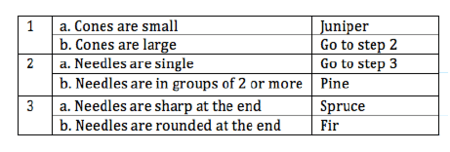
A dichotomous key for trees is provided. Hikers found a tree that has large brown cones and single sharp needles. What species of tree have the hikers found?
a)
Juniper
b)
Pine
c)
Spruce
d)
Fir
28.
The first part of a scientific name is an organism's _______________ and the second part is its ________________.
a)
species, genus
b)
phylum, order
c)
class, spices
d)
genus, species
29.
What are the two parts of an ecosystem?
a)
water and sunlight
b)
all living and nonliving organisms
c)
producers and consumers
d)
soil and nutrients
30.
The process by which plants use sunlight to make sugar from water and carbon dioxide is called 
a)
pollination
b)
photosysthesis
c)
scavenging
d)
fertilization
31.
A food web
a)
shows how energy is released by an organism
b)
compares the amount of energy at each level
c)
shows how different food chains in a community are linked together
d)
is unique since each organism can only be part of one food web
32.
A food chain is a diagram of how 
a)
communities are connected
b)
energy and nutrients pass among organisms in an ecosystem
c)
producers make food
d)
an ecosystem develops and changes
33.
An organism that uses what scavengers leave behind is a 
a)
herbivore
b)
carnivore
c)
decomposer
d)
omnivore
34.
In an energy pyramid, 
a)
the organisms in each level eat those in the level below them
b)
the amount of energy increases as you move up each level
c)
producers are at the top
d)
the smallest organisms are at the top
35.
Where does the energy start in this food chain?
a)
Plant
b)
Sun
c)
Deer
d)
Wolf
36.
What is the role of decomposers in a food chain?
a)
Use sunlight to make food
b)
Eat other organisms to gain energy
c)
Make the food for the whole food chain
d)
Break down dead organisms and add nutrients to the soil
37.
Which of these organisms would receive energy from the snake?
a)
Plant
b)
Rabbit
c)
Mouse
d)
Hawk
38.

Observe the food chain above. Which organism’s population would increase if finches were removed from the ecosystem?

a)

Grass

b)

Grasshopper

c)

Snake

d)

Hawk

39.

The roadrunner is a desert bird that eats fruits and seeds. It also eats insects, spiders, scorpions, and rattlesnakes.


What would likely happen if the roadrunner population disappeared from its ecosystem?

a)

There would be no more fruits or seeds.

b)

There would a decrease in spider populations.

c)

The rattlesnake population would stay the same.

d)

There would be an increase in scorpion populations.

40.

How many predators eat the rabbit for energy in this food web?

a)

2

b)

3

c)

4

d)

5

41.
The arrows in a food chain or web represents what?
a)
They point to the organism that is being eaten.
b)
It shows how sunlight flows within an ecosystem.
c)
They show what direction the energy is flowing between organisms. 
d)
They represent how water is transferred within a habitat.
42.

All living things need _______ to stay alive.

a)

producers

b)

consumers

c)

energy

d)

prey

43.

If the amount of food or resources available increases, the carrying capacity for an animal:

a)

Stays the same

b)

Increases

c)

Decreases

d)

Fluctuates

44.

How would you describe the population size at the12th unit of time?

a)

The population is constant.

b)

The population is decreasing.

c)

The population is increasing.

d)

The population increases then decreases.

45.

All of the meerkats that live in the same place at the same time make up a ____________.

a)

Community

b)

Ecosystem

c)

Population

d)

Biosphere

46.

Anything that restricts the size of a population is a ________________________.

a)

biotic potential

b)

carrying capacity

c)

species

d)

limiting factor

47.

What is happening to the population between the 4th and 8th unit of time?

a)

It is increasing slowly.

b)

It is increasing rapidly.

c)

It is constant.

d)

It is decreasing.

48.

All of the elephants that live in this area at the same time make up a _____________________.

a)

ecosystem

b)

community

c)

population

d)

biosphere

49.

Which of the following is NOT an example of a Density Dependent Factor?

a)

Parasitism

b)

Natural Disasters

c)

Predation

d)

Competition

50.

The movement of individuals into an area is known as:

a)

Supplementation

b)

Emigration

c)

Immigration

d)

Eradication

51.

All of the following are density-independent factors except:

a)

seasonal changes

b)

hurricanes

c)

less space

d)

deforestation

52.
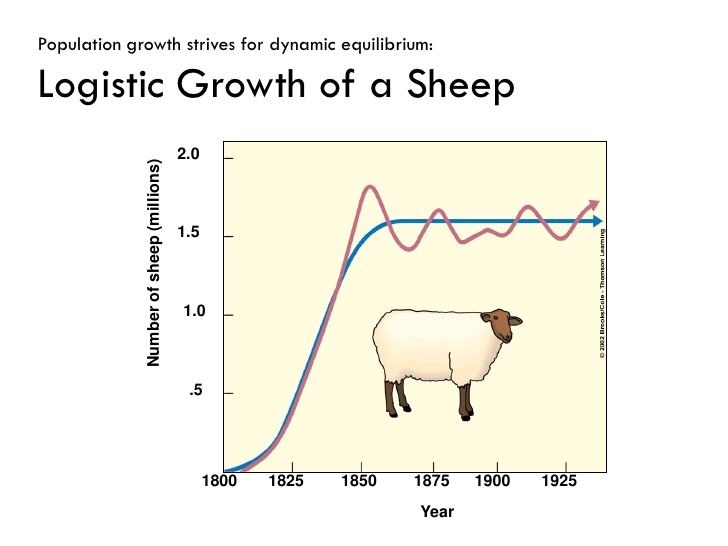
What is the carrying capacity for this sheep population?
a)
1.8 million
b)
1.25 million
c)
1.6 million
d)
1.o million
53.
which statement sounds accurate based on the graph data. 
a)
The zebra and lions do not affect each other
b)
when lions population increases, so does the zebra population
c)
When the zebra population increases, it causes the lion population to also increase
d)
when zebra populations go down, the zebra population goes up. 
54.
What happened to the wolf population between 1980 and 1982?
a)
it increased rapidly
b)
it decreased rapidly
55.
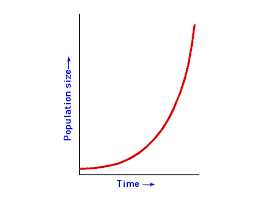
What type of growth is shown in the diagram?
a)
exponential growth
b)
logistic growth 
c)
predator-prey cycle
d)
boom-bust curve
56.
Type of growth that occurs under ideal conditions?
a)
predator-prey cycle
b)
logistic
c)
exponential
57.

Some female peacocks prefer males with large, colorful tales while other female peacocks prefer males with no tail at all. Females are now mating only with the tail they prefer. What type of reproductive barrier is this?

a)

behavioral isolation

b)

hybrid sterility

c)

temporal isolation

d)

mechanical isolation

58.
A flash flood carried a raft of Amazon ants away from their original population. There is enough distance between the two groups, that they will never meet in nature again. What type of reproductive barrier is this?
a)
behavioral isolation
b)
temporal isolation 
c)
gametic isolation
d)
geographic isolation 
59.

In the Great Lakes region of North America, gray wolves and coyotes are similar species but do not mate because their breeding periods occur at different times of the year.

a)

Geographic isolation

b)

Behavioral isolation

c)

Temporal isolation

60.

Label the natural selection graphs correctly...

a)

1 Stabilizing, 2 Directional, 3 Disruptive

b)

1 Disruptive, 2 Stabilizing, 3 Directional

c)

1 Directional, 2 Stabilizing, 3 Disruptive

61.
What type of selection is depicted in the picture? 
a)
stabilizing 
b)
directional 
c)
disruptive 
d)
the answer is not here
62.
What type of selection?
a)
Directional 
b)
Stabilizing
c)
Disruptive
63.
Which of the three graphs shows stabilizing selection?
a)
A
b)
B
c)
C