
 Worksheets
physics revision
Total questions: 74
Worksheet time: 1hrs 8mins
Name
Class
Date
1.
An ________ is a reflected sound.
a)
Vibration
b)
Echo
c)
Pitch
d)
Volume
2.
_____________ is the highness or lowness of a sound.
(Hint: Think about our sound song.)
(Hint: Think about our sound song.)
a)
Amplitude
b)
Pitch
c)
Volume
d)
Vibration
3.
__________ means to move back and forth quickly.
a)
Pitch
b)
Amplitude
c)
Vibration
d)
Echo
4.
______________ is the amount of energy in a sound wave.
a)
Amplitude
b)
Echo
c)
Volume
d)
Vibration
5.
Your ear changes the vibration of sound waves into signals. The signals are then interpreted by your brain.
a)
True
b)
False
6.
Sound waves travel the FASTEST through _____________.
a)
gases
b)
liquids
c)
solids
7.
If a sound has a high amplitude then it also has a ____________!!!
a)
fast echo
b)
slow pitch
c)
high volume
d)
low volume
8.
Sound waves travel the SLOWEST through _____________.
a)
gases
b)
solids
c)
liquids
9.
Sound travels as
a)
transverse waves
b)
longitudinal waves
c)
seismic waves
d)
air waves
10.

Which part of the ear increases the size of the vibrations of sound waves entering the ear?
a)
outer ear
b)
ear canal
c)
middle ear
d)
inner ear
11.

Which part of the ear acts as a funnel for sound waves?
a)
inner ear
b)
outer ear
c)
middle ear
d)
ear canal
12.
As air particles are pushed together, they create a region of higher density and pressure in a longitudinal wave. These areas are called:
a)
sound waves
b)
rarefactions
c)
compressions
d)
transverse wave
13.
As air particles become less crowded a region of lower density and pressure is created. This part of a longitudinal wave is called a:
a)
compression
b)
sound wave
c)
rarefaction
d)
transverse wave
14.

Sound travels at different speeds through different mediums. Through which medium would your voice travel the fastest?
a)
Air on a cold winter morning
b)
Air on a hot summer afternoon
c)
A metal wall
d)
A pool
15.

This part of the ear is vibrated by sound waves. It is a lightly stretched membrane that is the entrance to the middle ear.
a)
Pinna
b)
Ear Drum
c)
Hammer
d)
Cochlea
16.

This fluid-filled snail-shaped sack in the inner ear contains hair cells attached to nerves which transmit sound information to the brain.
a)
Cochlea
b)
Hammer
c)
Anvil
d)
Stirrup
17.

Your __________ vibrate when you talk
a)
stomach
b)
lips
c)
ears
d)
vocal cords
18.

An oscilloscope shows sound ________
a)
vibrations
b)
patterns
c)
imitations
d)
waves
19.

An image made by an ultrasound machine, often used for seeing internal organs in humans is called a(n):
a)
infrasound
b)
Ultrasound
c)
doppler effect
d)
decibel
20.

A sound with a high pitch would have
a)
a low frequency
b)
a high frequency
c)
a low amplitude
d)
a high amplitude
21.

Sound can be measured in ________. It is recommended that humans not be exposed to volumes over 85 _______ for long periods of time.
a)
decimals
b)
frequency
c)
hertz
d)
decibels
22.

A sound with a low pitch would have a:
a)
high frequency
b)
low frequency
c)
high amplitude
d)
low amplitude
23.

A very loud sound would have a(n):
a)
high frequency
b)
low frequency
c)
high amplitude
d)
low amplitude
24.

Reflection is the bouncing back of a wave after it strikes a barrier. A reflected wave is called a(n):
a)
echolocation
b)
refraction
c)
echo
d)
sound wave
25.

A very quiet sound would have a (n):
a)
high frequency
b)
low frequency
c)
high amplitude
d)
low amplitude
26.

The use of reflected sound waves to find objects is called:
a)
echolocation
b)
sound waves
c)
radar
d)
echo
27.
This happens when two sound waves overlap, resulting in a combined amplitude (a louder sound):
a)
sonic boom
b)
sonar
c)
interference
d)
resonance
28.
Can heat be created or destroyed?
a)
Yes
b)
No
c)
Only when things are cooling off
d)
Only when things are warming up
29.
Everything has heat
a)
True
b)
False
30.
Heat and Temperature are the same thing
a)
True
b)
False
31.
Heat that is transferred because of touching is called...
a)
Radiation
b)
Conduction
c)
Convection
d)
Reflection
32.
Energy that does NOT need a medium to transfer heat is called...
a)
Radiation
b)
Conduction
c)
Convection
d)
Reflection
33.
Heat passes from...
a)
High to low
b)
Cold to hot
c)
Hot to cold
d)
Heat cannot be passed
34.
Energy that does need a medium (usually air or water) to transfer heat is called...
a)
Radiation
b)
Conduction
c)
Convection
d)
Reflection
35.
What is an insulator?
a)
Something that does NOT absorb heat very well.
b)
Something that absorbs heat.
36.
What is a conductor?
a)
Something that does NOT absorb heat very well.
b)
Something that absorbs heat.
37.
Why do objects cool down?
a)
All heat will slowly be destroyed.
b)
The cold attacks the heat.
c)
Heat is always transferring so the heat will always move to a cooler place.
d)
The heat disappears.
38.
what is the meaning of convection?
a)
cold rises heat falls
b)
heat
c)
cold
d)
hot rises cold falls
39.
what is the meaning of conduction
a)
when heat transfers from objects that are not touching
b)
heat rise
c)
cold fall
d)
when heat transfers from objects that are touching
40.
what kind of heat is happening when the sun heats your body
a)
conduction
b)
convection
c)
density
d)
radiation
41.
heat rises
a)
true
b)
false
42.
heat energy traveling through space is an example of _____
a)
convection
b)
density
c)
radiation
d)
conduction
43.
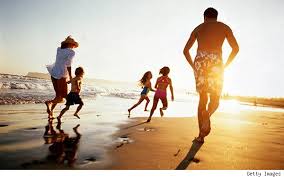
The sun shines down on this family as the play on the beach.
a)
conduction
b)
convection
c)
radiation
44.

A group of friends gather around a fire to stay warm.
a)
conduction
b)
convection
c)
radiation
45.
The bending of light when it moves through one kind of matter to another is.....
a)
absorption
b)
reflection
c)
refraction
d)
a rainbow
46.
The bouncing of light off an object is ....
a)
a mirror
b)
absorption
c)
reflection
d)
refraction
47.
The taking in of light by a material....
a)
absorption
b)
reflection
c)
refraction
d)
dark colors
48.
Light is a kind of.....
a)
reflection
b)
energy
c)
heat
d)
matter
49.
What happens to light after it hits a mirror?
a)
It goes through the mirror and bend.
b)
It goes straight through the mirror.
c)
It goes around the mirror.
d)
It bounces off the mirror.
50.
Which of these describes how light travels through an empty space?
a)
It travels straight but may change direction to avoid objects.
b)
It changes direction often even if there are no objects.
c)
It comes to a stop after it travels a certain distance.
d)
It travels in a straight line without stopping.
51.

What does the pencil in this picture show about light?
a)
Light is refracted when it hits a curved object.
b)
Light is reflected when it hits a curved object.
c)
Light is refracted when it passes from air into water.
d)
Light is reflected when it passes from air into water.
52.
What surface best reflects light?
a)
dull
b)
shiny
c)
clear
d)
black
53.
What kind of path does light take?
a)
It travels in a straight line until it hits something or goes through it.
b)
It bounces off all objects.
c)
It curves around all objects.
d)
It goes through all objects.
54.
What happens to light passing through a prism?
a)
It goes right through it.
b)
It bends and the light separates.
c)
It bounces off it
d)
It goes around it.
55.
How is refraction different from reflection.
a)
Reflection is the bouncing of light off an object and refraction is the bending of light when it moves through one kind of matter to another.
b)
Reflections is the bending of light when it moves through one kind of matter to another and refraction is the bouncing of light off an object.
56.
If a black and white car were in the parking lot all day. Compare the temperatures of the two cars.
a)
The black car would be cooler.
b)
The white car would be hotter.
c)
The black car would be hotter.
d)
They would be the same
57.

A cut piece of clear glass or plastic in the form of a triangle or other geometric shape.
a)
Person
b)
Prison
c)
Prism
d)
Preacher
58.

Curve in
a)
Converse
b)
Convex
c)
Convection
d)
Concave
59.

The way in which electric and magnetic forces interact
a)
Electromagnetic
b)
Spectrum
c)
Wavelength
d)
Prism
60.

When light strikes an object with a rough surface, photons bounce off at random angles.
a)
Occer
b)
Scope
c)
Scattering
d)
Scattegories
61.

A tiny bundle of energy by which light travels
a)
Photographs
b)
Photos
c)
Photons
d)
Friends
62.

A region that contains few or no particles
a)
Vacuum
b)
Velocity
c)
Velcro
d)
Volcano
63.

Allows little to no light through.
a)
Transparent
b)
Translucent
c)
Opal
d)
Opaque
64.

Curve Out
a)
Converse
b)
Concave
c)
Convex
d)
Convection
65.

The bending of waves as they pass from one substance into another.
a)
Reaction
b)
Reflection
c)
Refraction
d)
Repost
66.

Band of color in a rainbow, or from a light passing through a prism.
a)
Spectrum
b)
Space
c)
Prism
d)
Refraction
67.

The distance between one peak and the next in a wave
a)
Transpartent
b)
Scattering
c)
Wavelength
d)
Waste Pro
68.

The term for any wave that hits a surface and bounces off
a)
Transparent
b)
Translucent
c)
Refraction
d)
Reflection
69.

Blurs light as it passes through
a)
Transparent
b)
Translucent
c)
Opaque
d)
Refraction
70.

Transfer of energy when a wave disappears into a surface
a)
Transparent
b)
Refraction
c)
Reflection
d)
Absorption
71.

Allows most light through
a)
eflection
b)
Refraction
c)
Translucent
d)
Transparent
72.

The number of vibrations a wave makes in a given amount of time is a
a)
Absorption
b)
Medium
c)
Frequency
d)
Photon
73.

A substance through which light travels.
a)
Wavelength
b)
Opaque
c)
Frequency
d)
Medium
74.

Light travels on straight lines.
a)
Light Bulb
b)
Sunshine
c)
Light Rays
d)
Frequency
100 %

