wayground logo

Free Printable Worksheets

NEW

Font size

S
M
L
XL
Worksheets

HCC Paper 1 rivers

Total questions: 40

Worksheet time: 1hrs 9mins

Name
Class
Date
1.

What is the name for where a river starts?

a)

confluence

b)

mouth

c)

source

d)

waterfall

2.

Traction refers to the way in which material in the river's load are bounced along the riverbed

a)

True

b)

False

3.

When soluble particles are dissolved into the river it is called:

a)

Hydraulic Action

b)

Abrasion

c)

Saltation

d)

Solution

4.

Which process involves large boulders and rocks being rolled along the river bed?

a)

Saltation

b)

Traction

c)

Suspension

d)

Solution

5.

Which Process involves small pebbles and stones being bounced along the river bed?

a)

Solution

b)

Traction

c)

Saltation

d)

none of the above

6.

Tiny particles such as silt are usually transported:

a)

in solution

b)

in suspension

c)

by saltation

d)

by traction

7.

The load of the river is all the materials carried by the water

a)

True

b)

False

8.
Which method of transportation is 'bouncing' medium sized particles along the river bed?
a)
Traction
b)
Saltation
c)
Suspension
d)
Solution
9.

What is the edge of the river basin called?

a)

waterside

b)

waterway

c)

watershed

d)

water

10.
Which is NOT a method of transportation?
a)
Abrasion
b)
Saltation
c)
Traction
d)
Suspension
11.
Where would you find a waterfall?
a)
Upper course
b)
Middle Course
c)
Lower Course
12.
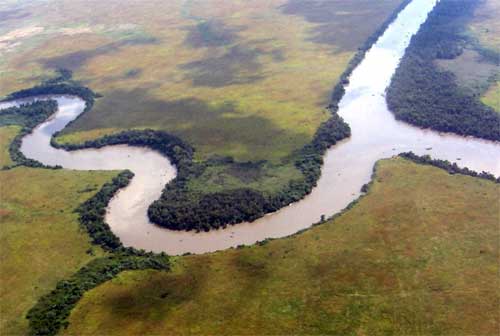
What landform can you see in the picture?
a)
Floodplain
b)
Delta
c)
Waterfall
d)
Oxbow lake
13.
"Rocks rolled along the river bed" is what type of transportation?
a)
Saltation
b)
Suspension
c)
Traction
d)
Solution
14.

"This is where plants, trees, or buildings collect the precipitation and slow it down" What am I?

a)

Interception

b)

Infiltration

c)

Percolation

d)

Surface runoff

15.
"Where the water filters into the ground and into the tiny pores in the soil" What am I?
a)
Infiltration
b)
Percolation
c)
Precipitation
d)
Interception
16.
"I am a smaller river joining a larger river" What am I?
a)
Confluence
b)
Tributary 
c)
Drainage Basin
d)
Watershed
17.
I am the land that gets flooded when the river overflows. What am I?
a)
Levee
b)
Delta
c)
Floodplain
d)
Meander
18.

Which of these is a human cause of flooding?

a)

Heavy rainfall

b)

Natural Hazards

c)

Impermeable rocks

d)

Deforestation

19.

What is an impermeable rock?

a)

A rock that doesn't let water through

b)

A rock that does let water through

20.

Attrition

a)

rocks dissolve in water

b)

rocks bounce along the river bed

c)

rocks scrape away at the land

d)

rocks smash together and break into smaller, smoother particles

21.

Deposition

a)

occurs when material transported by a river or waves is picked up to increasing energy

b)

occurs when material transported by a river or waves is dropped due to losing energy

22.

Narrow, steep-sided valley that is usually found downstream from a waterfall

a)

Floodplain

b)

Interlocking spurs

c)

V-shaped valley

d)

Gorge

23.

Restricting different land uses to certain locations on the floodplain - areas close to the river are kept clear of high-value land uses.

a)

River restoration

b)

Floodplain zoning

c)

Flood warnings

d)

Flood relief channels

24.
A river starts very small before getting larger. What is the name given to a small river that joins a larger river?
a)
Confluence
b)
Tribunal
c)
Tributary
d)
Joiner
25.
A waterfall is most likely to be found closer to what part of the river?
a)
River mouth
b)
River source
26.
A waterfall is created because of ...
a)
the types of layers of rock
b)
the force of gravity
c)
deforestation
d)
deposition
27.

Which one of the following helps create Waterfalls?

a)

Attrition

b)

Solution

c)

Silting

d)

Hydraulic Action

28.
The area that contains a river system is called a what?
a)
Drain Bassoon
b)
Drainage Basinet
c)
Drainage Basin
d)
Drain Basalt
29.

There are four main types of erosion for rivers. Which answer is correct.

a)

Hydraulic Action, Attrition, Rubbing, Silting

b)

Hydraulic Action, Abrasion (corrasion), Deposition, Solution

c)

Hydraulic Action, Abrasion (corrasion), Silting, Solution

d)

Hydraulic Action, Solution, Abrasion (corrasion), Attrition

30.
Deposition is when ...
a)
Objects are moved along the river.
b)
Objects are dropped along the river.
c)
Objects are suspended in the water.
d)
Objects are move into the ocean.
31.
Silting is an example of Deposition. What is silting?
a)
When rocks are deposited on the river bed.
b)
When rocks rub against the river bed, causing it to be deeper.
c)
When sand and particles are deposited along the river bed, causing it to be shallower.
d)
When flooding occurs because of heavy rainfall.
32.
Transportation in river systems has four main categories. These are ...
a)
Suspension, Solution, Attrition, Abrasion.
b)
Suspension, Solution, Saltation, Abrasion.
c)
Suspension, Solution, Saltation, Attrition.
d)
Suspension, Solution, Saltation, traction.
33.
A meander is best described as ...
a)
A straight section of the river.
b)
A winding section of a lake.
c)
A section of the river that joins another river.
d)
A winding section of a river.
34.
A meander is created when ...
a)
Sections of the river move slowly.
b)
Sections of the river move slowly and have materials deposited.
c)
Sections of the river move slowly, having materials deposited, creating bend.
d)
When it floods and the river creates a new path.
35.
The section where a smaller river joins a larger river is called a ...
a)
Tributary
b)
Congruence
c)
Confluence
d)
Convergence
36.
When the bends of a Meander get close enough they can join, creating a new river path. What is left is called ...
a)
An oxback lake
b)
An oxen lake
c)
An oxcart lake
d)
An oxbow lake
37.
The point where the river meets an ocean or lake is called the ...
a)
River Source
b)
River Mouth
c)
River Head
d)
River Section
38.
How does silting contribute to flooding?
a)
The river gets deeper and flows quicker, meaning water floods quicker.
b)
The river gets deeper and flows slower, meaning that the water can't move away.
c)
The river gets shallower and flows slower, meaning that water floods the banks quicker.
d)
The river gets shallower and slows quicker, meaning that water floods the banks quicker.
39.

Which of the following is an example of hard engineering to limit river flooding

a)

dredging

b)

planting trees (afforestation)

c)

flood plain zoning

d)

river restoration

40.

In the Somerset levels floods 2014 what is the name of the flood action group formed to campaign for flood protection?

a)

FLOP

b)

FLAG

c)

FLIP

d)

FLAP