wayground logo

Free Printable Worksheets

NEW

Font size

S
M
L
XL
Worksheets

ICP Physics Final Review 2019

Total questions: 65

Worksheet time: 56mins

Name
Class
Date
1.
Which of the following describes distance and displacement correctly?
a)
The blue arrow shows distance and the orange arrows show displacement
b)
The blue arrow shows displacement and the orange arrows show distance
c)
Both arrows show distance only
d)
Both arrows show distance and displacement
2.

You travel 30 miles west of your home. You turn around and start back home. After traveling 10 miles east, what is your displacement from home?

a)

40 miles west

b)

20 miles east

c)

20 miles

d)

20 miles west

3.
What is the speed of a car that travels 400 m in 20 minutes?
a)
20 miles/hr
b)
20 m/min
c)
800 m/min
d)
200 miles/hr
4.
What is velocity?
a)
the quickness of an object
b)
the location of an object
c)
acceleration
d)
speed in a specific direction
5.
Why does a car accelerate as it round a corner at a constant speed?
a)
Its direction changes
b)
It doesn't
c)
It slows down
d)
Its speeds up  
6.
When are you undergoing an acceleration in a car? 
a)
speed up
b)
slow down
c)
make turns
d)
All of the above 
7.
A negative acceleration means that your object is _____. 
a)
not accelerating
b)
not moving
c)
speeding up 
d)
slowing down 
8.
Which graph demonstrates the greatest positive speed?
a)
A
b)
B
c)
C
d)
D
9.
What kind of quantity has both a magnitude and a direction?
a)
scalar
b)
vector
c)
frame of reference
d)
time
10.
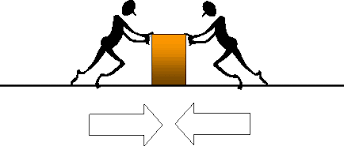
How will this object move? 
a)
It won't move. 
b)
It will move to the right. 
c)
It will move to the left. 
d)
It will move in both directions. 
11.
Which could be an example of an unbalanced force?
a)
A plate sitting on a dining table
b)
A ball at the top of a hill that is not moving
c)
Earth orbiting the Sun 
d)
A baseball that has been thrown to home plate.
12.
What law is best described by inertia?
a)
1st
b)
2nd
c)
3rd
13.

The resistance of an object to any change in its motion is called ______________________.

a)

inertia

b)

friction

c)

gravity

d)

weight

14.

According to Newton’s second law of motion, force is equal to mass times ______________________.

a)

inertia

b)

weight

c)

acceleration

d)

direction

15.

The picture is an example of Newton's...

a)

1st Law

b)

2nd Law

c)

3rd Law

16.
"For every action, there is an equal and opposite reaction."
a)
Newton's 1st Law
b)
Newton's 2nd Law
c)
Newton's 3rd Law
d)
Newton's 4th Law
17.
Any push or pull on an object.
a)
force
b)
velocity 
c)
inertia
d)
momentum
18.
The force that opposes motion between two surfaces in contact with each other.
a)
inertia
b)
friction
c)
momentum
d)
gravity
19.
The force of attraction between all matter.
a)
inertia
b)
friction
c)
net force
d)
gravity
20.

a cannon recoils after shooting a cannon ball. the velocity of the cannon's recoil is small because the

a)

impulse on the cannon is small

b)

mass of the cannon is large

c)

force on the cannon is small

d)

mass of the cannon ball is large

21.
The total momentum before a collision is _________ the total momentum after a collision.
a)
equal to 
b)
less than 
c)
more than
d)
It depends on the type of collision
22.
The momentum of an object depends upon the object's ___________&_____________.  
a)
size and shape
b)
mass and speed
c)
mass and veloctiy
d)
mass and energy
23.

If you push a coffee mug 1.4 m using a force of 5 N, the work done on the mug is?

a)

7 J

b)

6 J

c)

8 J

d)

9 J

24.
The amount of work done in a certain amount of time is known as 
a)
work
b)
effort force
c)
resistance force 
d)
power
25.
Conduction can only occur between two objects when –
a)
one object is less dense than the other.
b)
both objects are in physical contact with each other.
c)
one of the objects is made of a metal.
d)
both objects are exactly the same temperature.
26.

Heat will always transfer from the ___________ object to the ________ object.

a)

The hottest object to the coolest object.

b)

The coolest object to the hottest object.

c)

The solid object to the liquid object.

d)

The liquid object to the solid object.

27.
In what direction do hot liquids and gasses move?
a)
Side to Side
b)
Down
c)
Up
d)
Back and Forth
28.
The sun warming your skin is an example of heat transfer through 
a)
conduction
b)
convection
c)
radiation
d)
thermal electricity
29.
The flow of thermal energy from warmer objects to cooler objects 
a)
Ice Cold
b)
Heater
c)
Heat
d)
Convection 
30.
Energy of motion is which type of energy?
a)
Potential
b)
Kinetic
c)
Sound
d)
Gravitational
31.
On a roller coaster, where is maximum potential energy?
a)
At the bottom of a big hill
b)
When going around a corner
c)
When going upside down
d)
At the top of a big hill
32.
The ability to do work is
a)
power
b)
energy
c)
thermal
d)
kinetic
33.
What type of energy includes both kinetic and potential energy?
a)
mechanical energy
b)
chemical energy
c)
heat energy
d)
sound energy
34.

Potential energy depends on ____________ & ______________.

a)

mass, speed

b)

mass, position

c)

speed, position

d)

mass, weight

35.

Kinetic energy depends on _____________ & _____________.

a)

mass, speed

b)

mass, position

c)

mass, weight

d)

speed, distance

36.
Which point has the most potential energy?
a)
D
b)
F
c)
B
d)
A
37.
Which point has the greatest kinetic energy?
a)
W
b)
X
c)
Y
d)
Z
38.
What is happening to the energy of the girl from point A to point B
a)
kinetic changes to potential
b)
potential changes to kinetic
c)
energy is lost
d)
energy is gained
39.
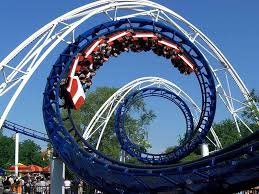
Why won't the roller coaster reach over the second hill?
a)
because it is going slow
b)
because energy cannot be created
c)
because it is going fast
d)
because energy cannot be destroyed
40.

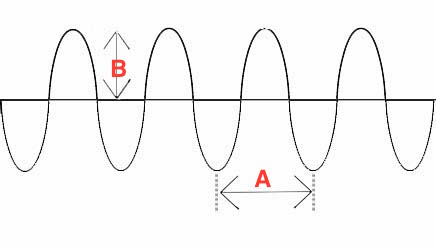
What property of the wave is represented by the letter "A"?

a)

amplitude

b)

crest

c)

trough

d)

wavelength

41.
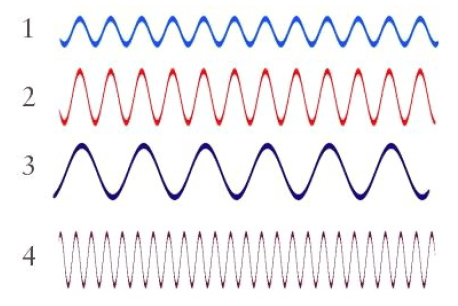
Which wave in the diagram has the greatest frequency?
a)
1
b)
2
c)
3
d)
4
42.
What kind of wave is pictured below?
a)
compressional wave
b)
transverse wave
c)
sound wave
d)
mechanical wave
43.

All waves carry ________ as they travel from one place to another.

a)

matter

b)

space

c)

energy

d)

water

44.

What property of the wave is represented by the letter "B"?

a)

amplitude

b)

crest

c)

trough

d)

wavelength

45.
Longitudinal waves are ______.
a)
Parallel
b)
Perpendicular
c)
Crazy
46.
If the frequency gets higher, the wavelength gets 
a)
longer
b)
shorter
47.

Jane jogs 18 km in 2 hours. Then she walks for 6 km in 2 hours. Find her average speed.

a)

9

b)

3

c)

12

d)

6

48.
A roller coasters accelerates from an initial velocity of of 6.0 m/s to a final velocity of 70 m/s over 4 seconds.  What's the acceleration?
a)
24 m/s2
b)
18 m/s2
c)
16 m/s2
d)
16 m/s
49.
Which line(s) show a negative acceleration ?
a)
A
b)
B and C
c)
D
d)
A, B, and 
A, B, and D
50.
If an object is stationary (not moving) the forces acting upon it are _____________
a)
unbalanced
b)
weak
c)
balanced
d)
Hulk Smash!
51.
Which of the following could cause an acceleration?
a)
A balance between two forces
b)
A balance between three forces
c)
An imbalance between two forces
d)
Zero forces
52.
What is the definition of "weight"?
a)
measure of the force of gravity on your body
b)
the time it takes to get on a ride 
c)
the amount of matter in an object
d)
the size of an object
53.
A person would weigh less on on the Moon than on the Earth because . . .
a)
Moon has more mass, and therefore more gravity
b)
Moon has less mass, and therefore more gravity
c)
Moon has more mass, and therefore less gravity
d)
Moon has less mass and therefore less gravity
54.
As distance between objects increases the pull of gravity...
a)
increases 
b)
decreases 
c)
Stays the same 
55.
The number of wavelengths that pass a point each second
a)
frequency
b)
wavelength
c)
pitch
d)
amplitude
56.

Sound waves are also known as ----- waves.

a)

Transverse

b)

Longitudinal

c)

Surface

d)

Electromagnetic

57.
Material that allows light to pass through allowing you to see "clearly" to the other side
a)
opaque
b)
translucent
c)
transparent
58.

The bending of waves around a barrier.

a)

refraction

b)

diffraction

c)

resonance

59.
The bending of a wave due to a change in its speed is
a)
interference
b)
reflection
c)
diffraction
d)
refraction
60.
The bouncing of light off an object is ....
a)
a mirror
b)
absorption
c)
reflection
d)
refraction
61.

What does the pencil in this picture show about light?

a)

Light is refracted when it hits a curved object.

b)

Light is reflected when it hits a curved object.

c)

Light is refracted when it passes from air into water.

d)

Light is reflected when it passes from air into water.

62.
Allows little to no light through.
a)
Transparent
b)
Translucent
c)
Opal
d)
Opaque
63.
The three primary colors of light are
a)
Red, Blue, Yellow
b)
Pink, Green, Blue
c)
Violet, Green, Red
d)
Blue, Green, Red
64.

Light acts like

a)

a wave.

b)

a particle.

c)

Both a wave and a particle

d)

neither a wave nor a particle.

65.

The full range of frequencies of electromagnetic radiation is called

a)

visible light.

b)

radio waves.

c)

the electromagnetic spectrum.

d)

invisible radiation.