Wayground logo

Free Printable Worksheets

Font size

S
M
L
XL
Worksheets

Semester 1 Review

Total questions: 108

Worksheet time: 6hrs 37mins

Name
Class
Date
1.

The sacred writings (texts) for the Jews

a)

Vedas

b)

Tripitaka

c)

Koran

d)

Torah

2.

Mecca is an important city for

a)

Hindus

b)

Christians

c)

Muslims

d)

Buddhists

3.

Which western religion(s) originated in the Middle East

a)

Judaism

b)

Christianity

c)

Islam

d)

All of the above

4.

Which belief is common to Judaism, Christianity, and Islam?

a)

reincarnation

b)

animism

c)

monotheism

d)

karma

5.

Followers of __________ pray in the direction of Mecca five times a day. One of their traditions is to whisper the name of Allah in a newborn baby’s right ear and to hold a baby naming ceremony called an Aqiqah.

a)

Judaism

b)

Christianity

c)

Islam

d)

All of the above

6.
How are the Five Pillars in Islam and Ten Commandments in Christianity similar?
a)
Guide for the afterlife
b)
guide for praying towards Mecca
c)
Guide for moral and ethical living
d)
guide for achieving God's forgiveness
7.
Who was the founder of Islam?
a)
Muhammad
b)
Moses
c)
Martin Luther
d)
Jesus Christ
8.
What is the name of the holy book of Islam?
a)
Bible
b)
Torah
c)
Qu'ran (Koran)
d)
Four Noble Truths
9.
Someone who believes in one God would be called a...
a)
monotheist
b)
polytheist
c)
atheist
d)
buddhist
10.
___________ is considered to be the founder of Judaism.
a)
Abraham
b)
Saul
c)
David
d)
Goliath
11.
A ______ is a Jewish house of worship.
a)
synagogue
b)
diaspora
c)
Torah
12.
The holy book of the Christians is called the...
a)
Torah
b)
Old Testament
c)
Holy Bible
d)
Psalms and Proverbs
13.
Who is the founder of Christianity?
a)
Abraham
b)
Paul
c)
Peter
d)
Jesus
14.
The synagogue is to Jewish people as the _________ is to Christians. 
a)
Church
b)
Torah
c)
Trinity
d)
Synagogue
15.
What did the Jews call their God?
a)
Yahweh
b)
Allah
c)
Messiah
d)
Vishnu
16.

The major cause of the split between the Roman Catholic Church and the Greek Orthodox Church was the —

a)

belief in the doctrine of the New Testament

b)

use of the Ten Commandments to guide behavior

c)

use of religious icons in church services

d)

belief in one God versus many gods

17.

The split of the Christian church into two churches was known as the —

a)

Crusades

b)

Eastern Split

c)

Roman Crusade

d)

Great Schism

18.

The issue that most divided the Church of Rome and the Byzantine Church was the —

a)

role of the Byzantine missionaries

b)

building of the Hagia Sophia

c)

role of the Pope

d)

use of mosaics in Church art

19.

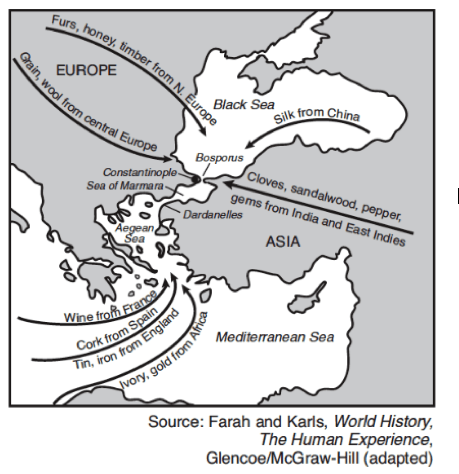
What can you conclude about the city of Constantinople?
a)
Constantinople is a difficult city to travel to
b)
Constantinople is located in Asia.
c)
Constantinople located at the center of major trade routes
d)
Constantinople is on the Mediterranean Sea.
20.
Who moved the Roman empire's capital east from Rome to Byzantium?
a)
 Justinian
b)
Augustus Caesar
c)
Julius Caesar
d)
Constantine
21.
During the time of Justinian, the culture and achievements of the Byzantine empire flourished. It could be called the Byzantine __________  Age. 
a)
Bronze
b)
Golden
c)
Silver
d)
Stone
22.
Parts of the Justinian Code were used by many different countries in the Western the world as they developed their own laws. 
a)
True
b)
False
23.

The Byzantine Empire preserved the cultural heritage of which empires?

a)

Egypt and Mesopotamia

b)

China and Persia

c)

Greece and Persia

d)

Greece and Rome

24.

Justinian was the ruler of the —

a)

Egyptian Empire

b)

Carthaginian Empire

c)

Byzantine Empire

d)

Persian Empire

25.
What is a fief?
a)
land given to Knights in exchange for loyalty
b)
Something Kings ate
c)
A disease that killed many peasants
d)
Not a real thing
26.
What is the difference between a Lord and a Vassal?
a)
Nothing
b)
Lords are the boss of the Vassal
c)
Vassals had more money
d)
Lords were not connected to Vassals
27.
Who was the King to reunite Europe after the Fall of the Roman Empire?
a)
William the Conqueror
b)
Charlemagne
c)
John VIII
d)
Caesar
28.
What was a peasant's job?
a)
Farming
b)
Building tools
c)
Cooking
d)
All of the above
29.
What were Knights expected to give in exchange for land?
a)
Loyalty
b)
Protection
c)
Taxes
d)
All of the above
30.

Which is a vassal to a lord, fought on horseback, was highly trained, and a skilled warrior in armor?

a)

Beserker

b)

Crusader

c)

Knight

d)

Cavalry

31.
the medieval knight's code of honor
a)
chivalry
b)
destiny
32.
What was the order of the hierarchy in European Feudalism?
a)
King, Knight, Noble, Peasant
b)
King, Noble, Knight, Peasant
c)
King, Noble, Peasant, Knight
33.
Which feudal class had the most people?
a)
Monarchs
b)
Lords
c)
Knights
d)
Peasants
34.
The term feudalism is best defined as a
a)
Division of power between branches of government
b)
Holy war between Christians and Muslims
c)
Process in which goods are traded for other goods
d)
System in which land is exchanged for military service or loyalty
35.
The Middle Ages began when the.....
a)
Roman Empire fell
b)
Greeks were polytheistic
c)
Agricultural Revolution began
d)
the Reformation started
36.
Which of these best defines feudalism?
a)
A political and economic arrangement in which a lord provides protection in exchange for loyalty and service.
b)
A hierarchy designed to ensure only kings are protected.
c)
A system of exchange where laborers work for wages in the form of money.
d)
A social order with kings at the top and knights at the bottom.
37.
A person of high rank by birth or title is a 
a)
Noble
b)
Serf
c)
Priest
d)
Knight
38.
What did the lord give to the vassal?
a)
land
b)
money
c)
nothing
d)
the Divine Right of rule
39.
A vassal was
a)
a king
b)
anyone who got land or something of value from a lord
c)
anyone who gave land to a person
d)
a peasant or serf
40.
Bushido, "the way of the warrior," represents what?
a)
the rules of daily behavior followed by samurai.
b)
The particular fighting style of the samurai.
c)
The code of loyalty sworn to a peasant..
d)
the religious rituals performed by samurai.
41.

Which characteristics were promoted by the bushido code?

a)

simplicity, harmony, and balance

b)

meditation and simplicity

c)

loyalty, bravery, and honor

d)

simplicity, understatement, and grace

42.
What was the main function of the samurai?
a)
write poetry
b)
manage farmland
c)
defend lords
d)
conquer China
43.

Who were the daimyo?

a)

hired warriors

b)

head of a large landowning families

c)

generals, or rulers over Japan

d)

people who ruled for a monarch or emperor

44.

What is Bushido?

a)

meditation

b)

Tamahagane

c)

way of the gods

d)

way of the warrior

45.
Who gave protection in exchange for food?
a)
Samurai
b)
Daimyo
46.
Which of the following best describes Social mobility in Europe
a)
Individuals could freely move between each class as they please as long as they paid a large tax
b)
Only the lower levels could interchange class
c)
It was similar to that of Caste System where there were rigidly defined levels of social class 
d)
Only the higher levels could interchange class
47.
Feudal societies are generally characterized by...
a)
A representative government
b)
An emphasis on social order
c)
Many economic opportunities
d)
The protection of political rights
48.

This dynasty ruled from 661 to 750 and its capital was Damascus in Syria. They expanded their empire to include central Asia, Afghanistan, northern Africa, & Spain. They organized their government after the Byzantines & allowed groups to practice their own religion. Arabic becomes the common language of the Muslim Empire.

a)

Abbasid Dynasty

b)

After Muhammad (The Four Caliphs)

c)

Seljuk Turks

d)

Umayyad Dynasty

e)

Ottoman Empire

49.

This dynasty ruled from 1526 to 1707 and its capital was in Delhi. They were descendants of the Mongols. The dynasty traded with Europe, the Ottoman Empire, the Far East, and Africa. Their most famous ruler was Akbar and the dynasty experienced a golden age under him. Later rulers wasted money on wars and building projects like the Taj Mahal.

a)

Muhammad's Government

b)

After Muhammad (The Four Caliphs)

c)

Mughals

d)

Umayyad Dynasty

e)

Ottoman Empire

50.

This dynasty ruled from 750 to 1055 and again in 1092 to 1258 and its capital was Baghdad. The dynasty brought in a Persian influence. They grew wealthy due to trade and encouraged learning and the arts. The ruler became the religious leader of the next dynasty & eventually regained power.

a)

Abbasid Dynasty

b)

After Muhammad (The Four Caliphs)

c)

Seljuk Turks

d)

Umayyad Dynasty

e)

Ottoman Empire

51.

How did the Ottoman Empire grow?

a)

It grew due to conquests.

b)

It grew due to purchases.

c)

It grew due to trade.

d)

Both A and C.

52.

Why was Constantinople an important city?

a)

Its latitude and longitude makes it the exact center of the Earth.

b)

It was the only city that had three major empires control it.

c)

It was the only city that changed its name three times.

d)

Most trade between Asia, Europe, and North Africa had to pass through it.

53.
Early African kingdoms such as Ghana (800s-1000CE) and Mali (1200-1450CE) made most of their wealth by
a)
selling slaves to the Portuguese.
b)
trading gold across the Sahara Desert.
c)
trading salt for silk across the Indian Ocean.
d)
raiding European ships sailing in the Atlantic.
54.
What three empires in western Africa flourished because of the trans-Saharan trade of gold and salt?
a)
Mali, Axum, Zimbabwe
b)
Ghana, Mali, Songhai
c)
Axum, Ethiopia, Ghana
d)
Timbuktu, Ethiopia, Mali
55.
From the 1000s CE through the 1400s CE, which of these goods would have been LEAST likely to have traveled out of western Africa towards the east along the trans-Saharan trade route?
a)
gold
b)
salt
c)
silver
d)
slaves
56.
Ghana, Mali, and Songhai all traded which TWO items?
a)
Gold and fish
b)
Gold and salt
c)
Gold and timber
d)
Gold and bronze
57.
In the Empire of Mali, who was Mali's greatest leader?
a)
Mufusa
b)
Mansa Musa
c)
King Kong
d)
Nelson Mandela
58.
What helped trade be possible across the Sahara? 
a)
Camels 
b)
Trucks
c)
Slaves
d)
Horses
59.
What African Trading Kingdom developed first?
a)
Ghana
b)
Mali
c)
Songhai
d)
Kush
60.
What West African Trading Kingdom developed third?
a)
Songhai
b)
Mali
c)
Ghana
d)
Kush
61.
West African culture was shaped by the ________________________  trade network
a)
Trans-Saharan
b)
Indian Ocean
c)
Middle Eastern
d)
Mediterranean 
62.
Great leader of Mali famous for his hajj (pilgrimage) to the Muslim holy city of Mecca
a)
Mansa Musa
b)
Sundiata
c)
Songhai
d)
Benin
63.
(9b) What was gold traded for?
a)
salt
b)
camels
c)
grain
d)
rice
64.
What is the correct order in which the West African empires existed?
a)
Songhai, Mali, Ghana
b)
Ghana, Mali, Songhai
c)
Mali, Ghana, Songhai
d)
Mali, Songhai, Ghana
65.

The Songhai Empire replaced the ___________ Empire.

a)

Ghana

b)

Mali

c)

Benin

d)

Great Zimbabwe

66.

The Mali Empire replaced the ___________ Empire.

a)

Songhai

b)

Ghana

c)

Aksum

d)

Benin

67.

How did Mansa Musa gain his wealth?

a)

Taxing the gold-salt trade

b)

Through war and conquest

c)

Generational wealth passed down to him

d)

Saving funds over the years

68.

What happened to Africa as a result of Mansa Musa's hajj?

a)

Mansa Musa and the Mali Empire was featured on the Catalan Atlas map

b)

TImbuktu became a religious and educational center

c)

Europeans began to raid Africa for their resources

d)

Other emperors in Africa began to copy Mansa Musa and took their citizens to Mecca

e)

All of the above

69.
Which continent is ancient Mali located on?
a)
Asia
b)
Africa
c)
North America
d)
South America
70.
What natural resource was used to preserve food and keep people healthy?
a)
Water
b)
Gold
c)
Pepper
d)
Salt
71.

What valuable natural resource was mined to the south of Ancient Mali (in West Africa) and was traded for salt?

a)

Platinum

b)

Copper

c)

Silver

d)

Gold

72.
What ruler of Mali is famous for his lavish trip to Mecca?     
a)
 Shaka Zulu
b)
Ramses II 
c)
Mansa Musa
d)
 Hannibal
73.
Why was Timbuktu an important city?
a)
because it was a big center for trading 
b)
because the king lived there 
c)
because griots told stories there 
d)
because it was big 
74.
what is the capital of the aztec empire?
a)
tonomitlandia
b)
bogota
c)
Madrid
d)
Tenochtitlan
75.
What did the Aztecs do to apease their gods?
a)
burning neighborning houses
b)
trying to kill the leader
c)
human sacrifice
d)
naming your child after their god
76.
The main crop grown by the Mayans was:
a)
Potatoes
b)
Maize
c)
Cotton
d)
Jade
77.
Mayans believed in many gods.  This is called:
a)
Monothesim
b)
Animism
c)
Polytheism 
78.
Who used terrace farming?
a)
Inca
b)
Aztec
c)
Mayan
79.
Who was known for their roads and bridges that was high in the Andes Mountains?
a)
Mayans
b)
Incas
c)
Aztecs
d)
Olmecs
80.
What civilization came up with the zero?
a)
Mayans
b)
Aztecs
c)
Olmecs
d)
Incas
81.
Which was NOT a Mesoamerican empire? 
a)
Maya
b)
Aztec
c)
Inca
d)
Songhai
82.
Which would be the effect of a surplus of food on the Aztec empire?
a)
decrease in wealth 
b)
decrease in population
c)
increase in famine
d)
increase in population
83.

Which empire was located in Central America?

a)

Maya

b)

Aztec

c)

Inca

d)

None of the above

84.

Which empire was taken over by Hernan Cortes?

a)

Maya

b)

Aztec

c)

Inca

d)

All of the above

85.

Which empire had a writing system titled, "glyphs"?

a)

Maya

b)

Aztec

c)

Inca

d)

All of the above

86.
What were the Maya able to create with great accuracy?
a)
Calendar
b)
Record Keeping System
c)
Theocracy
d)
Map of the Universe
87.
Which American civilization is referred to as the "Mother Culture" because they influenced later cultures?
a)
Olmec
b)
Maya
c)
Aztec
d)
Inca
88.
Three motivations for European explorers: God, Gold, and ______.
a)
Grace
b)
Glory
c)
Greed
d)
Glaciers
89.
The art and science of map making is called:
a)
cartography
b)
mapography
c)
quilting
d)
mapology
90.
Which of the following helped explorers determine latitude from the position of the sun, moon, and stars?
a)
compass
b)
caravel
c)
astrolabe
91.
Fast ship that could sail with & against the wind, large cargo area, and shallow hull that could navigate shallow water
a)
navigation ship
b)
caravel
c)
astrolabe
d)
compass
92.
Who sponsored Portuguese fleets that sailed along the western coast of Africa?
a)
Prince Henry the Navigator
b)
Queen Isabella
c)
Christopher Columbus
d)
Ferdinand Magellan 
93.
In which direction did the Spanish sail?
a)
East
b)
North
c)
West
d)
South
94.
What did Queen Isabella do for Christopher Columbus?
a)
sponsored his exploration
b)
married him
c)
made him royalty
95.
Conquistadors is a Spanish word meaning:
a)
to entrust
b)
to connect
c)
court
d)
conquerors
96.
Two things that conquistadors had that the Native Americans did not: horses and _______
a)
families
b)
gold
c)
guns
d)
land
97.
How was Ferdinand Magellan able to prove the Earth was round?
a)
He circumnavigated the Earth by ship from Spain and back again
b)
He opened up a school of navigation to educate the people
c)
He came up with Magellan's Mathematical Equation to prove it
d)
Christopher Columbus confirmed his theory on his voyage
98.
What was Christopher Columbus' purpose for exploration before discovering the New World?
a)
To find a faster and safer trading route to Asia
b)
To circumnavigate the world in the name of Italy
c)
To launch a surprise attack the enemies of Spain by sea
d)
To find the city of gold in southern Africa
99.
European countries wanted to find a faster route to...?
a)
Asia
b)
Africa
c)
The north pole
d)
California
100.

This explorer was the 1st to circumnavigate the world, and later died in the Philippines on his voyage.

a)

Vasco De Gama

b)

John Cabot

c)

Ferdinand Magellan

d)

Black Beard

101.

This Explorer was the first to establish an Indian trade route by sailing south around the Cape of Good Hope.

a)

Vasco de Gama

b)

Bartholomew Dias

c)

John Cabot

d)

Hernan Cortez

102.

This famous Spanish conquistador conquered the Aztec civilization.

a)

Francisco Pizarro

b)

Hernan Cortez

c)

Amerigo Vespucci

d)

Christopher Columbus

103.

This explorer was the first to sail around the Cape of Good Hope.

a)

Bartholomew Dias

b)

Ferdinand Magellan

c)

Christopher Columbus

d)

Vasco de Gama

104.

A German mapmaker named the New World, "America" because of this famous explorer.

a)

John Cabot

b)

Amerigo Vespucci

c)

Hernan Cortez

d)

Christopher Columbus

105.

A mercantile-based economy heavily focuses on imports and exports, this is called:

a)

Balance of Trade

b)

Mercantilism

c)

Exchange Economy

d)

The Emancipation of the Proletariate

106.

If you were to draw a line that connected Africa to America to Europe what shape would you make?

a)

A rhododendron

b)

An Oval

c)

A Square

d)

A Triangle

107.

What were the 3 major motivating factors for Explorers?

a)

Gold, Silver, Treasure

b)

God, Glory, Gold

c)

God, Glory, Gallantry

d)

Honor, Justice, Reinhardt!

108.
What country sponsored Christopher Columbus?
a)
Spain
b)
England
c)
Italy
d)
Portugal