wayground logo

Free Printable Worksheets

Font size

S
M
L
XL
Worksheets

COLD WAR

Total questions: 108

Worksheet time: 1hrs 14mins

Name
Class
Date
1.

During the Cold War, what bill did the U.S. Congress pass to provide financial assistance to western European countries?

a)

Truman Doctrine

b)

Open Door Policy

c)

Marshall Plan

d)

Domino Theory

2.

What policy implemented in the Cold War said the U.S. would give military aid to a country that needed to resist communism?

a)

Marshall Plan

b)

Truman Doctrine

c)

Domino Theory

d)

Open Door Policy

3.

During the Cold War, what policy did the U.S. follow to stop the spread of communism?

a)

Open Door Policy

b)

Big Stick Policy

c)

Containment Policy

d)

Dollar Diplomacy

4.

In what year did the Russians launch the satellite Sputnik?

a)

1941

b)

1957

c)

1969

d)

1991

5.

What happened as a result of the launch of Sputnik in 1957?

a)

It started the space race between the USSR and U.S.

b)

The U.S. government started NASA.

c)

U.S. began to spend more money on math and science to maintain national security.

d)

All of the above

6.

During what Cold War event did the U.S. bypass a Soviet blockade in Germany without provoking a military conflict?

a)

Berlin Airlift

b)

Vietnam War

c)

Watergate Scandal

d)

Bataan Death March

7.

During the Cuban Missile Crisis, what did President J.F. Kennedy do when he heard that the Soviet Union was constructing nuclear missile sites in Cuba.

a)

He launched a nuclear missile at the Kremlin in Moscow.

b)

He gave into the demands of the Soviet & Cuban government.

c)

He ordered a naval blockade around Cuba to prevent Soviet ships from bringing the necessary materials.

d)

He declared war on the Soviet Union & Cuba.

8.

What legislation helped American soldiers get an education and buy homes in the suburbs during the Cold War?

a)

Interstate Commerce Act

b)

Federal Housing Authority Act

c)

Social Security Act

d)

GI BIll

9.

What was the name of the rapid increase of population following the end of WWII called?

a)

Baby Boom

b)

Columbian Exchange

c)

Great Migration

d)

Demographic Shift

10.

How did the Counter-culture movement of the 1960s impact the Vietnam War?

a)

The hippies protested and organized mass demonstrations.

b)

They helped turn public opinion against the war.

c)

They helped get the 26th amendment passed.

d)

All of the above

11.

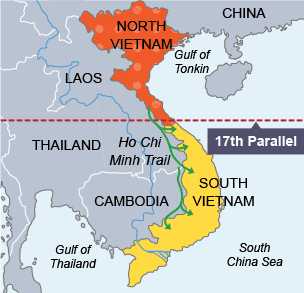
What theory caused the U.S. to enter the Vietnam War in order to stop the expansion of communism across Southeast Asia?

a)

Marshall Plan

b)

Domino Theory

c)

Open Door Policy

d)

Dollar Diplomacy

12.

What words should you immediately associate with the Cold War?

a)

Hitler & the Nazis

b)

Economic recession

c)

Containment of Communism

d)

Corruption & Industrialization

13.
What two nations were in competition with each other during the Cold War?
a)
Spain and Portugal
b)
England and France
c)
Germany and Italy
d)
United States and Soviet Union
14.

Where was Korea divided?

a)

18 parallel

b)

34 parallel

c)

38 parallel

d)

15 parallel

15.
In the 1950s, the United States became involved in the Vietnam War. Why did the United States become involved in this war?
a)
to prevent the collapse of the government of North Vietnam
b)
to stop Vietnam from taking over Hong Kong
c)
to stop the spread of communism to South Vietnam
d)
to prevent attacks against United States shipping
16.
How did the US respond to finding out that the Soviets had missiles in Cuba?
a)
They sent the Air Force to bomb Cuba
b)
They began placing missiles in the Soviet Union.
c)
They placed a naval blockade around Cuba.
d)
They invaded Cuba and the Soviet Union.
17.
This "figurative" wall divided communist countries from democratic counties--
a)
Great Wall of China
b)
Berlin Wall
c)
Iron Curtain
d)
Wall of Democracy
18.
Which of the following foreign policies gave financial aid to European nations to rebuild after WWII?
a)
Truman Doctrine
b)
Marshall Plan
c)
Warsaw Pact
d)
Domino Theory
19.
The physical barrier separating Communist East Berlin and Democratic West Berlin--
a)
Berlin Bloackade
b)
Berlin Base
c)
Berlin Wall
d)
Berlin Barrier
20.
Nations that were aligned with, but also under the influence and pressure of, the Soviet Union were called--
a)
European Nations
b)
NATO
c)
Warsaw Pact
d)
Satellite Nations
21.
What was the mutual defense alliance of non communist nations?
a)
NATO
b)
Warsaw Pact
c)
Truman Doctrine
d)
Open Skies
22.
What was the name for the 1955 alliance of Soviet-dominated countries of Eastern Europe  that were the counterpart to the western alliance?
a)
NATO
b)
Warsaw Pact
c)
European Alliance
d)
Iron Curtain
23.
Leader of communism in China
a)
Mao Zedong
b)
Hirohito Showa
c)
Xi Jinping
d)
Pu Yi
24.

Which leader promoted communism in North Vietnam?

a)

Ho Chi Minh

b)

Mao Zedong

25.

Who led the Nationalists in a civil war in China and was forced to retreat to Taiwan?

a)

Chiang Kai-shek

b)

Mao Tse-tung

26.

Mikhail Gorbachev agreed to arms reduction treaties with the United States in the 1980s because

a)

Soviet economy couldn't handle another arms race

b)

He wanted to compete against STAR WARS

c)

The Soviet Union wanted to become democratic

27.

US military spending rose after World War II when they entered which war?

a)

World War I

b)

Gulf War

c)

Vietnam War

d)

Korean War

28.

What were the defining characteristics of the Cold War?

a)

Prohibition, Flappers, Jazz

b)

Arms Race, Space Race, Red Scare

c)

Holocaust, Nazi Germany, Pearl Harbor

d)

Poverty, Unemployment, Dust Bowl

29.

What happened as a result of the launch of Sputnik in 1957?

a)

It started the space race.

b)

U.S. began to invest more money into math & science education.

c)

The U.S. started NASA.

d)

All of the above

30.

After WWII what happened to the population of the U.S?

a)

The population moved westward as a result of the railroad.

b)

African Americans moved north as part of the Great Migration.

c)

The population shifted from the Rust Belt to the Sun Belt.

d)

The population grew due to the Baby Boom.

31.

What did those in the counter-culture do when the government escalated deployment of troops in Vietnam and implemented a draft?

a)

The counter-culture organized protests.

b)

There were mass anti-war demonstrations.

c)

Some individuals burned their draft cards.

d)

All of the above

32.

What wars were fought during the Cold War as a result of containment and the Domino Theory?

a)

Korean & Vietnam War

b)

WWI & WWII

c)

Civil War & Spanish American War

d)

Persian Gulf & War on Terror

33.

What law did Congress pass to limit the military authority of the executive branch in order to avoid another Vietnam?

a)

Marshall Plan

b)

New Deal

c)

War Powers Act

d)

Gulf of Tonkin Resolution

34.

How did the media (television) impact the Vietnam War?

a)

Negative press coverage contributed to the public disillusionment with the war.

b)

The positive press coverage encouraged enlistment in the military.

c)

The impact of the media in Vietnam was rather minimal.

d)

The media showed that the majority of Americans supported the war effort.

35.

What event would be considered the start of Cold War?

a)

The Cuban Missile Crisis

b)

The Korean War

c)

The Division of Germany

d)

Soviet Detonation of Hydrogen bomb

36.
How did the Cold War experience change during the 1970's? 
a)
it ended with the fall of the Berlin wall 
b)
it reached its all time high during the Cuban Missile Crisis 
c)
it experienced Detente, or a cooling off 
d)
it expanded into Africa 
37.
The leaders who both, for different reasons, could be seen as causing the end of the Cold War would be 
a)
Kennedy and Khruschev
b)
Truman and Stalin 
c)
Nixon and Bhreshnev
d)
Reagan and Gorbechev 
38.
What international peace keeping organization formed after WWII?
a)
League of Nations
b)
United Nations
c)
NAFTA
d)
OPEC
39.
Who helped Japan to rebuild after WWII and helped them create a democratic government?
a)
USSR
b)
Great Britain
c)
France
d)
USA
40.
What country did the US help create in the Middle east-designed to be a homeland for the Jews?
a)
Saudi Arabia
b)
Israel
c)
Iraq
d)
Syria
41.
The USA is most closely associated with which of these terms?
a)
Democracy
b)
Totalitarianism 
42.
The USSR is most closely associated with which of these terms?
a)
Capitalism
b)
Communism
43.

African American Lawyer who won the Brown v. Board of Education court case and later became the first black Supreme Court Justice.

a)

Thurgood Marshall

b)

MLK

c)

Huey P. Newton

d)

Malcom X

44.

Recognized for the affect it had on women's involvement in organized sports at the college and high school levels.

a)

Title XI

b)

19th Amendment

c)

Title IX

d)

Women's suffrage

45.

There was a growth in political engagement by minorities with the passage of legislation to end-

a)

Literacy tests, voter intimidation, and gerrymandering

b)

Poll taxes, sit-ins, and freedom rides

c)

Labor unions, marches, and protests

d)

Literacy tests, integration, and desegregation

46.

Court case declared that separate black and white public schools to be unconstitutional.

a)

Plessy v. Ferguson

b)

Tinker v. Des Moines

c)

Brown v. Board of Education

d)

Dred Scott v. Sandford

47.

Companies discriminated African Americans so the federal government answered by passing the-

a)

Title IX

b)

Civil Rights Act of 1957

c)

Civil Rights Act of 1964

d)

24th Amendment

48.

President who imposed a ruling to integrate public schools

a)

Lyndon B. Johnson

b)

John F. Kennedy

c)

Harry S. Truman

d)

Dwight D. Eisenhower

49.

Court case that made legal justification for segregation

a)

Delgado v. Bastrop ISD

b)

Brown v. Board of Education

c)

Plessy v. Ferguson

d)

Tinker v. Des Moines

50.

Founder and leader of the Black Panther Party

a)

MLK

b)

Huey P. Newton

c)

Thurgood Marshall

d)

Malcom X

51.

Challenged the federal government to enforce Supreme Court rulings against discrimination in interstate transportation

a)

Freedom Rides

b)

Sit-ins

c)

Marches

d)

Boycotts

52.
Which of the following best describes the 2nd Amendment?
a)
Law-abiding citizens have right to a gun for self-defense.
b)
Individuals are entitled to guns and can do whatever they want with them.
c)
Guns are for collectibles and antiques.
d)
Citizens are entitled to guns for hunting and competitive purposes only.
53.
A group of people holding picket signs and protesting are exercising their right to:
a)
Civil Disobedience
b)
Assembly and Free Speech
c)
Sedition
d)
Freedom of Religion
54.

What organization did W.E.B. Du Bois found?

a)

The Back to Africa Movement

b)

Tuskegee Institute

c)

NAACP

d)

Access for all movement

55.
This amendment declared that all persons   born in the United States (except American Indian tribes) were citizens, that   all citizens were entitled to equal rights regardless of their race, and   their rights were protected by due process of the law (1868) (USH.9A)
a)
13th
b)
14th
c)
15th
d)
5th
56.
This amendment granted African American men the right to vote (1870) (USH.9A)
a)
13th
b)
14th
c)
15th
d)
5th
57.
This act abolished racial, religious, and sex discrimination by employers; unlawful for an employer to “fail or refuse to hire or to discharge any individual, or otherwise to discriminate against any individual with respect to his compensation, terms, conditions, or privileges or employment, because of such individual’s race, color, religion, sex, or national origin.” (signed into law by President Lyndon Johnson) (USH.9F)
a)
Civil Rights Act 1964
b)
Executive Order 1948
c)
Civil Rights Act 1957
d)
Voting Rights Act 1965
58.
 Martin Luther King Jr gave the famous “I Have A Dream” speech at what event?
a)
Freedom Rides
b)
Montgomery Bus Boycott
c)
March on Washington
d)
March from  Selma to Montgomery
59.

The Civil Rights Movement opposed Plessy v. Ferguson and its premise of?

a)

separate but equal

b)

equal rights for all races

c)

different pay for men and women

d)

voting rights for women

60.

The types of protests against segregation facilitated by Dr. Martin Luther King, Jr. was called?

a)

massive resistance

b)

organized resistance

c)

passive resistance

d)

racial resistance

61.

Disadvantages women faced in the workplace during the Civil Rights Movement included?

a)

longer work days

b)

discrimination in hiring

c)

lower wages than men

d)

separate but equal facilities

62.
This man was running for president, but was assassinated before he ever got the chance to run. 
a)
John F. Kennedy
b)
Robert F. Kennedy
c)
MLK
d)
FDR
63.
This U.S. president was president during the Cuban Missile Crisis and supported the Civil Rights Movement. He was also assassinated for his support. 
a)
John F. Kennedy
b)
Robert F. Kennedy
c)
MLK
d)
FDR
64.
Why did the United States begin to send advisers and troops to Vietnam in the 1950s?
a)
to prepare for the United States invasion of Laos
b)
to defend American bases in the Gulf of Tonkin
c)
to help the South Vietnamese revolt against the French
d)
to prevent the spread of communism into South Vietnam
65.
After Brown v. Board of Education, 9 AA students were admitted into a High School. The governor and state national guard stood in front of the doors stopping the admission. President Eisenhower sent federal troops to escort the students. Where did the event take place?
a)
Little Rock, Arkansas
b)
Montgomery, Alabama 
c)
Washington DC
d)
Del Rio, Texas 
66.
The Civil Rights Era in U.S. History is most characterized by social changes brought about by
a)
groups involved in violent riots and protests in American cities
b)
the efforts of leaders advocating non-violent civil disobedience
c)
the cooperation among the labor unions to pass new legislation
d)
a series of presidential initiatives aimed at ending racial segregation
67.
Which of the following organizations was dedicated to the practice of nonviolent protest?
a)
 KKK
b)
CORE
c)
.  the Black Panthers
d)
Nation of Islam
68.
Who assassinated Martin Luther King?
a)
James Earl Ray
b)
Malcolm X
c)
Lee Harvey Oswald
d)
The Nation of Islam
69.
What strategy did the NAACP adopt in its fight for civil rights?
a)
massive resistance
b)
attacking racism in the courts
c)
direct nonviolence
d)
sit-ins
70.
Programs that give preferences to minorities and women in hiring and admissions.
a)
affirmative action
b)
Fair Housing Act
c)
Civil Rights Act
d)
Women and Minority Act
71.
Who boosted Black nationalism first urging blacks to use armed self-defense and later changing to peaceful means?
a)
Malcolm X
b)
Martin Luther King Jr.
c)
Medgar Evers
d)
Thurgood Marshall
72.
What white supremacist terror organization used scare tactics to prevent African Americans from exercising their rights?
a)
KKK
b)
Anti-Saloon League
c)
Nation of Islam
d)
White Panthers
73.
What chairman of SNCC eventually challenged non-violence & promoted "Black Power"?
a)
Stokely Carmichael
b)
Martin Luther King, Jr.
c)
Medgar Evars
d)
Booker T. Washington
74.
What was the impact of the Civil Rights Movement?
a)
increased voter registration/turnout
b)
end of legal racial segregation
c)
increase in minorities holding office 
d)
all are correct
75.

Which of the following was a primary cause of the Cold War between the United States and the Soviet Union?

a)

direct, armed conflict between the two nations

b)

the founding of the United Nations

c)

a deep reduction in military expenditures

d)

a competition for political influence over other countries

76.

The Cold War refers to the period of tension between the United States and the Soviet Union from

a)

the end of World War II to the fall of the Soviet Union.

b)

the end of World War I to the bombing of Pearl Harbor.

c)

the Cuban Missile Crisis to the fall of the Berlin Wall.

d)

the Bolshevik Revolution to the end of World War I.

77.

Which of the following is most characteristic of the Cold War?

a)

The growth of nuclear arsenals in the United States and the Soviet Union

b)

The expansion of national borders by imperialistic European countries

c)

The implementation of isolationist foreign policies in Great Britain and China

d)

The rapid industrialization of many Southeast Asian countries

78.

The United States followed a policy of containment during the Cold War in response to the spread of communism.

How did the Marshall Plan reflect containment policy?

a)

It blocked Soviet missiles from from arriving in communist Cuba.

b)

It provided economic aid to European countries in order to prevent the spread of communism.

c)

It authorized the use of military force against communist forces in Vietnam.

d)

It stopped communist efforts to control the Korean Peninsula.

79.

Which of these was a cause of the Korean War?

a)

NATO air and naval forces blocked ships sailing to North Korea.

b)

United Nations inattention allowed guerrillas to infiltrate South Korea.

c)

North Korean forces, with Soviet approval, invaded South Korea.

d)

Widespread anti-colonial riots forced the Korean government to begin the war.

80.

During the Korean War, what prevented the southern part of the peninsula from falling permanently to the invading forces?

a)

The threat of a Soviet naval blockade

b)

The assistance of the Chinese military

c)

The use of atomic weapons on northern cities

d)

The involvement of UN forces under the command of the United States

81.
CONTROL OIL PRICES AROUND THE WORLD
a)
OPEC
b)
NATO
c)
UNITED NATIONS
d)
IRAN
82.
When they were arrested, the Watergate burglars were breaking into
a)
the republican office.
b)
the Democratic Party HQ.
c)
The Embassy.
d)
the congress headquarters.
83.
Which word means, "easing/lessening of tension?"
a)
Inflation
b)
Detente
c)
Stagflation
d)
Constipation 
84.
What is the economic term that refers to the double problems of rising inflation and unemployment?
a)
depression
b)
recession
c)
stagflation
d)
capitalism
85.
How did the “new left” make a major impact during the sixties?
a)
 Gained popular support after backing up Pres. Johnson’s foreign policy.
b)
 Many of the whites began to champion rights for minorities. 
c)
Provided a second avenue for the conservatives.
d)
Developed opportunities for the democrats to develop peace in Vietnam. 
86.
Which of the following BEST describes how most songs reflected the time period of the sixties and seventies?
a)
By showcasing the way people felt towards the Baby Boomers 
b)
Through rap and jazz music the musicians could voice their opinions
c)
Primarily were directed in protest to the Vietnam War 
d)
Songs were structured to display how people viewed trusted the government
87.
Which of the following BEST describes Title IX? 
a)
Prohibited discrimination against women in school operations.
b)
Provided women the right to vote.
c)
Established that women could be paid equally to that of their male counterpart. 
d)
Stated that women had the opportunity to run for government office. 
88.
The Cold War ended in 1991, when which country broke apart?
a)
China
b)
Kuwait
c)
Soviet Union
d)
Cuba
89.
How was the Iran Hostage Crisis resolved?
a)
the hostages were all killed
b)
the hostages were released as part of the agreement ending the Vietnam War
c)
the hostages were freed upon Reagan's inauguration
d)
the Camp David Accords led Israel to release the hostages
90.
Which of the following were significant social issues faced during the 1980s (The Reagan Era)?
a)
Alien landings in Roswell
b)
Crack cocaine
c)
Homosexual Marriage
d)
The gum disease gengivitas 
91.
What religious group formed to promote family values and support conservative politicians?
a)
Great Society
b)
New Right
c)
Moral Majority
d)
Social Gospel
92.
Who ran as the Republican candidate in the election of 1980?
a)
Reagan
b)
Carter
c)
Ford
d)
Kennedy
93.
What did Reagan do to taxes?
a)
Raise them
b)
Cut them
94.
What disease saw its first cases during Reagan's presidency?
a)
AIDS
b)
Hepatitis
c)
Cancer
d)
Herpes
95.
Selling weapons to Iran to free hostages and using the money to fund war in Central America
a)
Iran-Contra Affair
b)
Watergate Affair
c)
Reagonomics
d)
Camp David Accords
96.
What was the Strategic Defense Initiative?
a)
a series of military actions to root out communism in Central America
b)
a coalition of nations that volunteered to police the Middle East
c)
a plan to defend Eastern Europe in the event of a Soviet attack
d)
a program to use laser technology to defend America against missiles
97.

What caused the Persian Gulf War?

a)

Japanese bombed North Korea

b)

U.S. was bombed by Iraq

c)

Iraq invaded Kuwait

d)

Stock Market crashed

98.

Who was the president during this time?

a)

Ronald Reagan

b)

George H.W. Bush

c)

John F Kennedy

d)

Beto O'Rourke

99.

Who was the Iraqi leader

a)

King Mufasa

b)

Saddam Hussein

c)

Adolf Hitler

d)

Hunter Walker

100.

Which was not one of Saddam Hussein's reasons to invade Kuwait.

a)

Iraq claimed Kuwait was slant drilling stealing oil

b)

Kuwait was overproducing oil

c)

Kuwait launched missiles into Iraq

101.

What is the name of the aircraft introduced in the Persian Gulf War?

a)

Boeing 747

b)

Millennium Falcon

c)

F1-117 Nighthawk

d)

K.I.T.T.

e)

Battle Bus

102.
On September 11, 2001, this terrorist organization launched a four-prong, coordinated attack on the USA:
a)
Hamas
b)
Al Qaeda
c)
Tamil Tigers
d)
ISIS
103.
Terrorists ____________ four planes, intending to fly them into strategic US building
a)
bought
b)
hijacked
c)
built
104.
The four intended targets of the terrorist attack were chosen for their _______ representation of America's strengths (democracy and capitalism).
a)
literal
b)
symbolic
105.
Two targets were in NYC, at the time, the largest structures in North America:
a)
Empire State Building/Chrysler Building
b)
Washington Monument/Capitol Building
c)
World Trade Center 1 and 2, "Twin Towers"
106.
One plane reached its target in Washington, DC, striking the 
a)
White House
b)
Capitol
c)
Pentagon
d)
Washington Monument
107.
Who was the President of the United States on 9/11?
a)
George HW Bush
b)
George W Bush
c)
Bill Clinton
d)
Barack Obama
108.
Immediately after 9/11, the US began an unconventional war against the attackers' organization by launching airstrikes and sending ground troops to:
a)
Iraq
b)
Afghanistan
c)
Saudi Arabia
d)
Syria