wayground logo

Free Printable Worksheets

Font size

S
M
L
XL
Worksheets

U.S. History Review

Total questions: 113

Worksheet time: 1hrs 21mins

Name
Class
Date
1.

What Amendment was passed to guarantee African American men the right to vote?

a)

13th

b)

14th

c)

16th

d)

15th

2.
Which amendment abolished slavery?
a)
13th
b)
14th
c)
15th
d)
19th
3.
What group gained control of Congress after Lincoln's assassination?
a)
Southern Democrats
b)
Former Confederates
c)
Radical Republicans
d)
Communists 
4.
In which plan, rejected by Lincoln, did a majority of the southern states' white adult males have to pledge loyalty to the Union?
a)
Wade-Davis Bill
b)
10% plan
c)
Civil Rights Act
d)
Freedmen's Bureau
5.

Under Presidential Reconstruction, southern whites passed laws restricting the rights of African Americans called--

a)

Black codes

b)

Slave Laws

c)

Confederate Rights

d)

Merica Laws

6.
The white terrorist group that attacked Blacks and white republicans to restore Democratic control in the South was the--
a)
Kappa Kappa Kappa
b)
Redeemers
c)
Pure Race Fraternity 
d)
Ku Klux Klan
7.
How did the 14th amendment overrule the Dred Scott decision?
a)
It abolished slavery
b)
It said slaves could vote
c)
It protected African Americans as equal citizens
d)
It said that African Americans could move north
8.
Which of the following reversed the Supreme Court ruling in Dred Scott v. Sandford?
a)
A. The Dawes Act
b)
B. The Fourteenth Amendment
c)
C. The Compromise of 1877
d)
D. The Kansas-Nebraska Act
9.
Which Amendment states that anyone born in the United States is a citizen?
a)
14th
b)
15th
c)
16th
d)
13th
10.
Strict punishment of Confederate veterans and financial assistance to African Americans were policies pushed by which of the following group during the Reconstruction Era?
a)

Radical Democrats
b)
Moderate Republicans
c)
Radical Republicans
d)
Moderate Democrats
11.
During Reconstruction, most former Confederate states
a)
were placed under military rule for a time
b)
were readmitted into the Union, but only after promising to end slavery within 10 years
c)
given full representation in Congress without issue
d)
supported the immediate end of slavery throughout the U.S.
12.
Reconstruction was the process of
a)
rebuilding the South after the Civil War
b)
creating land zones for freedmen after the Civil War
c)
instituting Black Codes for former slaves
d)
eliminating the plantation economy in the South
13.
Northerners who migrated to the mostly destroyed post-war south to make large profits and/or help freedmen were known as
a)
Scalawags
b)
Ku Klux Klan
c)
Carpetbaggers
d)
Sharecroppers
14.
After an electoral dispute resulting in the Compromise of 1877, it was agreed that Rutherford B. Hayes would become President if
a)
he would create a new Freedmen's Bureau
b)
he ended Reconstruction and removed troops from the south
c)
he would allow African Africans full rights in the North only
d)
he created pro-cotton legislation in Congress
15.
Many southern states passed laws after the Compromise of 1877.  The laws that legalized the segregation of whites and blacks were called
a)
Jim Crow Laws
b)
Black Codes
c)
Freedman's Bureau
d)
Reconstruction
16.
What best describes Lincoln's 10 Percent Plan?
a)
Creating an income tax
b)
Creating a larger military
c)
Re-uniting the United States
d)
Conquering 10% of the South
17.
Which plan required a 50% oath of loyalty, creation of the Freedman's Bureau, and punishment of the South
a)
Johnson
b)
Lincoln
c)
Radical Republicans
d)
Democrats
18.
Why was Lincon's 10 Percent Plan not put in to effect?
a)
The war wasn't finished yet
b)
He became Secretary of State
c)
He was assassinated
d)
He lost the war
19.
Who did the Radical Republicans attempt to impeach?
a)
Lincoln
b)
Johnson
c)
Grant
d)
Hayes
20.

"Separate but Equal "was the decision for which supreme court case?

a)

Plessy v Jim Crow

b)

Homer v Jim Crow

c)

Plessy v Ferguson

d)

Brown V Board of of Education

21.

The attempt to remove the vote is called?

a)

voter fraud

b)

disfranchisement

c)

suffrage

d)

none of the above

22.
Which amendment to the U.S. Constitution gave women the right to vote?
a)
Fifteenth Amendment 
b)
Twentieth Amendment 
c)
Eighteenth Amendment
d)
Nineteenth Amendment
23.
What countries were allies (on the same side) in World War I?
a)
Great Britain, France, United States, Russia
b)
Germany, Russia, Austria-Hungary
c)
United States, France, Austria-Hungary, Great Britain
d)
Germany, Japan, Russia
24.

Black educator who created the Tuskegee Institute. He wanted blacks to learn a skill and become more self-sufficient, which would lead to equality

a)

Booker T. Washington

b)

Alexander Stephens

c)

W.E.B. DuBois

d)

Henry Grady

25.

The Supreme Court decision of Plessy v. Ferguson justified which action?

a)

indentured servitude

b)

racial segregation

c)

immigration quotas

d)

grandfather clauses

26.
Which of the following was NOT a problem with sharecropping?
a)
The endless cycle of debt
b)
former slaves were tied to the land
c)
It was a lot like slavery
d)
Freedmen made a lot of $$
27.

Small southern farmers who supported the Republicans to benefit politically and economically were called ___________.

a)

Scalawags

b)

Carpetbaggers

c)

Freedmen

d)

Tenant Farmers

28.
What political party was made up of Freedmen, Scalawags, and Carpetbaggers?
a)
Republican
b)
Democrat
c)
Democratic-Republicans
d)
Socialist
29.
What was the purpose of the grandfather clause?
a)
To allow anyone to vote that had a grandfather born in Georgia.
b)
To allow grandfathers to vote without paying a poll tax.
c)
To allow a veteran or descendant of a veteran to vote.
d)
To allow anyone to vote if a father or grandfather had voted before 1867.
30.
The movement to help women get their voting rights was called
a)
Women's suffrage
b)
The Womens' Unity Parade
c)
The Million Women March
d)
The Women's Pact
31.
This disfranchisement law made it hard for poor whites and African Americans to vote.
a)
Poll Tax
b)
Grandfather Clause
c)
Land Lottery
d)
White Primary
32.
-Wanted African Americans to get a college education
-Demanded equality for all groups of people
a)
Booker T. Washington
b)
W.E.B. Dubois
c)
Alonzo Herndon
d)
John Hope
33.
His farewell address warned against foreign alliances. 
a)
John Jay
b)
George Washington
c)
John Witherspoon
d)
John Locke
34.
What impact did poll taxes & literacy tests have?
a)
prevented blacks from voting
b)
segregated public schools
c)
helped blacks get elected to public office
d)
ended Reconstruction
35.

What term describes how the South has voted nationally since Reconstruction?

a)

Confederacy

b)

Solid South

c)

Republican South

d)

Dixie Democrat

36.
Established in 1865 to provide assistance to former slaves and poor whites.
a)
Black Codes
b)
Freedmen's Bureau
c)
Jim Crow Laws
d)
Tenure of Office Act
37.
The law which stripped Native Americans of their land and forced assimilation 
a)
Chinese Exclusion Act
b)
Dawes Act
c)
Black Codes
d)
Jim Crow Laws
38.
How did supporters of the Dawes Act of 1887 expect it to affect Native Americans?
a)
by relocating Native American tribes further west
b)
by assimilating Native Americans to white culture
c)
by strengthening tribal identities among Native Americans
d)
by recognizing equal rights of citizenship for Native Americans
39.
How did the construction of the Transcontinental Railroad affect the demographics of the United States during Reconstruction?
a)
It increased the need for laborers in urban areas. 
b)
It limited the need for foreign immigrants.
c)
It encouraged westward expansion. 
d)
It altered the economy in southern rural areas. 
40.
The Homestead Act (1862) attempted to promote development of western lands by doing what?
a)
creating a system of dams for crop irrigation
b)
providing free land to settlers
c)
removing all restrictions on immigration
d)
placing Native American Indians on reservations
41.

The book A Century of Dishonor by Helen Hunt Jackson attempted to inform the public about problems of

a)

African Americans

b)

Native Americans

c)

Mexican Americans

d)

Asian Americans

42.
Which animals did Plains Indians depend on for survival?
a)
cattle and horses
b)
cattle and sheep
c)
horses and rabbits
d)
horses and buffalo
43.
1.  About 50,000 African Americans who went west to make a new life after the Civil War were known as 
a)
 Buffalo Soldiers
b)
Exodusters 
c)
Carpetbaggers 
d)
Tuskegee 
44.
How did railroads impact Native Americans?
a)
They helped them thrive
b)
They made them wealthy
c)
They altered their way of life and took their land
d)
They had minimal effect on them
45.
__________________ refers to the belief that Native Americans should give up their way of life to become part of “white” culture.
a)
Reconstruction
b)
assimilation
c)
populism
d)
cultural separation
46.

Why was the buffalo important to Native Americans?

a)

Native Americans disliked cattle.

b)

They used buffalo for food, clothing, tools and shelter.

c)

Buffalo fought off the settlers for the Native Americans.

d)

Native Americans worshiped buffalo.

47.

Caused by the Indian Removal Act

a)

King Phillip's War

b)

Wounded Knee

c)

French and Indian War

d)

Trail of Tears

48.
Which present-day state were most of the Native Americans relocated to during the 1830s?
a)
Georgia
b)
North Carolina
c)
Oklahoma
d)
Mississippi
49.
Idea that the United States would expand from the East Coast to the West Coast and was supported by God in doing so was called 
a)
Inevitable Discovery 
b)
America First 
c)
Manifest Destiny
d)
Homeland Security 
50.
What were the effects of the Transcontinental railroad?
a)
Increased settlement and business in the west
b)
Helped the railroad industry turn into a powerful industry
c)
Increased business activity and east-west trade
d)
All of these answers
51.
What is the name given to the belief that the United States had the right and duty to expand across the North American continent?
a)
Manifest destiny 
b)
Monroe Doctrine 
c)
Great Awakening 
d)
Louisiana Purchase
52.
What attracted White settlers to the Western U.S.?
a)
land
b)
opportunity
c)
natural resources
d)
all of the above
53.

Which is the generally accepted year for the closing of the frontier?

a)

1] 1865

b)

2] 1877

c)

3] 1900

d)

4] 1890

54.
The movement of people from one place to another is called 
a)
Migration
b)
Immigration
c)
Emigration
d)
Movement
55.
The process of people leaving the farms or rural areas for more populated cities is called....
a)
Suffrage
b)
Urbanization
c)
Rural
d)
Boom Bust
56.
The 18th amendment did which of the following?
a)
Banned the sale of all alcohol
b)
Guaranteed the right to vote for black men 
c)
Allowed the sale of alcohol
d)
Gave women the right to vote
57.

The Progressives wanted to reform (improve).....

a)

government

b)

living conditions

c)

food industry

d)

All of the above

58.

Upton Sinclair wrote what famous book about the food industry?

a)

Rumble in the Jungle

b)

The Jungle Book

c)

The Jungle

d)

Jungle to Jungle

59.

As a result of The Jungle, Teddy Roosevelt signed the....

a)

New York Tenement Act

b)

17th Amendment

c)

Pure Food & Drug Act and Meat Inspection Act

d)

Declaration of Independence

60.

Which of the following was a muckraker?

a)

Jacob Riis

b)

John D. Rockefeller

c)

Andrew Carnegie

d)

J.P. Morgan

61.

To expose the poor living conditions in New York City slums, Jacob Riis published.....

a)

The Jungle

b)

Meat Inspection Act

c)

The Pure Food & Drug Act

d)

How the Other Half Lives

62.

The recall enables voters to....

a)

take your car back to the dealer to get fixed

b)

referendum the initiative into a bill

c)

use the Force

d)

remove public officials from public positions

63.

The attempt to prohibit the sale of alcoholic beverages in the United States during the 1920's showed that

a)

amending the Constitution is easily and frequently done

b)

government can control the thinking and behavior of its citizens

c)

most people will obey state laws, but not federal laws

d)

laws that go against public attitudes and the values of many people are difficult to enforce

64.

Book written by Upton Sinclar

a)

The Jungle

b)

The Octopus

c)

History of Standard Oil

d)

How the Other Half Lives

65.

Subject of The Jungle

a)

Problems such as poverty faced by people in the cities

b)

Abuses of the railroad company on farmers

c)

Horrible practices in Chicago Meat packing plants, such as rats on meat

d)

Political corruption in major cities

66.

Book written by Lincoln Steffans

a)

The Jungle

b)

How the Other Half Lives

c)

Shame of the Cities

d)

History of Standard Oil

67.

Subject of Shame of the Cities

a)

Political corruption in big cities

b)

Haphazard practices in Chicago meat packing plants

c)

Abuses of the railroad company on farmers

d)

Problems faced by people living in the cities such as poverty

68.

Book written by Jacob Riis

a)

How the Other Half Lives

b)

The Jungle

c)

History of Standard Oil

d)

McClure's Magazine

69.

Subject of How the Other Half Lives

a)

Problems faced by those living in the inner city, such as poverty and poor living conditions

b)

Haphazard practiced in Chicago meat packing plants, such as rats running along the meat

c)

Political corruption in big cities where politicians were more concerned with profit and politics

d)

Abuses on farmers committed by the railroad company

70.

Book written by Ida Tarbell

a)

History of the Standard Oil Company

b)

How the Other Half Lives

c)

The Octopus

d)

The Jungle

71.

Subject of History of the Standard Oil Company

a)

Haphazard working conditions in a Chicago meat packing plant such as rodents running around the factory

b)

Poor treatment of farmers by the railroad company which stole their land to expand

c)

Documented John D. Rockefeller's rise to power, focusing on his lack of ethics which harmed his workers

d)

Poor living conditions faced by those living in urban areas

72.

Legislation enacted as a result of the "The Jungle"

a)

Pure Food & Drug Act

b)

Tenement Housing Act

c)

17th Amendment

d)

21st Amendment

73.

Imperialism is...

a)

when a powerful nation uses its resources to help a weaker nation

b)

when a weaker nation invites a powerful nation to help it industrialize

c)

when a powerful nation takes control of the economy and government of a weaker nation

d)

when weak nations join together to fight a strong nation

74.

What was the ship that sunk in Havana Harbor that was a cause of the Spanish American War?

a)

The Mayan

b)

The Maine

c)

The Massachusetts

d)

The Maryland

75.

Which of the following caused President Wilson to declare war on Germany?

a)

the assassination of Archduke Ferdinand of the Austro-Hungarian empire

b)

unrestricted submarine warfare and the Zimmerman telegram

c)

the selling of weapons to Great Britain by the United States

d)

disputes over German colonial claims to Samoa and the Marshall Islands

76.

What was the impact of new technologies during World War 1, such as the use of machine guns, poison gas and barbed wire?

a)

Casualties were low because soldiers were protected.

b)

Soldiers were able to advance rapidly on one another.

c)

Field commanders believed it was important to attack first.

d)

Soldiers lived in trenches when they could not advance without heavy casualties.

77.

The explosion of the USS Maine

a)

proved that McKinley was a weak president

b)

rallied Americans against Spain

c)

caused American prejudice about Spanish immigrants

d)

formed a bond between America and Cuba

78.

Militarism means....

a)

Building up armed forces and getting ready for war

b)

Having pride in your nation

c)

Trying to build an empire

d)

Agreements to help others

79.
10)  At the beginning of WWI, the U.S. was neutral, which means
a)
We did not choose sides.
b)
We helped Europe.
c)
We gave both sides money.
d)
Both B and C
80.
14)  The Treaty of Versailles required ____________ to admit that they had started the war and to pay back the Allies the amount of 32 billion dollars.
a)
Russia
b)
The U.S.
c)
Germany
d)
Georgia
81.
sensationalized events in Cuba by American newspapers eager for war with Spain .
a)
Propaganda
b)
Dollar Diplomacy
c)
Spanish American War
d)
Yellow Journalism
82.
argued that to achieve world power a country needed a powerful Navy
a)
Sanford Dole
b)
Theodore Roosevelt
c)
Alfred T. Mahan
83.
asserted the United States’ right to intervene in Cuban affairs at any time
a)
Platt Amendment
b)
Roosevelt Corollary
c)
Big Stick Diplomacy
d)
Open Door Policy
84.
gave equal trading rights to all countries in China
a)
Big Stick Diplomacy
b)
Open Door Policy
c)
Roosevelt Corollary
d)
Imperialism
85.
addition to the  Monroe Doctrine stating the US would intervene in the affairs of Caribbean nations as a police presence if necessary
a)
Open Door Policy
b)
DeLome Letter
c)
Imperialism
d)
Roosevelt Corollary
86.
the policy or practice of extending a nation's rule over other less powerful territories
a)
Imperialism
b)
Propaganda
c)
Protectorate
d)
Monroe Doctrine
87.
Which of the following was a major cause of the Great Depression?
a)
overproduction and underconsumption
b)
a decrease in the supply of consumer goods
c)
an increase in demand for imported products
d)
an increase in the price of wheat on the world market
88.
Who was the President of the United States when the Stock Market crashed?
a)
Franklin D. Roosevelt
b)
Herbert Hoover
c)
Woodrow Wilson
d)
Theodore Roosevelt
89.
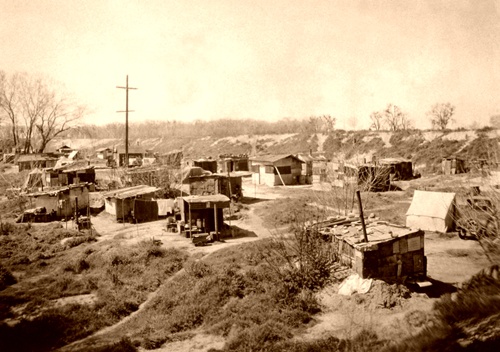
What was the main reason for the emergence of “Hoovervilles” like the one shown in the photograph?
a)
Many Americans had lost jobs during the Great Depression.
b)
Thousands of homes had been destroyed by the effects of the Dust Bowl.
c)
Housing projects could not keep up with the demand for homes needed by the poor.
d)
Preparations for World War I had created a shortage of building materials.
90.
During the early 1930s, the main goal of the Bonus Army was to pressure the Hoover administration to
a)
strengthen the nation’s defenses
b)
end the military draft
c)
bring American troops home from overseas
d)
support the early payment of money promised to veterans
91.
What was a guiding principle of the New Deal economic policies?
a)
Pro-business tax breaks would solve the problems associated with urban poverty.
b)
Antitrust legislation would destroy the free market economy of the United States.
c)
Rugged individualism must be allowed to solve social inequality.
d)
Government must assume more responsibility for helping the poor.
92.
This was a major innovation found in most homes by the end of the 20s.
a)
Radio
b)
Television
c)
Telephone
d)
Microwave.
93.
Henry Ford is credited with mastering 
a)
Modern day filming.
b)
Use of the Assembly Line.
c)
Flying aeroplanes.
d)
Radio Broadcasting.
94.
When WWI started, what was the wealth gap between the rich and poor like in the United States?
a)
It was very small gap between the rich and the poor.
b)
Wealth in American society was basically equal among all citizens.
c)
There was a large gap between the rich and the poor.
d)
None of the above.
95.
The Scopes Monkey Trial of 1925 had to do with teaching of Fundamentalism and ______.
a)
school
b)
Evolution
c)
life
d)
religion
96.
The Red Scare led to which of the following?
a)
The ratification of the 19th amendment
b)
a demand for limits on immigration
c)
the start of the Great Depression
d)
the repeal of the 18th amendment 
97.
Nativists are against _______?
a)
Corruption
b)
African Americans
c)
Railroads
d)
Immigrants
98.
What were illegal places where people drank alcohol called?
a)
speakeasies
b)
speaksoftly
c)
cellars 
d)
hidden spots
99.
Which decade saw the rise of the automobile, the red scare, and Scopes Trial?
a)
1910s
b)
1920s
c)
1930s
d)
1940s
100.
Which decade saw bank failures, the Dust Bowl, and the New Deal?
a)
1910s
b)
1920s
c)
1930s
d)
1940s
101.
Which trial saw the conflict between Modernism and Traditionalism?
a)
Sacco and Vanzetti 
b)
Scopes Trial
c)
Schenck vUnited States
d)
Korematsu v. United States
102.
Which movement made Jazz popular?
a)
Return to Normalcy
b)
Harlem Renaissance
c)
Nativism
d)
Great Migration
103.
What program wanted high tariffs for imports and isolationism? 
a)
New Freedom
b)
Square Deal
c)
New Deal
d)
Return to Normalcy
104.
Why did African Americans move North during the Great Migration?
a)
Homestead Act
b)
Jobs in factories
c)
Nativism in the South
d)
Lower cost of living in cities
105.
Which New Deal program targeted the problem faced by bank failures?
a)
AAA
b)
FDIC
c)
Social Security
d)
SEC
106.
Which scandal saw the President attempt to take over the Judical Branch? 
a)
Zimmerman Note
b)
Tweed Ring
c)
Teapot Dome
d)
Court Packing Scheme
107.
Which New Deal agency prevents fraud in the Stock Market?
a)
FDIC
b)
SEC
c)
CCC
d)
Social Security
108.
A nationalist from this country assassinated Archduke Franz Ferdinand.
a)
Russia
b)
Germany
c)
Serbia
d)
France
109.
Which was not a cause of WW1?
a)
nationalism
b)
imperialism
c)
militarism
d)
isolationism 
110.
Who declared war on Serbia to start WWI?
a)
France
b)
U.S
c)
Great Britain 
d)
Austria- Hungary 
111.
Having pride in your country is known as
a)
militarism
b)
nationalism
c)
imperalism
d)
alliances
112.
Formal friendship between nations are called:
a)
treaties
b)
alliances
c)
clubs
d)
democracies
113.
The "spark" that was an immediate cause of World War I was
a)
The sinking of the Lusitania
b)
The assassination of Archduke Franz Ferdinand
c)
Increased nationalism
d)
The Zimmerman Telegram