
 Worksheets
PHYS S2 Exam Review
Total questions: 76
Worksheet time: 58mins
What is a "force"?
A push or pull
An energy field
Mass in motion
The tendency of objects to keep doing whatever they are doing
Forces are ___ which means they have ____.
Vectors; magnitude and direction
Vectors; direction only
Scalars; magnitude and direction
Scalars; magnitude only
What are the units of force?
Newtons (N)
Joules (J)
Watts (W)
Kilograms (kg)
Which of these are NOT contact forces? Select all the apply.
Electrical force (Fe)
Gravitational force (Fg)
Air resistance (Fair)
Friction (Ff)
Tension (Ftens)
The tendency of an object to resist changes in motion is called this.
Inertia
Momentum
Velocity
Vector
What determines how much inertia something has?
The mass of the object
How fast the object is moving (velocity)
A combination of mass and velocity
Gravity
Which has more inertia: a motorcycle traveling at 25 m/s or a parked 18-wheeler truck?
The motorcycle
The 18-wheeler
They have the same inertia
Cannot be determined
What is the relationship between mass and weight?
Weight is mass pulled down by gravity
Mass is weight pulled down by gravity
Mass and weight are the same thing
Mass is a metric unit; weight is an American unit
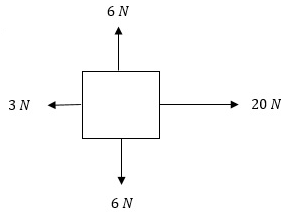
What is the NET FORCE of this diagram?
17 N, right
17 N, left
23 N, right
12 N, up
If the net force is equal to zero, the forces acting on the object are
balanced
unbalanced
You’re riding in the car with your friend. He slams on the brakes and you fly forward. Which one of Newton’s laws explains why this happens?
Newton's 1st Law
Newton's 2nd Law
Newton's 3rd Law
Newton's Law of Universal Gravitation
Thankfully you are wearing a seatbelt which keeps you from flying into the windshield. Your 100 kg body accelerates to a stop at a rate of -5 m/s2. What force was need to stop you?
-500 N
-500 J
-5000 N
-20 N
How does the force your body exerts on the seatbelt compare to the force the seatbelt exerts back on you?
The force on the seatbelt is greater
The force on you is greater
You and the seatbelt experience the same force
Cannot be determined without knowing the angle of the seatbelt
If your body pushing against the seatbelt is the action force, what is the reaction?
You push down on the car seat
The seatbelt pulls on the car seat
The car pushes you forward
The seatbelt pushed back on you
A 5.0 kg bat strikes a 0.25 kg baseball. Which experiences greater acceleration: the bat or baseball?
The bat
The baseball
The acceleration is the same
Cannot be determined without knowing the force
A hockey puck slides across a frozen pond. The puck’s mass is 0.15 kg. What is the puck’s weight?
0.15 N
0.15 kg
1.5 N
0.015 N
What would be the mass of a 0.15 kg hockey puck on the moon where gravity is 1.6 m/s2?
0.15 kg
1.5 N
0.24 N
2.4 N
The 0.15 kg hockey puck slides across a frozen pond where the coefficient of friction (𝜇) is 0.2. What is the force of friction?
0.3 N
0.03 𝜇
0.75 N
1.3 N
You push a heavy desk across the room. Did it take more force to start moving it or to keep it moving?
To start it moving
To keep it moving
The force is always the same
It is impossible to know without knowing the mass of the desk
What is momentum?
Mass in motion
Momentum is the same as mass
Momentum is the same a velocity
Momentum is mass with direction
Which has the most momentum?
A 0.25 kg mouse running across the room
A 950 kg car parked in a driveway
A 1,250 kg sleeping elephant
A 15,000 kg train sitting in the station
Two identical baseballs are hit at the same time. One flies off at 5.0 m/s and the other at 3.5 m/s. Which has more momentum?
The one hit at 5.0 m/s
The one hit at 3.5 m/s
Cannot be determined
They are the same size so they have the same momentum
What is the momentum of a 0.4 kg baseball thrown at 10 m/s?
4 kg*m/s
10.5 kg*m/s
.04 kg*m/s
9.6 kg*m/s
How can a golf ball and bowling ball have the same momentum?
They have different velocities
They have the same velocity
They can't
They are moving at the same speed, but in different directions
Momentum is always conserved which means that momentum after a collision is always ________ momentum before a collision
Equal to
Greater than
Less than
Inversely proportional to
A 1,000 kg truck traveling at 20 m/s collides with a stationary 1,000 kg car and they move off together. What type of collision is this?
Elastic
Inelastic
Imperfect
Frictional
A 500 kg truck traveling at 10 m/s collides with a stationary 500 kg car and they stick together. What is their velocity after the crash?
10 m/s
5 m/s
20 m/s
5 m/s2
A 5.0 kg bowling ball rolling at +3.0 m/s collides with a 7.0 kg bowling ball rolling at -2.0 m/s. They bounce and move off separately. What type of collision is this?
Elastic
Inelastic
Imperfect
Unbalanced
____________ is the ability to do work (i.e. to move objects).
Energy
Force
Friction
Motion
What has the greatest influence on how much kinetic energy an object has?
Mass
Velocity
Gravity
Height
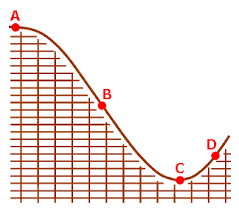

A car traveling at a constant speed (25 mph) makes a left hand turn without speeding up or slowing down. Did the car accelerate?
Yes, because it changed directions
Yes, because an equal and opposite force pulls it to the left
No, because its speed didn't change
No, because the forces are balanced
An object makes 5 complete revolutions in 20 seconds. What is the period?
4 s
4 Hz
0.25 s
0.25 Hz

A curved groove is place on the top of a level table as shown in the diagram. A ball is pushed in the groove at P so that it leaves at Q. Which picture shows how the ball will move when it leaves the groove at Q?


Centripetal force, created by swinging something in a circle, acts in a direction--
along the path of motion
away from the center of the circle
toward the center of the circle
tangent to the circle
Two children are riding a merry-go-round. One is 2.0 m from the axis of rotation; the other is 3.0 m away. Which child is moving slower?
The child who is 2 m away
The child who is 3 m away
They are on the same ride so they must have the same speed
Cannot be determined without knowing their masses
Which is greater: the gravitational force the Earth exerts on the moon or the gravitational force the moon exerts back on the Earth?
The Earth pulls more on the Moon
The Moon pulls more on the Earth
The force between them is equal
They aren't touching so there is no force between them
The relationship between mass (how big something is) and gravitational force (how much it pulls on objects around it) is
Direct
Inverse
Indirect
Proportional square
If the distance between two objects is doubled, what happens to the gravitational force they exert on each other?
It is reduced by 4
It is reduced by 2
It is doubled
It is quadrupled
What determines how strong the gravitational force between two objects is? Select all that apply
The mass of the objects
How close together the objects are
How quickly the objects are moving
How quickly the objects are accelerating
Who first proposed the idea that gravity is universal?
Isaac Newton
Albert Einstein
Jim Gates
Stephen Hawking
Two bowling balls sit 2.0m apart from each other. One is 10.0 kg; the other is 12.0 kg. Which would increase the gravitational force between them the most?
Move them closer together
Move them farther away
Double the mass of the 10 kg ball
Double the mass of the 12 kg ball
What subatomic particles have a charge? Select all that apply.
Electrons
Protons
Neutrons
Positrons
What is ALWAYS true of electrically neutral objects?
Protons = electrons
Protons = neutrons
Neutrons = electrons
Protons = electrons = neutrons
What happens when a neutral object loses electrons?
It becomes positively charged
It becomes negatively charged
It also loses protons so it can stay neutral
It becomes polarized
What must happen for a positively charged object to become negatively charged?
It must gain electrons
It must lose electrons
It must gain protons
It must lose protons
Charge (q) is measured in
Coulombs
Volts
Amps
Watts
You pull a wool sweater over your head. In the process it becomes negatively charged. What must be true of your hair?
It is positively charged
It is negatively charged
It is still neutral
It is charged, but we cannot know if it is positive or negative
Two balloons pull inward towards one another. What MUST be true?
At least one is charged
They both have the same charge (+/+ OR -/-)
They are oppositely charged (+/-)
One must be polarized

Which object shows correct polarization?
Object B
Object C
Object D
Object E

An aluminum pie plate is dried with a cotton towel. What statement is true?
The pie pan becomes negatively charged; the towel becomes positive
The pie pan becomes positively charged; the towel stays neutral
The towel becomes negatively charged; the pan stays neutral
The towel becomes negatively charged; the pan becomes positive
A force of 5.0 N exists between two charged objects. If the charge of one of the objects is doubled, what will the force between them be?
10 N
2.5 N
7.5 N
20 N
A force of 9.0 N exists between two charged objects. If the distance between the objects is tripled, what will the force between them be?
27 N
1 N
3 N
81 N
What are the two requirements of a circuit? Select TWO!
A close conducting path
Power source
An insulated path
A light bulb
The flow of protons

How are the resistors connected?
In parallel
In series
Middle two are in parallel, right most is in series
What is the resistance if the current is 2A and the voltage is 10V?
8 Ω
20 Ω
12 Ω
5 Ω


