wayground logo

Free Printable Worksheets

NEW

Font size

S
M
L
XL
Worksheets

Weathering & Erosion

Total questions: 55

Worksheet time: 36mins

Name
Class
Date
1.
Which diagram represents mechanical weathering?
a)
G
b)
F
c)
H
d)
J
2.
When Joe saw the Rocky Mountains for the first time, he exclaimed, "These mountains are much younger than ours back East!" Which feature supports his conclusion that the Rockies were relatively young mountains?
a)
Their sedimentary layers are still exposed
b)
They have rounded tops
c)
They have sharp peaks
d)
Weathering has not yet hardened the rock
3.
Which of the following is the most important agent of chemical weathering to form this cave?
a)
Water - It can carry acid and dissolve rock
b)
Erosion - Moves the rocks from one place to another
c)
Wind - It displaces rocks
d)
Exfoliation - New cracks give chemical reactions the chance to operate
4.
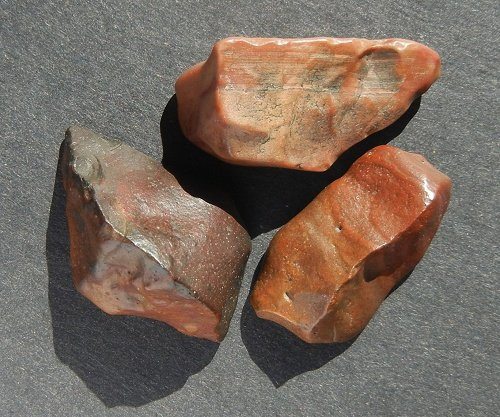
These rocks were made smooth by wind blowing smaller rock particles across their surface.  This is an example of:
a)
ice wedging
b)
chemical weathering
c)
acid rain
d)
abrasion
5.
These rocks were broken apart from the continuous freeze/thaw of water in the cracks of the rocks. This is an example of:
a)
ice wedging
b)
acid rain
c)
permeability
d)
abrasion
6.
A cliff formed near the ocean.  Which statement best describes how this cliff formed?
a)
Warm air melted the rock.
b)
Sun rays evaporated the rock.
c)
Ocean waves washed away rock.
d)
Plant roots pushed away the rock.
7.
Weathering causes rocks and minerals to break into smaller pieces.  Which event is the best example of weathering?
a)
a raindrop splashing in a lake
b)
a snowball rolling down a mountain
c)
a tree root growing into the crack of a rock
8.

By what amount did the surface area of the rock increase as the number of pieces of rock increased from 5 to 20?

a)

100 cm2

b)

200 cm2

c)

300 cm2

d)

400 cm2

9.

The dropping off of sediments in a new place is called __________.

a)

weathering

b)

deposition

c)

sedimentary rock

d)

drop off zone

10.

Which of the following is NOT a cause of weathering, erosion, and deposition?

a)

Wind

b)

ice

c)

fire

d)

water

11.

What is sediment?

a)

bits of rock, sand, and silt caused by the weathering of rocks

b)

decaying plant or animal material

c)

the process of rocks being broken down and carried away

d)

the top layer of the soil

12.

A landform made of sediment that is deposited where a river flows into an ocean or lake is called a...

a)

sea cave

b)

mountain

c)

delta

13.
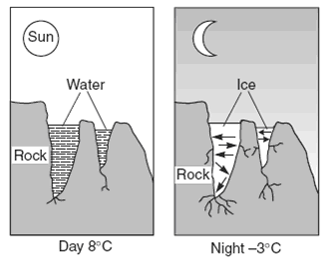
The diagrams  shows a natural process that weathers rock.
 Which statement best explains why this process results in weathering?
a)
frozen water acts as a solute
b)
water expands when it freezes
c)
the mass of water increases when it freezes
d)
frozen water dissolves most types of rock
14.
The ___________of a mountain weathers the fastest
a)
bottom
b)
middle
c)
top
d)
all parts weather the same
15.
Which agents  break down earth materials?
a)
wind only
b)
earthquakes and gravity
c)
ice and 007
d)
wind, water, and ice
16.
What is an enormous mass of ice moving over land?
a)
Ice wedging
b)
Glacier
c)
Iceberg
d)
Dune
17.
fossil fuels react with water producing acid rain that wears minerals away in the rock
a)
chemical weathering
b)
mechanical weathering
c)
erosion
d)
deposition
18.

Which of the following features would be most affected by weathering?

a)

A

b)

B

c)

C

d)

D

19.

What do floodplains, sandbars, and river deltas have in common?

a)

They've all been formed by water erosion

b)

They've all been formed by glacial erosion

c)

They've all been formed by wind erosion

d)

They've all been formed by sandblasting

20.
the process by which layers or sheets of rock gradually break off
a)
exfoliation
b)
abrasion
c)
erosion
d)
deposition
21.

What type of glacier forms in a mountainous area?

a)

Alpine

b)

continental

c)

till

d)

moraine

22.

What type of glacier covers huge areas of land?

a)

alpine

b)

continental

c)

till

d)

moraine

23.

unsorted rock material deposited directly by ice as it melts

a)

glacial drift

b)

stratified drift

c)

till

d)

glacier

24.
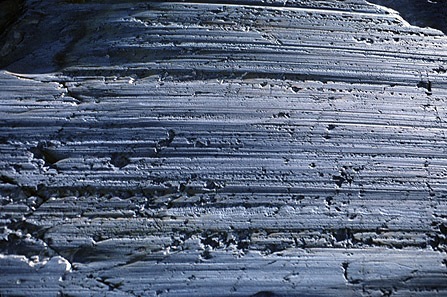
_____ are parallel scratch marks on bedrock
a)
Plucking
b)
Abrasion
c)
Straitions
d)
Till
25.
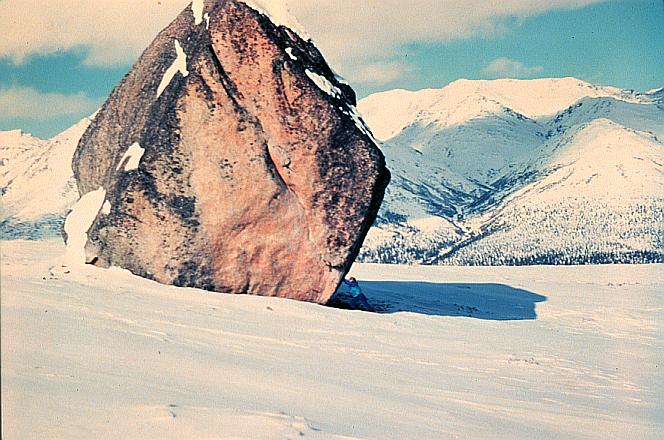
_____ are enormous boulders transported and deposited by glaciers, often far from their source region.
a)
Till
b)
Erratics
c)
Moraines
d)
Fjords
26.

Melting glaciers means...

a)

more rain

b)

accelerating sea level rise

c)

more sun

d)

trouble for elephants

27.
An alpine/valley glacier generally forms in mountainous areas
a)
true
b)
false
28.
What is a bowl-shaped depression formed by glacial erosion?
a)
cirque
b)
arrete
c)
ice pack
d)
kettle
29.
Glaciers often form V shaped valleys
a)
true
b)
false
30.
glacial erosion causes ______ as it moves across the land?
a)
plucking and striations
b)
beaches and sand bars
c)
sea caves and headlands
d)
sand dunes and losses
31.
What does Abrasion do?
a)
Breaks rocks
b)
Carries sand which polishes rocks.
c)
Buy you new shoes
d)
Abrasion burrows through rocks in the soil.
32.
What can form from Wind erosion and Deposition?
a)
Sand Dunes and Loess deposits
b)
Luster and Streak
c)
Gravity and sediment
d)
Plateau and Faults
33.
What do Loess deposits help form?
a)
Thin soil
b)
Chunky soil
c)
Fertile soil
d)
Bouncy soil
34.

the process of wearing down by friction - like sand blasting

a)

exfoliation

b)

abrasion

c)

erosion

d)

deposition

35.
Which is NOT a type of mass movement?
a)
landslide
b)
slump
c)
mudflow
d)
windstorm
36.
The force that moves objects downhill is ...
a)
mass movement
b)
gravity
c)
slump
d)
deposition
37.
Watery clay slides down a mountain. This is an example of a ...
a)
creep
b)
landslide
c)
slump
d)
mudslide
38.
Which of these is NOT an agent of erosion?
a)
water
b)
gravity
c)
waves
d)
sediment
39.
After many years, a gravestone on a hillside falls over. This is an example of ...
a)
creep
b)
landslide
c)
slump
d)
mudslide
40.
Several processes caused by gravity that moves sediment downhill is called ...
a)
landslide
b)
deposition
c)
mass movement
d)
erosion
41.
The process by which rock and soil are moved from place to place is called ...
a)
weathering
b)
erosion
42.
Which type of mass movement happens very slowly?
a)
slump
b)
creep
c)
landslide
d)
mudslide
43.
Rock and soil suddenly slip downhill in one large mass. This is an example of ...
a)
slump
b)
creep
c)
landslide
d)
mudslide
44.
What part of the wave is shown at letter A?
a)
crest
b)
trough
c)
wavelength
d)
frequency
45.
Which part of the wave is shown at letter B?
a)
crest
b)
trough
c)
wavelength resting point
46.
Which part of the wave is shown at letter C?
a)
crest
b)
wavelength
c)
resting point
d)
amplitude
47.
Which part of the wave is shown at letter E?
a)
trough
b)
crest
c)
resting point
d)
amplitude
48.
Which wave has a longer wavelength?
a)
wave C
b)
wave D
49.
Which of these coastal landforms are created by deposition?
a)
Cave
b)
Stack
c)
Beach
d)
Wave cut platform
50.
Which of these coastal landforms is created by erosion?
a)
Cave
b)
Tombolo
c)
Beach
d)
Spit
51.
What type of Landform do you think London Bridge in Port Campbell would be?
a)
Stack
b)
Tombolo
c)
Arch
d)
Headland
52.

What are the 2 basic ingredients needs to make sand?

a)

Rock & Wave Energy

b)

Rock & Water

c)

Wave Energy and Water

d)

Water & Rock

53.

a deposit of sand parallel to the shore is called _____________________.

a)

Sandbar

b)

Barrier Spit

c)

Offshore beach

d)

delta

54.
A severe storm would be most likely to damage a coastal area by causing 
a)
erosion
b)
earthquakes
c)
pollution
d)
volcanoes
55.
How can a flood be a constructive process? 
a)
It can pollute water supplies, making the water dangerous to drink.
b)
It can deposit rich, fertile soil as the water moves away.
c)
It can destroy plants, trees, and animal habits.
d)
It can knock down houses, buildings, and power lines.