
 Worksheets
Population Ecology
Total questions: 20
Worksheet time: 16mins

What type of factor has an increasing impact as the population size increases?
density-independent
density-dependent
cohort effect
survivorship factor
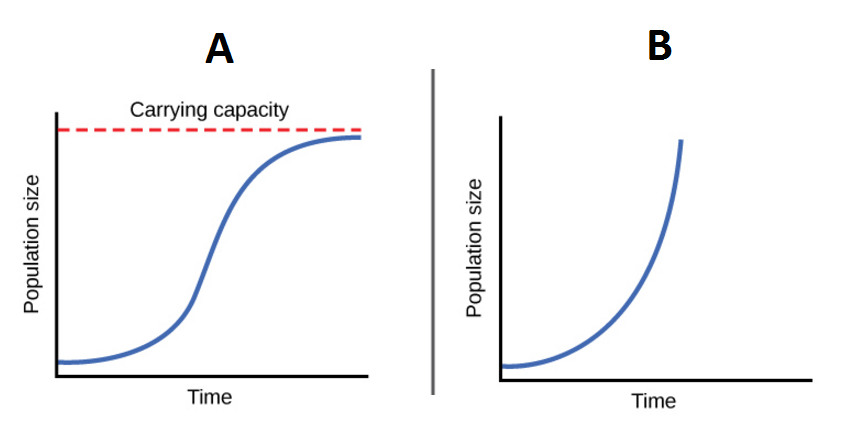
What type of growth model is shown in image A?
Exponential
Logistic
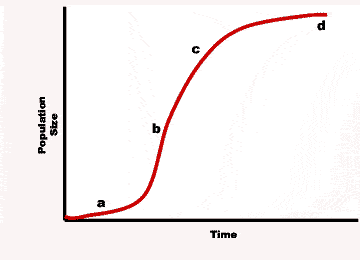
What point on the graph represents carrying capacity?
a
b
c
d
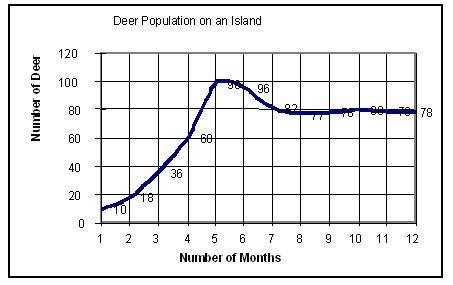
Which choice most closely approximates the deer population's carrying capacity based on the graph?
100
80
60
10

The Florida Panther is a large cat that is native to the southern parts of Florida. Recently, the panther's main food source, rabbits, have been infected with a deadly disease that only affects rabbits. How would this most likely affect the population of panthers in the coming years?
The panther population will decrease since they won't have access to as much food
The panther population will not be affected because they will adapt to eating other food
The panther population will increase because they will produce more offspring to make up the difference
The panther population will decrease because they will contract the disease.

Sea turtles are marine reptiles. They rely on an external heat source, which makes them ectotherms. They are commonly found in waters off the Mid-Atlantic and Northeast United States during the summer and early fall. Typically, they begin to migrate south to warmer water by late October. However, some sea turtles strand along our shores when water temperatures drop rapidly or unexpectedly. This is called “cold stunning.” Cold stunning is similar to hypothermia in humans. Initial symptoms include a decreased heart rate, decreased circulation, and lethargy, followed by shock, pneumonia and possibly death.
Based from this passage, why do sea turtles migrate?
Sea turtles migrate because their food source is more abundant in the south during the fall.
Sea turtles migrate because predators become more abundant in the Mid-Atlantic and Northeast of the U.S. during the summer and early fall.
Sea turtles migrate because humans are fishing more often in the areas where they are commonly found during summer and fall.
Sea turtles migrate because they depend on external sources of heat to help maintain their body temperature.

The average number of individuals of the same species per unit of surface area at a given time is the ……………………
population density
population growth
population birth rate
population size


