Wayground logo

Free Printable Worksheets

Font size

S
M
L
XL
Worksheets

Earth Science Final Exam Review

Total questions: 183

Worksheet time: 3hrs 30mins

Name
Class
Date
1.
During this step of the scientific method, a scientist would gather background information. 
a)
Hypothesis
b)
Research
c)
Observation
d)
Experiment 
2.
This step of the scientific method is an educated guess or a prediction. 
a)
Hypothesis
b)
Research
c)
Observation
d)
Conclusion
3.
The independent variable is what you _______ during an experiment.
a)
change
b)
do not change 
c)
measure
d)
count
4.
The dependent variable in an experiment is what you ________________. 
a)
Change
b)
Measure
5.
A series of steps used by scientists to solve a problem or answer a question. 
a)
scientific method
b)
recipe
c)
data collection
d)
metric system
6.
Testing a hypothesis often involves a(n):
a)
answer
b)
experiment
c)
problem
d)
safety check
7.
The summary at the end of an experiment that explains the results. 
a)
conclusion
b)
procedures
c)
materials
d)
responding variable
8.
What are the four main layers of Earth?
a)

atmosphere, biosphere,

hydropshere, geosphere

b)
core,mantle, crust, atmosphere
c)
hydrosphere, cryosphere, geosphere, mesosphere
d)
none of them
9.
Which best describes the mantle?
a)
molten metal
b)
dry land and ocean floor
c)
hot but solid rock
d)
warm liquid
10.
Choose the one that does not correspond to Biosphere.
a)
trees
b)
animals
c)
oxygen
d)
humans
11.
From the outside to the inside, the correct order of the layers of Earth is
a)
inner core, outer core, mantle, crust
b)
crust, mantle, outer core, inner core
12.
The continents are part of the
a)
inner core.
b)
outer core.
c)
mantle.
d)
crust.
13.

What branch of earth science deals with the study of the solid earth’s history?

a)

Geology

b)

Oceanography

c)

Meteorology

d)

Astronomy

14.

Which of Earth's spheres includes the oceans, groundwater, lakes and glaciers?

a)

Atmosphere

b)

Biosphere

c)

Hydrosphere

d)

Geosphere

15.

What are the three main parts of the geosphere?

a)

Atmosphere, Crust, Core

b)

Lithosphere, Mantle, Core

c)

Crust, Mantle, Core

d)

Asthenosphere, Lithosphere, Atmosphere

16.
What is the profile view to Topographic Map #1? 
a)
A
b)
B
c)
C
d)
D
17.
What is the profile view to Topographic Map #2?
a)
B
b)
C
c)
D
d)
E
18.
What is the elevation of point B? (Contour interval is 100m)
a)
800 ft
b)
850 ft
c)
900 ft
d)
1000 ft
19.
What feature is formed at B?
a)
river
b)
rift valley
c)
sink hole
d)
mountain
20.
What do close contour lines represent on a map?
a)
waterfall
b)
steep area
c)
gradual area
d)
river
21.
What do contour lines that are farther apart represent?
a)
waterfall
b)
steep area
c)
gentle slope
d)
river
22.
How many mountain tops does this map have?
a)
one
b)
two
c)
three
d)
four
23.
How many mountain peaks are represented?
a)
one
b)
two
c)
three
d)
four
24.
A rock formed from fragments of other rocks is a(n)
a)
Metamorphic Rock
b)
Sedimentary Rock
c)
Extrusive Rock
d)
Igneous Rock
25.

The substance that is melted rock below the ground is called what?

a)

Magma

b)

Sediment

c)

Gas

d)

Water

26.

What are the particles of weathered rock called?

a)

Sediments

b)

Fossils

c)

Rocks

d)

Minerals

27.

This is the continuous process of rock changing from one type to another.

a)

Igneous rocks

b)

Sedimentary rocks

c)

Metamorphic rocks

d)

Rock Cycle

28.

This is the type of rock that forms when earth processes change the texture and heat and pressure are applied.

a)

Igneous rock

b)

Sedimentary rock

c)

Metamorphic rock

d)

Rock Cycle

29.

These are traces or remains of a once-living thing sometimes found in sedimentary rocks.

a)

Rocks

b)

Sediments

c)

Fossils

d)

Minerals

30.

This is the type of rock that forms from sediment that gets cemented or pressed together under pressure.

a)

Igneous rock

b)

Sedimentary rock

c)

Metamorphic rock

d)

Rock Cycle

31.

This is the type of rock that forms from magma or lava hardening.

a)

Igneous rock

b)

Sedimentary rock

c)

Metamorphic rock

d)

Rock Cycle

32.

Which missing rock type is the arrow pointing at?

a)

Igneous

b)

Sedimentary

c)

Metamorphic

33.

Which missing rock type is the arrow pointing at?

a)

Igneous

b)

Sedimentary

c)

Metamorphic

34.

Which missing rock type is the arrow pointing at?

a)

Igneous

b)

Sedimentary

c)

Metamorphic

35.

How does a metamorphic rock become an igneous rock?

a)

Heat and pressure

b)

Melting and cooling

c)

Weathering/Erosion and Cementation

d)

Cycle

36.

How does an igneous rock become a sedimentary rock?

a)

Heat and pressure

b)

Melting and cooling

c)

Weathering/Erosion and Cementation

d)

Cycling

37.

How does a sedimentary rock become a metamorphic rock?

a)

Heat and pressure

b)

Melting and cooling

c)

Weathering/Erosion and Cementation

d)

Cycling

38.

Which material is melting and cooling to become an igneous rock?

a)

Sediments

b)

Sedimentary rocks

c)

Magma

d)

Igneous rocks

39.

Which material is being broken down through weathering and erosion?

a)

Igneous

b)

Magma

c)

Sediments

d)

Sedimentary

40.
A naturally occurring, inorganic solid
a)
mineral
b)
rock
c)
coal
d)
magma
41.
How light is reflected off a mineral
a)
streak
b)
color
c)
luster
d)
fracture
42.
Measure of how easily a mineral can be scratched
a)
fracture
b)
cleavage
c)
hardness
d)
streak
43.
Breakage along smooth, flat planes
a)
fracture
b)
cleavage
c)
streak
d)
ore
44.
The color of a mineral's powder
a)
color
b)
streak
c)
luster
d)
powder
45.
Breakage along rough or jagged edges
a)
cleavage
b)
fracture
c)
streak
d)
luster
46.
Metallic and nonmetallic are two examples of the physical property _______________.
a)
streak
b)
color
c)
luster
d)
cleavage
47.
What does the Mohs Scale measure?
a)
Streak
b)
Luster
c)
Hardness
d)
Cleavage
48.
What does inorganic mean?
a)
Something that is living
b)
Something that is dead, but was once living
c)
Something that was never living
49.

A substance that cannot be broken down into a simpler substance by ordinary chemical changes.

a)

Element

b)

Rock

c)

Streak

d)

Magma

50.

A solid substance in which the atoms are arranged in an orderly, repeating, three-dimensional pattern

a)

Rock

b)

Lava

c)

Mohs

d)

Crystal

51.

Which IS a characteristic of a mineral?

a)

Reflects light

b)

Naturally formed

c)

Resistance to scratching by another mineral

d)

Breaks along flat surfaces

52.
Minerals are identified by observing their ___________.
a)
physical properties
b)
name
c)
location
53.
Physically breaking down rocks and materials is called__________weathering.
a)
Chemical
b)
Mechanical
c)
Biological
d)
Permeable
54.
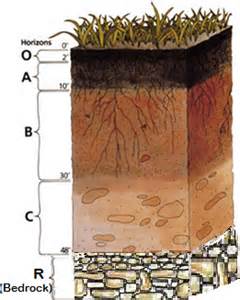
The layer of soil which the topsoil is found.
a)
Horizon A
b)
Horizon B
c)
Horizon C
d)
Horizon D or R
55.
The movement of rocks and weathered materials is called_________.
a)
Chemistry
b)
Physical
c)
Weathering
d)
Erosion
56.
Which horizon is made up of partially weathered rocks?
a)
Horizon A
b)
Horizon B
c)
Horizon C
d)
Horizon D or R
57.
Which horizon contains clay, silt, minerals, and a little humus?
a)
 Horizon A
b)
Horizon B
c)
Horizon C
d)
Horizon D or R
58.
What contributes sediment to soil formation?
a)
Parent rock
b)
Father rock
c)
Mother rock
d)
Large rocks
59.
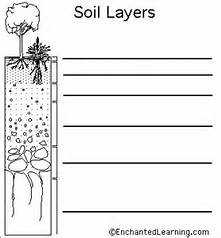
Does the vertical cross-section of soil in the picture show a soil profile or a soil horizon?
a)
Soil Profile
b)
Soil Horizon
60.
Do the horizontal cross sections in the picture show soil profiles or soil horizons?
a)
Soil Profiles
b)
Soil Horizons
61.
In which answer choice are the soil particles arranged in order from LARGEST to SMALLEST?
a)
Silt, sand, clay
b)
Silt, clay, sand
c)
Clay, silt, sand
d)
Sand, silt, clay
62.

Permeability is...

a)

when soil gets carried away

b)

when soil is broken down by wind, water, or ice

c)

how fast water travels through the soil

d)

how much water the soil holds

63.

Porosity is...

a)

when soil gets carried away

b)

when soil is broken down by wind, water, or ice

c)

how fast water travels through the soil

d)

how much water the soil holds

64.

Soil is made up of...

a)

minerals, rock fragments, air , water, and organic material

b)

sand, silt, and clay

c)

dead plants and animals and minerals

d)

air, water, and decomposers

65.

Which factor or factors below builds soil?

a)

climate

b)

slope of the land

c)

parent material

d)

time

e)

organisms

66.
A metamorphic rock is formed through:
a)
sediment cementing together over time. 
b)
a different type of rock changing over time due to heat and pressure.
c)
the cooling and solidification of magma. 
d)
Two parent rocks producing a baby rock. 
67.
mountains can form:
a)
at a convergent plate boundary, where plates slowly come together.
b)
At a transform plate boundary, where plates slide and grind against one another. 
c)
when soil piles up on top of more soil
68.
The Law of Superposition states that:
a)
Layers deposited on top are the oldest.
b)
Layers deposited on the bottom are the oldest. 
c)
Layers deposited on bottom are the youngest. 
d)
Layers are deposited randomly in no particular order. 
69.
The lithosphere is made up of:
a)
The outermost layer of the earth that we can see-- rocks and topsoil. 
b)
hot, flowing mantle material. 
c)
The rocky outer layer of the earth and some of the mantle. 
d)
The inner and outer core. 
70.
A mold fossil is:
a)
A fossil that has been preserved by molds and fungi. 
b)
An organism that has been buried by sediment and then decomposes, leaving an impression. 
c)
Organisms or their parts are replaced by minerals. 
d)
evidence of a previously living organism like its poop or tracks. 
71.
One piece of evidence that the continents have drifted over time is:
a)
We have found "matching" fossils on different continents, indicating that those continents were once together. 
b)
Land bridges ('nuff said).
c)
We can track the ancient paths of continents through seismology. 
72.
Earthquakes occur because:
a)
two plates are grinding past each other. When the plate gets "stuck" and finally releases, and Earthquake occurs because of stored up energy.
b)
Underneath the ocean there is a feature called the mid-ocean ridge. When plates collide here, an earthquake occurs. 
c)
Tsunamis in the ocean cause a "ripple effect" or earthquakes on land. 
d)
an avalanche at higher elevations produces earthquakes at lower elevations. 
73.
Convection currents:
a)
Cause tsunamis when they are strong. 
b)
bring heat from the sun-warmed surface of the earth to the interior. 
c)
bring heat from the core of the earth towards the surface. 
d)
have caused many mass-extinctions throughout Earth's history. 
74.
The area where two tectonic plates meet
a)
mantle
b)
focus
c)
boundary
d)
convection
75.
Which word describes a volcano that might erupt again?
a)
active
b)
dormant
c)
extinct
d)
cone
76.
Which word describes a volcano that is erupting or will erupt soon?
a)
active
b)
dormant
c)
extinct
d)
magma
77.
Pick the word that is NOT a type of volcano.
a)
composite
b)
magma
c)
cinder cone
d)
shield
78.
Which theory describes the movement of the continents?
a)
Continental Drift
b)
Transverse Boundary
79.
Where does seafloor spreading occur?
a)
near the shore
b)
the North Pole
c)
Mid-Ocean Ridge
d)
Antarctica
80.
Primary waves can travel through...
a)
solids
b)
liquids
c)
gasses
d)
all of the above
81.
Secondary waves can travel through...
a)
solids 
b)
liquids
c)
gasses
d)
all of the above
82.
Which word describes a volcano that will never erupt again?
a)
active
b)
dormant
c)
extinct
d)
cone
83.
This type of motion occurs when two tectonic plates move away from each other
a)
divergent
b)
convergent
84.
This theory describes the movement of the Earth's continents
a)
Sea Floor Spreading
b)
Tectonic Plates
c)
Pangaea
d)
Continental Drift
85.

Oceans, glaciers, lakes, and rivers are part of Earth's

a)

hemisphere

b)

lithosphere

c)

hydrosphere

d)

atmosphere

86.

What is a naturally occurring, inorganic, solid, with a crystal structure, and definite chemical composition?

a)

Rock

b)

Mineral

c)

Meteor

d)

Comet

87.

The basic building blocks that make up rocks are called what?

a)

Sand

b)

Minerals

c)

Comets

d)

Asteroids

88.

Based on the law of superposition, what is the order of these rock layers, from oldest to youngest?

a)

1, 2, 3, 4

b)

2, 1, 4, 3

c)

3, 2, 1, 4

d)

4, 3, 2, 1

89.

Which is the correct order of the scientific method?

a)

Hypothesis, Conclusion, Experiment, Question, Analyze data, Observations

b)

Experiment, Question, Conclusion, Analyze data, Observations, Hypothesis

c)

Analyze data, Observations, Hypothesis, Question, Conclusion, Experiment

d)

Question, Hypothesis, Experiment, Observations, Analyze data, Conclusion

90.
Fossils are only found in
a)
Sedimentary rocks
b)
Foliated Metamorphic rocks
c)
Igneous Rocks
d)
Nonfoliated Metamorphic rocks
91.
Which of the following are associated with volcanoes?
a)
Sediments and soil
b)
Crystals and sand
c)
Magma and lava
d)
Mica and granite
92.
Natural resources are
a)
renewable.
b)
nonrenewable.
c)
resources that exist without actions of humankind. 
d)
resources produced by humans from using biotic and abiotic factors found in nature.
93.
Renewable resources 
a)
can be replenished.
b)
cannot be replenished.
c)
are limited.
d)
are fossil fuels.
94.

Fossil fuels are nonrenewable because...

a)

they are used to produce heat.

b)

they take a long time to form.

c)

they can be found underground.

95.

How does air pressure change as you climb a mountain?

a)

it decreases (less air pressure)

b)

it increases (more air pressure)

c)

stays the same

d)

the temperature gets warmer

96.
Elevation, or how high up you are, is also called ...
a)
altitude
b)
atmosphere
c)
height
d)
decreasing
97.
A layer of air that surrounds Earth to keep us warm is called ...
a)
atmosphere
b)
Sun's rays
c)
ozone layer
d)
air pressure
98.

What protects Earth from ultraviolet rays from the sun?

a)

ozone layer

b)

mesosphere

c)

air pressure

d)

troposphere

99.
In what layer would you find the ozone layer?
a)
troposphere
b)
stratosphere
c)
mesosphere
d)
thermosphere
100.
What layer comes next:
Troposphere - 
stratosphere -
?????
a)
mesosphere
b)
exosphere
c)
thermosphere
d)
ionosphere
101.

What gas makes up the majority of the atmosphere?

a)

oxygen

b)

nitrogen

c)

water vapor

d)

carbon dioxide

102.
In what layer of the atmosphere would you find clouds and weather?
a)
troposphere
b)
stratosphere
c)
mesosphere
d)
thermosphere
103.

The driving force of the Water Cycle is?

a)

The troposphere

b)

The Sun

c)

The oxygen

d)

The clouds

104.

What heats or cools faster: land or water?

a)

Land

b)

Water

105.
They are highest clouds in the sky. They look wispy, white and feathery. Usually mean good weather.
a)
Cumulus
b)
Cumulonimbus
c)
Cirrus
d)
Stratus
106.
They are low in the sky and look soft and fluffy. They have flat bases that are usually a little darker than the heaping top.
a)
Cirrus
b)
Cumulonimbus
c)
Cumulus 
d)
Stratus
107.
What type of front brings cool, cold weather to an area?
a)
cold front
b)
warm front
c)
stationary front
d)
occluded front
108.
What type of front brings warm and humid weather to an area?
a)
cold front
b)
warm front
c)
stationary front
d)
occluded front
109.
A warm and dry air mass is best described as...
a)
continental tropical
b)
continental polar
c)
maritime tropical
d)
maritime polar
110.
A cool and humid air mass is best described as...
a)
continental tropical
b)
continental polar
c)
maritime tropical
d)
maritime polar
111.
a cool and dry air mass is best described as...
a)
continental tropical
b)
continental polar
c)
maritime tropical
d)
maritime polar
112.
The type of plate boundary where two plates come together is a .....
a)
Convergent Boundary
b)
Divergent Boundary
c)
Transform Boundary
d)
Plate Boundary
113.
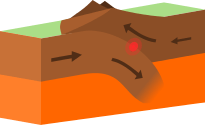
What type of plate boundary is this?
a)
Plate
b)
Divergent
c)
Convergent
d)
Transform
114.
What type of event will occur at this boundary?
a)
Earthquake
b)
Volcano Eruption
c)
Tornado
d)
Mountain Building
115.
A divergent boundary occurs when plates ....
a)
Pull apart
b)
Come together
c)
Slide past each other
d)
subducting
116.
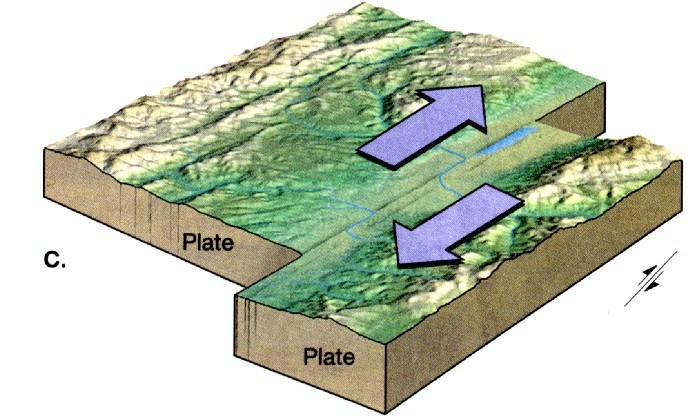
What type of plate boundary is this?
a)
Transform
b)
Convergent
c)
Divergent
d)
Plate
117.
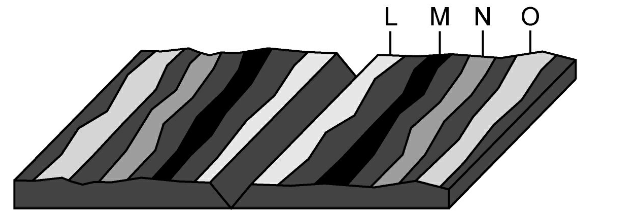
Where would the oldest rock be found?
a)
L
b)
M
c)
N
d)
O
118.
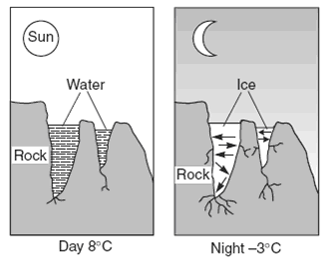
These rocks were broken apart from the continuous freeze/thaw of water in the cracks of the rocks. This is an example of:
a)
ice wedging
b)
acid rain
c)
permeability
d)
abrasion
119.
At which type of boundary are mountains formed?
a)
Convergent
b)
Divergent
c)
Subductive Zone
d)
Transform
120.
At which type of plate boundary does seafloor spreading occur?
a)
Tranform
b)
Convergent
c)
Divergent
d)
Subductive Zone
121.
When an oceanic plate and a continental plate collide, which one will subduct?
a)
oceanic
b)
continental
c)
neither
122.
Most volcanoes and earthquakes occur...
a)
along the coast
b)
along tectonic plate boundaries
c)
in the Arctic
d)
in the ocean
123.
Who is the person credited with developing the theory of continental drift?
a)
Harry Hess
b)
Galileo
c)
Alfred Wegener
d)
Newton
124.
The time it takes half of the atoms of a radioactive element to decay
a)
relative age
b)
half-life
c)
absolute age
d)
radioactive decay
125.
Preserved remains or traces of an organism that lived in the past.
a)
vertebrate
b)
carbon film
c)
invertebrate
d)
fossil
126.
The Law of Superposition helps scientists to determine what?
a)
The absolute age of rock layers
b)
The age of fossils
c)
The relative age of rock layers
d)
the super powers of rocks
127.
According to the law of superposition, which layer is the youngest?
a)
A
b)
B
c)
C
128.

Based on the law of superposition, where would the oldest rocks be found.

a)

at the bottom

b)

at the top

c)

second from the bottom

d)

second from the top

129.

Which technique can be used to determine the exact age of a rock?

a)

Radiometric dating

b)

Relative dating

130.

Which letter matches with the OLDEST layer of rock?

a)

W

b)

X

c)

Y

d)

Z

131.
Which rock layer in the diagram seems to be the oldest?
a)
F
b)
E
c)
B
d)
A
132.
what's the half life of this substance?
a)
1 day
b)
5 days
c)
3 days
d)
9 days
133.
Analyze the seashell found in the white layer.  Which statement is true of the rock layer that contains this fossil?
a)
It could also contain a fossil from the bottom layer.
b)
It is older than the layers below it.
c)
It is younger than the layers above it.
d)
It is older than the layers above it.
134.
Which of the following is the oldest?
a)
Layer L
b)
Intrusion D
c)
Intrusion H
d)
Layer E
135.
Which of the following correctly lists the layers in order from oldest to youngest?
a)
A, B, C, D, E
b)
E, B, C, D, A
c)
E, D, C, B, A
d)
C, B, A, D, E
136.
How does the law of crosscutting explain the age of a fault?
a)
The fault is younger than the rocks above it.
b)
The fault is younger than the rocks it cuts through.
c)
The fault is older than the rocks above it.
d)
The fault is older than the rocks it cuts through.
137.
What types of landscapes are featured near or with volcanoes?
a)
Uplifts, Erosion, and Weathering
b)
Hot Spots and Flood Basalts
c)
Vents, Craters, and Calderas
d)
Batholiths, Stocks and Sills
138.
What is letter A in the picture?
a)
Vent
b)
Crater
c)
Conduit
d)
Tephra
139.
What is letter B in the picture?
a)
Magma Chamber
b)
Crater
c)
Vent
d)
Conduit
140.

Magma leaves a volcano through a....

a)

Sill

b)

Vent

c)

Chamber

d)

Crater

141.

Once magma reaches the Earth's surface it is called.......

a)

Silica

b)

Lava

c)

Rock

d)

Molten

142.

When a volcano erupts quietly, what kind of mountain forms?

a)

A Shield Volcano

b)

A Cinder Cone Volcano

c)

A Composite Cone Volcano

143.

TRUE or FALSE: A volcano that erupts quietly will produce a lot of cinders, ash, and bombs

a)

TRUE

b)

FALSE

144.

Volcanoes with steep sides made of layers of ash is called......

a)

Cinder Cone

b)

Shield Volcano

c)

Composite Volcano

145.

What do we call molten hot liquid rock while it is still below the Earth's surface?

a)

Magma

b)

Igneous

c)

Cinder

d)

Lava

146.

Tall, cone-shaped mountains made of both cooled lava layers and layers of ash are called

a)

shield volcanoes

b)

composite volcanoes

c)

lava plateaus

d)

cinder cone volcanoes

147.

How fast a lava is able to flow is based on its

a)

Location

b)

Viscosity

c)

Amount

d)

Weight

148.

A fluid's thickness and resistance to flow is called....

a)

Viscosity

b)

Consistency

c)

Thickness

d)

Magma

149.
What is an epicenter? 
a)
Where an earthquake started
b)
The surface right above where an earthquake started 
150.
What is a fault?
a)
A crack in a plate.
b)
Where two plates move toward each other.
151.
Which travels fastest, always being the first detected by seismic stations?
a)
P waves
b)
S waves
152.
An instrument that detects and measures earthquakes is a 
a)
seismogram
b)
focus seismic map
c)
focus
d)
seismograph 
153.
Earthquakes under the water can cause _________________________________.
a)
tornadoes
b)
tsunamis
c)
lightening
d)
hailstorms
154.
P-wave 
a)
The center of a earthquake. 
b)
Also know as shear or secondary wave. 
c)
Always the first to arrive;  seismic wave that causes particles of rock to move in back-and-forth direction
d)
Hilbert
155.
Many earthquakes happen along the borders of...
a)
Countries
b)
Tetonic Plates
c)
Climate Zones
d)
None of the above.
156.
Smaller earthquakes that occur in the same area after a larger earthquake has occurred.
a)
aftershock
b)
liquefaction
c)
tsunami
157.

A(n) ____ is the triangular or fan-shaped deposit of sediment that forms where a river empties into an ocean or lake.

a)

alluvial fan

b)

delta

c)

meander

d)

drainage basin

158.

A(n) ____ is a layer of permeable rock that lets water move freely.

a)

cave

b)

water table

c)

aquifer

d)

spring

159.

A water shed is...

a)

a tiny building on a river

b)

a floodplain

c)

the deposition of sediments when a stream empties onto dry land

d)

the land area from which a stream gets its water

160.

Sediments that have many large, interconnected pores is highly...

a)

permeable

b)

impermeable

c)

eroded

d)

all of these

161.
The process of breaking up Earth's surface into sediment is called...
a)
sediment
b)
erosion
c)
weathering
d)
deposition 
162.
Which of these is an example of erosion
a)
Light Shinning onto a mountain
b)
Rain breaking down rock 
c)
Wind blowing away sediment
d)
All of the above
163.
What happens when weathering and erosion work together?
a)
New Mountains are created
b)
The climate changes overnight
c)
Metal objects become rusty
d)
They change the Earth's surface
164.
The diagrams  shows a natural process that weathers rock.
 Which statement best explains why this process results in weathering?
a)
frozen water acts as a solute
b)
water expands when it freezes
c)
the mass of water increases when it freezes
d)
frozen water dissolves most types of rock
165.
What is the major cause of weathering and erosion to form canyons?
a)
wind
b)
ice
c)
glaciers
d)
moving water
166.
Which agents  break down earth materials?
a)
wind only
b)
earthquakes and gravity
c)
ice and 007
d)
wind, water, and ice
167.
What is an enormous mass of ice moving over land?
a)
Ice wedging
b)
Glacier
c)
Iceberg
d)
Dune
168.
the breakdown or decomposition of rock that takes place when minerals change through chemical processes
a)
chemical weathering
b)
mechanical weathering
c)
erosion
d)
deposition
169.
A _____ is a mass of ice that moves downhill due to its weight.
a)
glacier
b)
erratic
c)
fjiord
d)
moraine
170.
_____ is rock debris embedded in base of ice create polishing, grooves and striations.
a)
Plucking
b)
Abrasion
c)
Weathering
d)
Erosion
171.
_____ is the removal of large chunks of rock debris.
a)
Plucking
b)
Abrasion
c)
Weathering
d)
Erosion
172.
This force causes the movement of glaciers
a)
pressure
b)
ice age
c)
gravity
d)
firn
173.

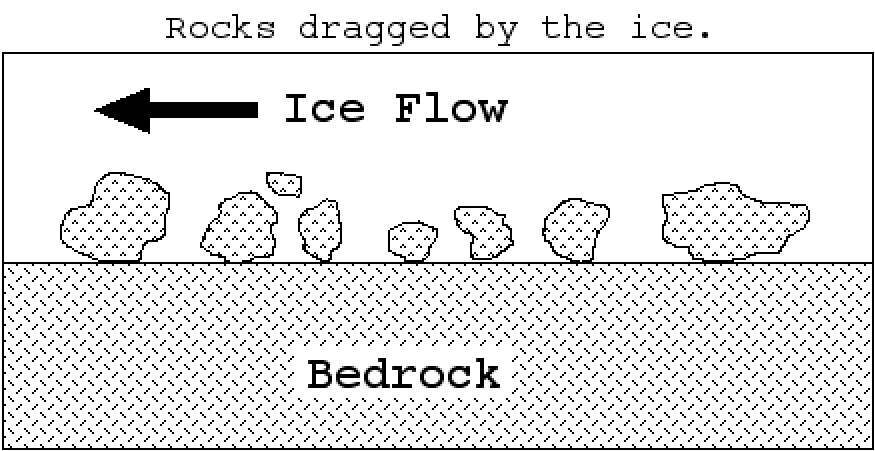
The photograph shows scratched and grooved

bedrock with boulders on its surface. The scratches and grooves were most likely created when

a)

alternating thawing and freezing of water cracked the bedrock

b)

flooding from a nearby lake covered the bedrock

c)

a glacier dragged rocks over the bedrock

d)

rocks from a landslide slid along the bedrock

174.

Which landscape feature was most likely formed by glacial activity?

a)

an eroded plateau

b)

a flat floodplain

c)

a U-shaped valley

d)

a V-shaped valley

175.

Base your answer to the following question on the diagram which represents a profile of a mountain glacier in the northern United States. Over a period of years, this glacier gains more snow mass than it loses. What will be the most likely result of this gain?

a)

The glacier will decrease in size, and the ice front will retreat.

b)

The glacier will decrease in size, and the ice front will advance.

c)

The glacier will increase in size, and the ice front will retreat.

d)

The glacier will increase in size, and the ice front will advance.

176.

The diagram represents a stream valley. Which diagram below best shows how this valley might be modified after a glacier has moved through it?

a)
b)
c)
d)
177.

About 97% of Earth's water is found in _________________ and salt lakes.

a)

rivers

b)

ground water

c)

oceans

d)

swamps

178.

Most of the Earth's fresh water exists in

a)

glaciers and ice caps

b)

lakes

c)

oceans

d)

rivers

179.

Of all the water on Earth about _____% is usable fresh water.

a)

97

b)

68

c)

3

d)

1

180.
How much of our water is fresh water?
a)
3%
b)
5%
c)
10%
d)
20%
181.
Surface water includes
a)
rivers, streams, and lakes
b)
confined aquifers 
c)
unconfined aquifers
182.
ground water becomes surface water by
a)
wells
b)
springs
c)
geysers
d)
all
183.

How do ocean currents affect climate?

a)

it warms and cools the land that is near an ocean

b)

it keeps the shores drier

c)

it makes the midlands drier

d)

it makes the middle of the continents rainer