wayground logo

Free Printable Worksheets

Font size

S
M
L
XL
Worksheets

Honors Chem Second Semester Review

Total questions: 161

Worksheet time: 3hrs 56mins

Name
Class
Date
1.
How many liters would you need to make a 1 M solution if you have 6 mol of Sodium Hydroxide? 
a)
2
b)
3
c)
4
d)
2.
What is the molarity of 4 g of NaCl (MM=58.45) in 3,800 mL of solution?
a)
0.018 M
b)
0.0011 M
c)
1.052 M
d)
0.062 M
3.

Which concentration of sweet tea would you expect to taste the sweetest?

a)
1M
b)
3M
c)
3.1M
d)
2.5M
4.
True or False? The higher the concentration of a solution the less solutes it has in it.
a)
True
b)
False
5.
How many grams of AgNO3 (MM = 169.87) are needed to prepare 0.125M solution in 250 mL of water? 
a)
.03g
b)
0.5g
c)
5.3g
d)
84.9g
6.
How many mL of 10.8M HCl are required to make 100.0 mL of 3.00M acid?
a)
27.8 mL
b)
27.78 mL
c)
2.8 mL
d)
278 mL
7.
What atom matches this electron configuration?
1s22s22p63s2
a)
Neon
b)
Magnesium
c)
Aluminum
d)
Potassium
8.

How many electrons can have energy associated with n=1?

a)
1
b)
2
c)
8
d)
0
9.
What is the shape of an s orbital?
a)
sphere
b)
dumbbell
c)
double dumbbell
d)
TOO COMPLEX TO KNOW IT.
10.
What is the shape of a p orbital?
a)
sphere
b)
it's just too complex to think about it
c)
dumbbell
d)
I don't know this stuff.
11.

How many electrons can have the energy associated with any given d sublevel?

a)
8
b)
10
c)
2
d)
4
12.
Which is associated with more energy? 
a)
2p
b)
2s
c)
3p
d)
1s
13.
How many total electrons can the f orbitals in a sublevel hold?
a)
2
b)
14
c)
6
d)
10
14.
What is this element? 
1s22s22p63s23p64s23d104p6
a)
Argon
b)
Krypton
c)
Selenium
d)
Bromide
15.
Rows on the period table are called _____ while columns are called _____.
a)
groups, families
b)
groups, periods
c)
periods, groups
d)
families, groups
16.
An orbital can at most hold how many electrons?
a)
1 electron
b)
2 electrons
c)
3 electrons
d)
4 electrons
17.
Electrons occupy orbitals of lowest energy first is part of what electron configuration rule?
a)
Hund’s Rule
b)
Aufbau Principle
c)
Pauli Exclusion Principle
18.
Electrons are paired based on their spin directions, clockwise and counterclockwise, is what electron configuration rule?
a)
Hund’s Rule
b)
Aufbau Principle
c)
Pauli Exclusion Principle
19.
What is this element? 
[Ar]4s2
a)
Calcium
b)
Sodium
c)
Scandium
d)
Titanium
20.
What is the noble gas shorthand for Sulfur?
a)
[Ar]3p4
b)
[He]3s23p4
c)
[Ne]3s23p4
d)
[Na]3s23p4
21.
Which orbital shows a violation of Hund's Rule?
a)
A
b)
B
c)
C
d)
D
22.
Which orbital shows a violation of the Pauli Exclusion Principle?
a)
A
b)
B
c)
C
d)
D
23.
Which orbital shows a violation of the Aufbau Principle?
a)
A
b)
B
c)
C
d)
D
24.
Which element is pictured?
a)
neon
b)
fluorine
c)
magnesium
d)
argon
25.
Which element is depicted from this orbital diagram
a)
Fluorine
b)
Neon
c)
Chlorine
d)
Argon
26.

Which of the following states that a single electron occupies each orbital within a subshell before electrons begin pairing?

a)

Hund's rule

b)

aufbau principle

c)

pauli exclusion principle

d)

lewis rule

27.
This wave has the second highest frequency on the spectrum. 
a)
microwaves
b)
visible light
c)
x-rays
d)
gamma ray
28.
The higher the frequency the ______ the energy. 
a)
higher
b)
lower
c)
neither, stays the same
29.
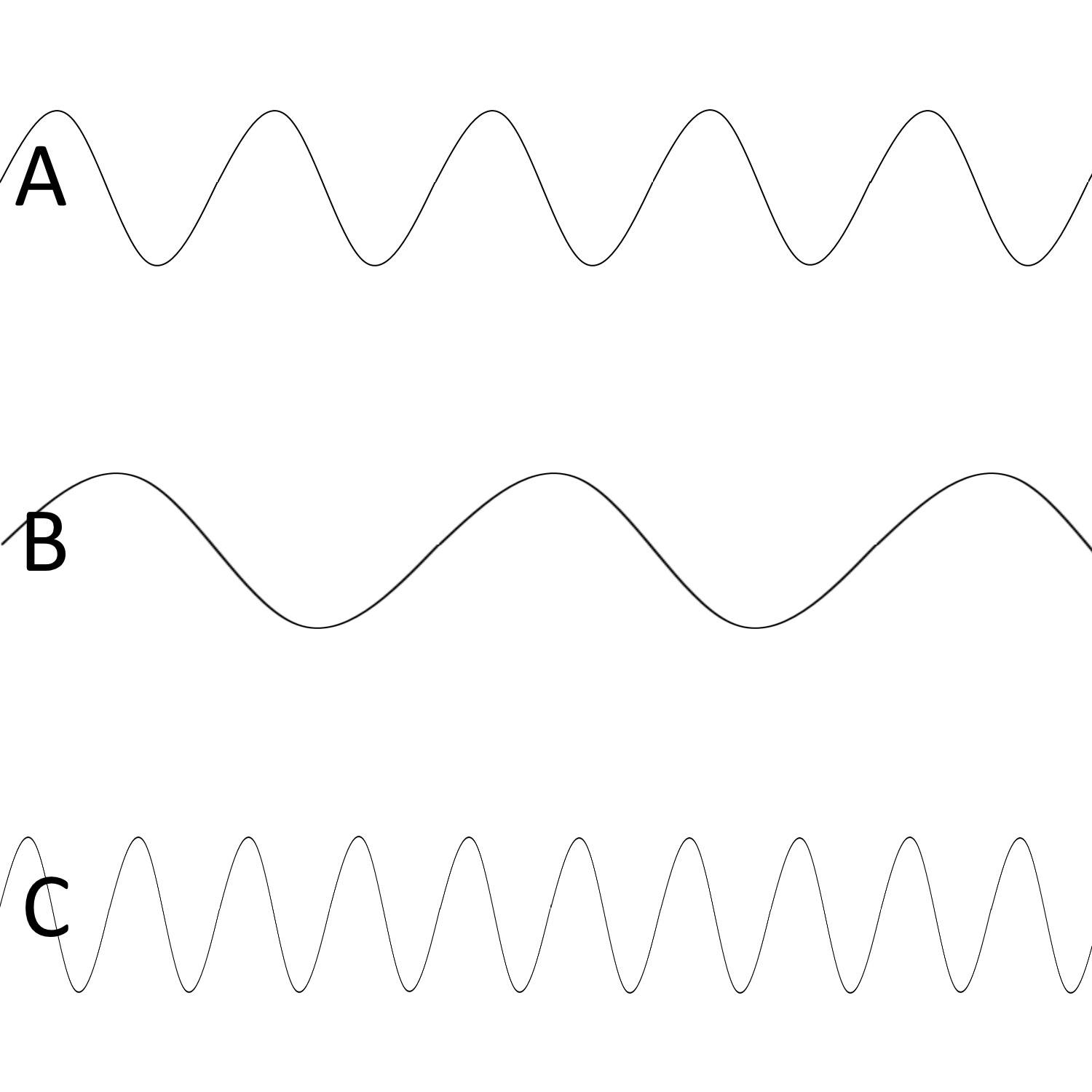
Which wave has the largest wavelength?
a)
A
b)
B
c)
C
d)
None (same wavelength)
30.
Which wave has the largest frequency?
a)
A
b)
B
c)
C
d)
None (same frequency)
31.
If all three are waves of light, which wave has the largest speed?
a)
A
b)
B
c)
C
d)
None (same speed)
32.

Which particle is a wave of light?

a)

proton

b)

neutron

c)

electron

d)

photon

33.
Which type of light has the lowest energy of this group?
a)
Radio
b)
Microwave
c)
Infrared
d)
Ultraviolet
34.
Which type of light has the largest wavelength of this group?
a)
X-rays
b)
Microwave
c)
Infrared
d)
Ultraviolet
35.
Which type of light has the highest energy of this group?
a)
red
b)
yellow
c)
green
d)
blue
36.
Which type of light has the smallest frequency of this group?
a)
red
b)
yellow
c)
green
d)
blue
37.
When an electron absorbs a photon of light, it also...
a)
gains positive charge
b)
gains negative charge
c)
increases energy level
d)
decreases energy level
38.
When an electron emits a photon of light, it also...
a)
gains positive charge
b)
gains negative charge
c)
increases energy level
d)
decreases energy level
39.
This color in the visible part of the spectrum has the lowest energy. 
a)
Blue
b)
Green
c)
Red
d)
Violet
40.
This color in the visible part of the spectrum has the highest energy.
a)
Blue
b)
Red
c)
Violet
d)
Yellow
41.
This color in the visible part of the spectrum has the smallest wavelength.
a)
Blue
b)
Red
c)
Violet
d)
Yellow
42.
This color in the visible part of the spectrum has the largest frequency.
a)
Orange
b)
Yellow
c)
Blue
d)
Green
43.

The following path of an electron emits a light wave that our eyes can detect.

a)

Ground -> Excited

b)

Excited -> Ground

c)

One full orbit of the nucleus

d)

Protons emit light. The question is misleading.

44.

Light acts like

a)

a wave.

b)

a particle.

c)

a wave sometimes and a particle at other times
45.

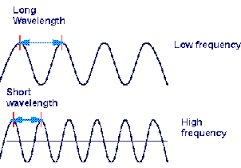
Wavelength and Frequency are related in that...

a)

they are always the same

b)

when one increases, the other decreases (inversely proportional)

c)

there is no correlation

d)

they both vary in an irregular pattern

46.

Which atom has the largest atomic radius?

a)

potassium

b)

rubidium

c)

francium

d)

cesium

47.
As you move down the periodic table atoms get bigger.  This is because ____________.
a)
The atoms have more mass.
b)
The atoms have more protons.
c)
The atoms have more energy levels
d)
The atoms have more nuetrons
48.
As you move across the periodic table atoms tend to get smaller because, ______________.
a)
the atoms have more mass.
b)
the atoms have less mass
c)
the atoms have more protons.
d)
the atoms have less electrons.
49.
The more protons there are, the  ____ .
a)
Weaker the pull
b)
Smaller the electrons
c)
Stronger the pull
d)
The bigger the electrons
50.
What family has the most reactive metals? 
a)
Halogens
b)
Alkaline Earth metals
c)
Alkali metals
d)
transition metals
51.
What family has the most reactive NON-metals? 
a)
Halogens
b)
Noble gases
c)
Alkali gases
d)
Chalcogens
52.
As you travel down the periodic table the ionization energy __________? 
a)
increases
b)
decreases
c)
does not change
53.
As you go from left to right across the periodic table the ionization energy __________? 
a)
increases
b)
decreases
c)
does not change
54.
What family has almost zero or very little electron affinity?
a)
Halogens
b)
Noble gases
c)
Alkali gases
d)
Chalcogens
55.
What family has the greatest electron affinity?
a)
Halogens
b)
Noble gases
c)
Alkali gases
d)
Chalcogens
56.
As you go from left to right across the periodic table the electron affinity __________? 
a)
increases
b)
decreases
c)
does not change
57.

As you go down the periodic table the electron affinity __________?

a)

increases

b)

decreases

c)

does not change

58.
Which of the following is the correct Lewis structure for the compound PBr3?
a)
structure A
b)
structure B
c)
structure C
d)
structure D
59.
According to the octet rule most elements need _______ valence electrons.
a)
2
b)
8
c)
6
d)
18
60.
In the correct Lewis structure for CH4, how many unshared electron pairs surround the carbon?
a)
2
b)
8
c)
0
d)
4
61.
In CO2, how many UNSHARED pairs of electrons does each oxygen have?
a)
2
b)
1
c)
4
d)
6
62.
Hydrogen needs _____ electrons in its valence shell to be stable.
a)
4
b)
6
c)
8
d)
2
63.
If electrons are shared unequally then the bond is....
a)
Non-polar covalent
b)
Ionic
c)
Non-polar ionic
d)
Polar covalent
64.

Metals and nonmetals typically form which kind of bond?

a)
Polar covalent
b)
Ionic
c)
Non-polar covalent
d)
Metallic
65.
If electrons are shared equally then the bond is....
a)
Non-polar covalent
b)
Ionic
c)
Non-polar ionic
d)
Polar covalent
66.

How strongly an atom attracts electrons in a bond is called....................

a)
Ionization energy
b)
Electronegativity
c)
Electricity
d)
Nuclear force
67.
Three pairs of electrons are shared in a
a)
Single bond
b)
Double bond
c)
Triple bond
68.
Which of the following is the correct Lewis dot structure for the molecule fluorine (F2)?
a)
A
b)
B
c)
C
d)
D
69.
How many electrons can be used in the Lewis Structure for : NO3 -
a)
23
b)
20
c)
18
d)
24
70.
What is the correct structure for BF3?
a)
Option A.
b)
Option B. 
c)
Option C.
d)
Option D.
71.
How many valence electrons are available for bonding in the sulfate ion (SO4-2)?
a)
30 electrons
b)
32 electrons
c)
28 electrons
d)
impossible to tell
72.

What is the correct Lewis Dot Structure for ammonia NH3

a)
b)
c)
d)
73.

How many total valence electrons are participating in bonding in the molecule above?

a)

8

b)

4

c)

2

d)

3

74.

In HCN (Carbon is usually the central atom) what kind of bond is between the C and N

a)

Single

b)

Double

c)

Triple

75.
Choose the correct shape for this molecule:
a)
Trigonal planar
b)
Trigonal pyramidal
c)
Tetrahedral
d)
Linear
76.
Choose the correct shape for this molecule:
a)
Trigonal planar
b)
Trigonal pyramidal
c)
Bent
d)
Linear
77.
Choose the correct shape for this molecule:
a)
Trigonal planar
b)
Trigonal pyramidal
c)
Bent
d)
Tetrahedral
78.
Choose the correct shape for this molecule:
a)
linear
b)
Trigonal pyramidal
c)
Bent
d)
Tetrahedral
79.
Choose the correct shape for this molecule:
a)
Tetrahedral
b)
Trigonal pyramidal
c)
Bent
d)
Trigonal planar
80.
Choose the correct shape for this molecule:
a)
Bent
b)
Linear
c)
Tetrahedral
d)
Trigonal pyramidal
81.

When you have Be-F, what is the polarity?

a)

nonpolar

b)

polar

c)

ionic

82.

When you have Si-O, what is the polarity?

a)

nonpolar

b)

polar

c)

ionic

83.

When you have F-F, what is the polarity?

a)

nonpolar

b)

polar

c)

ionic

84.

When you have C-H, what is the polarity?

a)

nonpolar

b)

polar

c)

ionic

85.

When you have Zn-F, what is the polarity?

a)

nonpolar

b)

polar

c)

ionic

86.
Which of the following is a polar molecule?
a)
CH4
b)
Xe
c)
H2O
d)
CO2
87.
Which of the following molecules, based on the elements present, would be most polar?
a)
HF
b)
H2
c)
HCl
d)
HBr
88.
A molecule containing polar covalent bonds is always polar.
a)
True
b)
False
89.

Is this molecule polar or non-polar?

a)

Non-polar

b)

Polar

90.
In covalent bonds, electrons are ___________.
a)
transferred
b)
gained
c)
lost
d)
shared
91.
In a polar covalent bond, electrons are shared ___________.
a)
equally
b)
unequally
c)
between non-metals with similar electronegativities
d)
between a metal and a non-metal
92.
In this Lewis structure, the symbol above F means...
a)
electrons are being transferred to Fluorine
b)
electrons are less attracted to F than H
c)
electrons are more attracted to F than H
d)
Fluorine has formed a cation
93.
This is an example of a __________ bond.
a)
non-polar covalent
b)
polar covalent
c)
ionic
d)
metallic
94.
Gas Laws involve what three terms?
a)
Solid Liquid Gas 
b)
Speed Velocity Acceleration 
c)
Elements Compounds Mixtures 
d)
Pressure Temperature Volume 
95.
When the temperature is constant (k) inside a balloon, if you add pressure on it, the volume will ..... 
a)
Decrease
b)
Increase
c)
Not Change at all
d)
Particles will solidify 
96.
For example, if you increase the temperature of a gas inside a balloon, the balloon will....
[pressure is constant (k)]
a)
Expand (increase in volume)
b)
Deflate (decrease in volume
97.
Pick the best answer to explain all properties of gases....
a)
They're fluids 
Can be compressed
Little space between particles 
b)
They're solids 
Can be compressed
Lots of space between particles 
c)
They're fluids 
Cannot be compressed
Lots of space between particles 
d)
They're fluids 
Can be compressed
Lots of space between particles 
98.

How do you convert C to Kelvin (K)?

a)

C + 273

b)

C x 273

c)

C / 273

d)

C + 32 + 273

99.
If a balloon is cooled what will happen to the volume?
a)
Volume will increase
b)
Volume will decrease
c)
Volume will not change
100.
Which of the following would increase the (gas) pressure of a system?
a)
Increase the Temperature
b)
Pump in more gas
c)
Decrease the volume
d)
All of these
101.
In the ideal gas law, which variable represents the gas constant?
a)
n
b)
R
c)
T
d)
V
102.
Gases have...
a)
A definite shape and volume
b)
A definite shape but no definite volume
c)
No definite shape but a definite volume
d)
No definite shape or volume
103.
What is the variable for this number 1.5 mol
a)
P
b)
T
c)
n
d)
V
104.
What is the variable for this number 122 K
a)
P
b)
T
c)
n
d)
V
105.
What is the variable for this number 9.10 atm
a)
P
b)
T
c)
n
d)
V
106.
What is the variable for this number 22.4 L
a)
P
b)
T
c)
n
d)
V
107.
What is the variable for this number 4.1 mmHg
a)
P
b)
T
c)
n
d)
V
108.
What is the variable for this number 0oC
a)
P
b)
T
c)
n
d)
V
109.
Which of the following is NOT a part of Kinetic Molecular Theory?
a)
Gas particles have mass and occupy space (the individual particles have volume)
b)
Gas particles do not have mass and occupy space (the individual particles have volume
c)
Gas particles move in straight lines
d)
The more heat energy the gas particles have, the faster they move
110.
At a constant pressure, the volume decreases.  What happens to the temperature?
a)
increases
b)
decreases
c)
stays the same
111.

If a reversible reaction is exothermic in the forward direction, it will be ...

a)

exothermic in the reverse direction

b)

endothermic in the forward direction too

c)

endothermic in the reverse direction

d)

not involve energy in reverse direction

112.

When amounts of reactants and products become constant in reversible reaction, what might happen to the reversible reaction?

a)

Reversible reaction reaches equilibrium.

b)

Reversible reaction fastens forward reaction.

c)

Reversible reaction fastens reverse reaction.

d)

Reversible reaction slows down forward reaction.

113.
This symbol indicates that a reaction is ____________
a)
reversible
b)
irreversible
114.
Le Chaltelier's Principle states that if a chemical system at equilibrium is stressed,
a)
the system will adjust to increase the stress
b)
the system will adjust to reduce the stress
c)
the system will not adjust
115.
Define chemical equilibrium.
a)
A reaction is reversible.
b)
The concentration of the reactants is equal to the concentration of the products.
c)
The rate of a forward reaction is equal to the rate of the reverse reaction.
d)
The reaction stops and no further change in concentration occurs.
116.
For the reaction...
SO2 + O2  <−>  SO3
If the concentration of SOis increased, the equilibrium of the reaction will shift ___________.
a)
left
b)
right
c)
left and right 
d)
neither left nor right
117.
For the reaction...
SO2 + O2 <−>  SO3
If the equilibrium shifts to the right, the concentration of O2 will ___________.
a)
increase
b)
decrease
c)
remain the same
d)
double
118.
For the reaction...
SO2 + O2 <−>  SO3
If the concentration of Ois decreased, the equilibrium of the reaction will shift ___________.
a)
left
b)
right
c)
left and right
d)
neither left nor right
119.
For the reaction...
heat  +  N2  +  O2  <−>  2NO
If  O2 is removed, the  concentration of N2 will _______.
a)
increase
b)
decrease
c)
remain the same
d)
double
120.
A substance that increases speed of chemical reaction without being being changed is called:
a)
Catalyst
b)
Acid
c)
Base
d)
pressure
121.
Increase in temperature of the reactants can do one of the following
a)
Slow collision frequency
b)
Allow less effective collision between the particles
c)
Cause particles to lose speed
d)
Increase collision between the particles thus increasing the rate.
122.
For the reaction...
heat  +  N2  +  O2  ↔  2NO
If the heat is added to the chemical system, the equilibrium will shift _______.
a)
left
b)
right
c)
left and right
d)
neither left nor right
123.
In an endothermic reaction the products have 
a)
more energy than the reactants
b)
less energy than the reactants
c)
the same energy as the reactants
d)
no energy
124.
For the reaction...
heat  +  N2  +  O2  ↔  2NO
If the heat is removed to the chemical system, the equilibrium will shift _______.
a)
left
b)
right
c)
both left and right
d)
neither left nor right
125.
In an exothermic reaction the products have
a)
more energy than the reactants
b)
the same energy as the reactants
c)
less energy than the reactants
d)
no energy
126.
At what time the reaction reached equilibrium?
a)
t1
b)
t2
c)
t3
d)
t4
127.
Define chemical equilibrium.
a)
A reaction is reversible.
b)
The concentration of the reactants is equal to the concentration of the products.
c)
The rate of a forward reaction is equal to the rate of the reverse reaction.
d)
The reaction stops and no further change in concentration occurs.
128.
What is the activation energy?
a)
the quantity of heat absorbed in a reaction
b)
the minimum energy needed to begin a reaction
c)
the energy given off after reactants collide.
d)
both the energy and frequeny of collisions in increased
the energy difference between reactants and products
129.
What is the proper K for the following reaction? 
   2 NO(g)  +  O2(g)  2 NO2(g)
a)
K = [NO2]2 / [NO]2[O2]
b)
K =  [NO]2[O2] / [NO2]2
c)
K = [NO]2[O2][NO2]2
d)
K = 2[NO][O2] / 2[NO2]
130.
What kind of reaction is this?
a)
Endothermic
b)
Exothermic
c)
Cannot be determined
131.
If the equilibrium constant is much greater than one (K >> 1) then
a)
Equilibrium is not established.
b)
Equilibrium lies to the right (products are favored)
c)
Equilibrium lies to the left (reactants are favored)
d)
Neither products or reactants are favored.
132.
If the equilibrium constant is much less than one (K << 1) then
a)
Equilibrium is not established.
b)
Equilibrium lies to the right (products are favored)
c)
Equilibrium lies to the left (reactants are favored)
d)
Neither products or reactants are favored.
133.

What is the oxidation state of Cl in ClO- ?

a)

0

b)

+1

c)

-1

d)

+2

134.

What is the oxidation state of Cu in Cu2+?

a)

-1

b)

-2

c)

+2

d)

0

135.

What is the oxidation state of H in H2?

a)

+2

b)

+1

c)

0

d)

None of the above

136.

What is the oxidation state of Pb in PbO ?

a)

+2

b)

+4

c)

0

d)

-2

137.

C in CO32-?

a)

-4

b)

+2

c)

0

d)

+4

138.

S in HSO4- ?

a)

+5

b)

-6

c)

+6

d)

+2

139.
A chemical reaction that involves a gain/loss of electrons is called:
a)
Double Replacement
b)
Neutralization
c)
Oxidation-Reduction
d)
Hydrolysis
140.
If in a reaction, copper is reduced; its number of electrons has:
a)
Increased
b)
Decreased
c)
Remained Constant
d)
Varies Randomly
141.
If an atom loses electrons during a chemical reaction, the atom was:
a)
Oxidized
b)
Reduced
c)
Neutralized
d)
Precipitated
142.
The sum of all oxidation numbers in a neutral compound is ___.
a)
0
b)
1
c)
-1
d)
depends on the compound
143.
What is the oxidation of C in CH4?
a)
-4
b)
-1
c)
+4
d)
+1
144.

When a lithium atom forms an Li+ ion, the lithium atom

a)

gains a proton

b)

gains an electron

c)

loses a proton

d)

loses an electron

145.

Which change in oxidation number indicates oxidation?

a)

-1 to +2

b)

-1 to -2

c)

+2 to -3

d)

+3 to +2

146.
Reduction happens at the 
a)
anode
b)
cathode
c)
salt bridge
d)
voltmeter
147.
Oxidation happens at the
a)
anode
b)
cathode
c)
salt bridge
d)
voltmeter
148.
Reactions in voltaic cells are
a)
spontaneous, redox reactions
b)
non-spontaneous, redox reactions
c)
spontaneous, non-redox reactions
d)
non-spontaneous, non-redox reactions
149.
This electrode in a voltaic cell gains mass
a)
anode
b)
cathode
150.
This electrode loses mass 
a)
anode
b)
cathode
151.

What does the metal wire and salt bridge transport in voltaic cells?

a)

electrons and ions

b)

electrons and protons

c)

ions and acid

d)

acids and bases

152.
In which direction does electricity flow in a voltaic cell (battery)?
a)
Electrons flow from the cathode to the anode
b)
Electrons flow from left to right
c)
Electrons flow from anode to cathode
d)
Electrons flow from right to left
153.
In the reaction
2Ca(s) + O2(g) --> 2CaO(s), calcium is __________
a)
Reduced
b)
Synthesized
c)
Oxidized
d)
None of the above
154.
How would you write the electrons in the reaction O2 --> O2-2 ?
a)
+2e- on the products
b)
+2e- on the reactants
c)
+e- on the products
d)
+e- on the reactants
155.
Temperature is a measure of the...
a)
total energy in a substance
b)
total kinetic energy in a substance
c)
average potential energy in a substance
d)
average kinetic energy of molecules in a substance
156.
A slower particle has a lower energy than an identical, faster particle.
a)
True
b)
False
157.
The transfer of thermal energy between objects of different temperatures is called...
a)
temperature
b)
heat
c)
internal energy
d)
none of these
158.
A substance with a high specific heat:
a)
Is always extremely hot.
b)
Requires a lot of energy to become hot.
c)
Is not heavy.
d)
Does not requires a lot of energy to become hot.
159.
Thermal energy always moves:
a)
From a high temperature object to a lower temperature object.
b)
From a lower temperature object to a higher temperature object.
c)
From an object with lower kinetic energy to an object with higher kinetic energy.
d)
From an object of higher mass to an object of lower mass.
160.
The temperature of a glass of cold water will eventually...
a)
Match the temperature of the surrounding environment.
b)
Always be colder than the surrounding environment.
c)
Become warmer than the surrounding environment.
d)
Never change temperature.
161.
The first law of thermodynamics states that energy is
a)
created
b)
destroyed
c)
conserved
d)
created and destroyed