wayground logo

Free Printable Worksheets

Font size

S
M
L
XL
Worksheets

Econ Final Review

Total questions: 75

Worksheet time: 53mins

Name
Class
Date
1.
  Competition and free enterprise are most common in which type of economic system? 
a)
A traditional
b)
 B market
c)
C communist
d)
D planned
2.
  Which type of economic system is MOST likely to experience high amounts of government regulation and low amounts or private ownership? international
a)
 A. ) market
b)
B.)   command
c)
 C.) traditional 
d)
D.)   international
3.
A person who uses and buys goods and services 
a)
money 
b)
producer 
c)
consumer 
d)
economics 
4.
Importing more than exporting is
a)
trade surplus
b)
trade deficit
c)
balance of trade
d)
balance of payment
5.
The value of all the final goods and services produced within a nation in a given year.
a)
Gross Domestic Product
b)
per capita GDP
c)
Gross National Product
6.
A product that one country SELLS to another.
a)
import
b)
export
7.
The factories, machines, and technology that people use to make products to sell.
a)
capital goods
b)
human capital
c)
entrepreneurship
8.

A negative consumption shock will cause ...

a)

a rightward shift in demand curve for labor.

b)

a leftward shift in demand curve for labor.

c)

a rightward move along the demand curve for labor.

d)

a leftward move along the demand curve for labor.

9.

When a firm is optimistic (feels good) about future business opportunities...

a)

the will decrease their demand for labor.

b)

they will increase their demand for labor.

c)

they will sell off plant machinery and factories.

d)

they will close offices to decrease costs.

10.

A general rise in the price level of an economy

a)

Real GDP

b)

Standard of Living

c)

Inflation

d)

Aggregate Supply

11.

The amount of goods and services ALL buyers in the economy are willing/able to buy at all the possible price levels.

a)

Aggregate Supply

b)

Aggregate Demand

c)

Investment

d)

GDP

12.

Goods and services produced in other countries, then brought to the United States in exchange for currency.

a)

Exports

b)

Imports

c)

GDP

d)

Investment

13.
Which is not an economic indicator
a)
GDP
b)
Inflation rate
c)
Law of supply and demand
d)
Unemployment rate
14.
If the prices of many products _______, inflation is present.
a)
pull
b)
rise
c)
fall
d)
remain the same
15.
__________study of how people (including companies/countries) make choices on buying, selling, using, and distributing goods/services.
a)
Economics
b)
Consumer Science
c)
Opportunity Costs
16.
__________ Things required to live such as food, shelter, clothing, air
a)
Need
b)
Want
c)
Tradeoff
17.
____________ The actual thing you gave up to have something else. Everything has a cost
a)
Opportunity Cost
b)
Tradeoff
c)
Incentive
18.
The two branches of economics are micro & macro. 
a)
True
b)
False
19.
Money's only real benefit is as a medium of exchange
a)
True
b)
False
20.
Money must be durable, portable, and stable
a)
True
b)
False
21.
_______________ father of economics, wrote the wealth of nations, and believed in a concept known as the invisible hand. 
a)
Adam Smith
b)
David Ricardo
c)
Thomas Malthus
22.

______________ not having enough resources to satisfy all of the needs/wants

a)

Scarcity

b)

Opportunity Cost

c)

Tradeoff

23.

Money is a medium of exchange, store of value, and a unit of account, durable, portable, divisible, and uniform.

a)

True

b)

False

24.

Scarcity forces people to_____________________

a)

Make Choices

b)

satisfy all their wants and needs

c)

Give up opportunity cost

25.
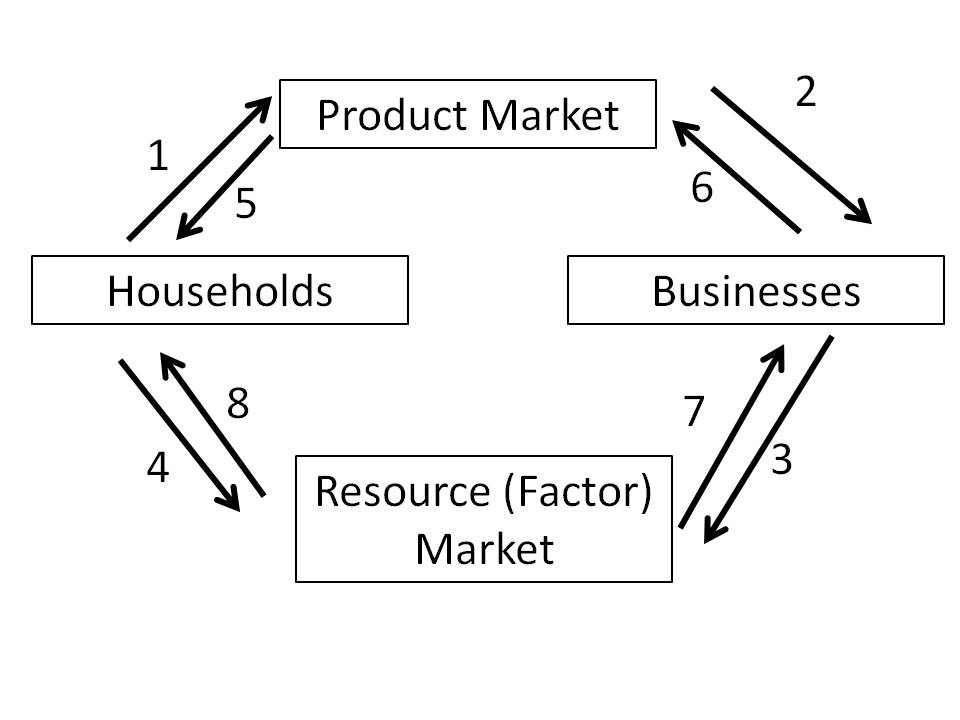
Arrows 4 and 7 on this circular flow diagram demonstrate
a)
prices
b)
taxes
c)
goods and services flow
d)
money flow
26.
The arrows 1 to 2 in this diagram represent which aspect of the economy?
a)
goods and services flow
b)
money flow
c)
taxes
d)
factors of production
27.
Place where buyers and sellers meet to exchange goods and services for money
a)
Market
b)
Factor of production
c)
Money
d)
Interdependent
28.
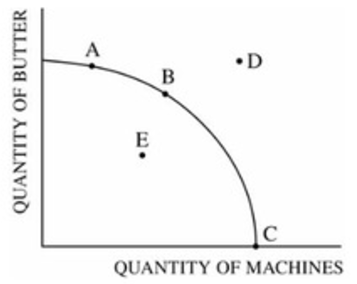
The diagram shows the production possibilities curve for Country Y. Which of the following statements is true?
a)
If Country Y is producing at point C, it is using all its resources efficiently
b)
The opportunity cost of producing more machines is constant
c)
Country Y cannot produce at point E
d)
The most efficient point of production is point D
29.
Which of the following constitute the fundamental questions every economic system must answer?
a)
I, III, V only
b)
I, II, and IV only
c)
I, II, and V only
d)
II, IV, and V only
30.
The four types of economic systems are: 
a)
Traditional, Command, Mixed, & Market
b)
Traditional, Command, Combined, & Market
c)
Communism, Capitalism, Free Market, and Macroeconomics
d)
Microeconomics, Macroeconomics, Individual, and Traditional.
31.
Which of the following is an economic system in which economic decisions are made according to social roles & culture?
a)
Market economy
b)
Command economy
c)
Traditional
Traditional economy
d)
Mixed
Mixed economy
32.
The Country of North Korea has a dictator that makes all of the economic decisions. What type of economy is this?
a)
Traditional 
b)
Market 
c)
Command 
d)
Centrally Planned 
33.

The economic problem is that

a)

resources are limited and wants are limited.

b)

resources are unlimited and wants are limited.

c)

resources are limited and wants are unlimited.

d)

resources are unlimited and wants are unlimited.

34.
This is the reason we have to make choices.
a)
Scarcity
b)
Shortages
c)
Opportunity Costs
d)
Trade offs
35.
When a point lies inside of the PPF it can be said that
a)
Resources are under employed
b)
Resources are fully utilize
c)
Production is beyond the resource potential
d)
Opportunity cost of production is constant
36.
Division of labor is a characteristic of 
a)
home craft businesses
b)
assembly line production
c)
classroom education
d)
entrepreneurship
37.

What is always associated with an economic decision?

a)

an opportunity cost

b)

a tariff rate

c)

monetary cost

d)

exchange rate

38.

Allen is working a summer job to earn money for college in the fall. Which two activities will most help him reach his goal?

a)

saving money

b)

getting a loan

c)

reducing spending

d)

managing time

e)

increasing expenses

39.

A debtor is...

a)

the person who borrows.

b)

the person who lends.

40.
This is a tax on imports that is used to increase price of foreign products and raise government revenue. 
a)
tariff
b)
quota
c)
subsidy
d)
embargo
41.
Who is most likely to be hurt by inflation?
a)
someone who borrowed money
b)
a retiree on a fixed income
c)
a business owner
d)
the U.S. government
42.
Which of the following will most likely occur during the expansionary phase of the business cycle? 
a)
Real GDP rises and unemployment falls.
b)
Real GDP rises and unemployment rises. 
c)
Real GDP declines and inflation rises.
d)
Interest rates rise and the number of business failures rise. 
43.
How do individuals contribute to the circular flow of economic activity? 
a)
Businesses buy goods and services from individuals
b)
Businesses purchase productive resources in product markets
c)
Individuals provide labor for factor markets and buy goods in product markets
d)
Individuals buy productive resources from factor markets and provide labor for product markets
44.
The principle that consumers tend to buy less of a good or service when its price increases, all else held equal, is called
a)
a.  the law of supply
b)
a.  the law of demand
c)
a.  the law of increasing cost
d)
a.  the law of maximum satisfaction
45.
How do supply and demand influence market price?
a)
Supply determines market price because the seller sets the price.
b)
The price is determined by the highest price consumers are willing to pay.
c)
The price is determined by the lowest price producers are willing to accept.
d)
The market clearing price is where quantity demanded is equal to quantity supplied.
46.
According to the graph, what is the quantity at equilibrium?
a)
14
b)
400
c)
600
d)
1200
47.
Which factor might cause an increase in the supply of a product?
a)
a.  A decrease in productivity 
b)
a.  Fewer sellers in the marketplace 
c)
a.  A decrease in government regulations
d)
a.  An increase in the cost of raw materials
48.
Consumers are told that the consumption of cauliflower will significantly reduce the risk of cancer. Which of these scenarios is likely to happen in the cauliflower market? 
a)
The demand curve will shift to the left and the price of cauliflower will fall
b)
a.   The supply curve will shift to the right and the price of cauliflower will rise
c)
a.   The supply curve will shift to the right and the price of cauliflower will fall
d)
a.  The demand curve will shift to the right and the price of cauliflower will rise
49.
According to Law of demand, there is ______ relation between Price and Quantity demanded.
a)
Direct
b)
Inverse
c)
Reverse
d)
No
50.
Quantity of anything bought from the market at a given price is __________.
a)
Demand
b)
Supply
c)
Wealth
d)
Economics
51.
(2) Which of the following resources would economists classify as “capital”?    
a)
Raw Bauxite in a South African mine 
b)
A hammer used in framing a house 
c)
A worker hired to repair engines 
d)
Trees used to make paper 
52.
Movement along the Demand curve to the right is called
a)
decrease in demand
b)
decrease in quantity demanded
c)
increase in demand
d)
increase in quantity demanded
53.
When economists measure the responsiveness of consumers to changes in price, they are measuring:
a)
the percentage change in price
b)
the price elasticity of demand.
c)
the price elasticity of supply.
d)
income elasticity.
54.
In which market structure does a firm have greatest control over its product’s price?
a)
perfect competition
b)
monopoly
c)
oligopoly
d)
monopolistic competition
55.
Interdependence and price leadership are characteristics of firms in what kind of market structure?
a)
monopoly
b)
oligopoly
c)
monopolistic competition
d)
perfect competition
56.
The Law of Supply:
a)
Is the exact replica of the Law Of Demand
b)
Reflects producers offering more of a good as  its price increases and less as its price falls 
c)
Has an inverse relationship with price.
d)
Reflects producers offering less of  a good as its price increases and more of  as its price falls.
57.
The main function of the Federal Reserve System in the U.S. economy is to
a)
establish monetary policy
b)
establish fiscal policy
c)
establish trade policy
d)
balance the federal budget
58.
When a product is selling at equilibrium price,
a)
producers can not supply enough of it
b)
consumers want more 
c)
producers supply what consumers demand
d)
daily price changes occur
59.
When a society invests in education, it improves the standard of living by improving
a)
labor
b)
capital goods
c)
human capital
d)
entrepreneurship
60.
What type of business organization has the advantage of specialization but the disadvantage of unlimited liability?
a)
sole proprietership
b)
partnership
c)
corporation
d)
oligopoly
61.
One disadvantage of a corporation is
a)
unlimited liability for shareholders
b)
complicated decision making process
c)
a lack of specialization
d)
inability of shareholders to earn a profit
62.

What is the business cycle?

a)

A moderate but sustained downturn in the economy. Recessions are part of the economy's normal cycle of ups and downs.

b)

The situation that occurs when an economy is growing and people are spending more money; their purchases stimulate the production of goods and services, which in turn stimulates employment

c)

The alternating periods of economic expansion and economic recession

d)

A situation in which unlimited wants exceed the limited resources available to fulfill those wants
63.
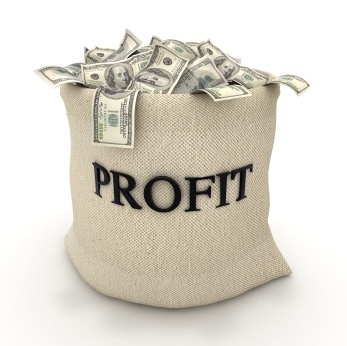
Which of the following is the best definition of PROFIT?
a)
The total amount of income a business makes from selling products or services
b)
The amount of money a business has left over after paying for their costs.
c)
The total amount of money a business spends.
64.
If you own a home, you must pay for electricity you use.  The amount you pay changes every month depending on how much you use. This is an example of a...
a)
FIXED cost.
b)
VARIABLE cost.
65.
Costs that do not change when the quanity of output produced changes?
a)
Fixed Costs
b)
Variable Costs
c)
Explicit Costs
d)
Implicit Costs
66.
Additional cost associated by producing one additional unit of product.
a)
Fixed Costs
b)
Average Costs
c)
Marginal Costs
d)
Emplicit Costs
67.
The amount a firm receives for the sale of its output.
P x Q = _____
a)
Profit
b)
Total Revenue
c)
Marginal Revenue
d)
Average Profit
68.
A movement upward and to the left along a demand curve is called a(n)
a)
increase in demand.
b)
decrease in demand.
c)
decrease in quantity demanded.
d)
increase in quantity demanded.
69.
Which is NOT a characteristic of perfect competition?
a)
Numerous buyers and sellers
b)
Standardized product
c)
Differentiated product
d)
Independent buyers and sellers
70.
The least competitive market structure
a)
Monopoly
b)
Oligopoly
c)
Monopolistic competition
d)
Perfect competition
71.
Which is NOT a characteristic of an oligopoly?
a)
Many sellers, few buyers
b)
Standardized or differentiated products
c)
More control of prices
d)
Little freedom to enter/exit market
72.
1.  Law of demand shows relation between:
a)
a)  Income and price of commodity
b)
b) Price and quantity of a commodity
c)
c)  Income and quantity demand
d)
d)  Quantity demanded and quantity supplied
73.
Which one of the following is considered an economic want?
a)
Food & Water
b)
Clothing
c)
Shelter
d)
Transportation
74.

Which of the following is NOT a question that all societies must answer?

a)

What to produce

b)

How to produce

c)

Why to produce

d)

For whom to produce

75.
Scarcity is central to the study of economics because it implies that
a)
markets cannot properly allocate resources.
b)
wants can not be fulfilled and thus all goods must be rationed.
c)
every choice involves an opportunity cost.
d)
wants are unlimited.