
 Worksheets
World History 1st Semester Exam
Total questions: 75
Worksheet time: 13hrs 30mins
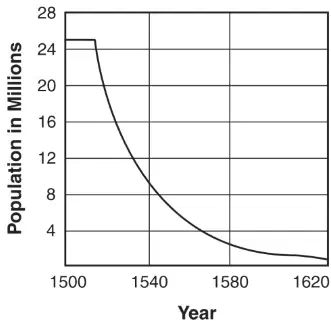
Decline of Estimated Native Population of Central Mexico chart: What was the main cause of the population change shown on the chart above?
the migration of several culture groups to North America
losses due to Spanish military actions against native peoples
starvation resulting from declining agricultural production
the introduction of disease by contact with Europeans
The stories from Marco Polo’s travels encouraged Europeans to
journey to Asia in search of wealth.
abandon the feudal land system.
launch the Crusades against Muslims.
isolate themselves from foreigners.
England became a Protestant country during the Reformation when its
king declared himself head of the Church of England.
people demanded the adoption of Lutheran beliefs.
priests opposed reforms implemented by the Pope.
armies were exposed to Calvinist beliefs while in France.
What was the Spanish Inquisition (1478–1834)?
a system designed to establish new colonies in the Americas
the exchange of goods between Spain and Central and South America
the religious court established to find and punish heretics
a military campaign to drive the Muslim armies out of Spain
During the Renaissance, there was a rebirth of interest in, and study of, the classical cultures of
Greece and Rome.
Japan and India.
Egypt and Turkey.
Russia and China.
The first African slaves were brought to the Americas to
be servants for wealthy New England families.
build missions and settlements for the Spanish.
work on Portuguese sugar plantations in the Caribbean.
help colonists fight wars against the Native Americans.
In the 1400s, the first Portuguese explorers sailed along the coast of Africa. What was the main purpose of their voyages?
finding a water route to India’s spices
finding natives who would trade with them
finding slaves who could be sold in other lands
finding a new world that no European had ever seen
What was an effect of Spanish contact with Native American groups in Mexico and South America?
Spanish explorers brought the Aztecs and Incas horses and weapons for battle.
Brutal attacks by the Spanish conquistadores and the spread of disease led to the fall of the Aztecs and Incas.
The Spanish joined forces with the Aztecs and Incas against the Mayas and Toltecs.
Spanish explorers brought the language and religious customs of Native Americans back to Spain.
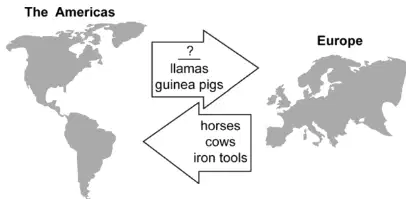
Use this diagram to answer the following question. The Columbian Exchange map shows arrows between The Americas and Europe, with items such as llamas and guinea pigs listed toward Europe, and horses, cows, and iron tools listed toward The Americas. Which crop was brought to Europe from the Americas?
rice
oats
corn
wheat
There were many advancements during the Age of Exploration. Which led to the settlement of the Americas?
better farming technology
better printing technology
better sailing technology
better military technology
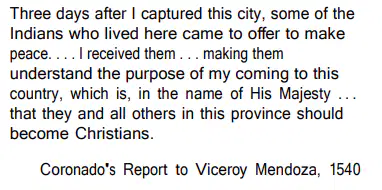
According to the excerpt, what caused Coronado to conquer this city?
He was seeking trade with the native people.
He wanted to convert his fellow explorers in the region to Christianity.
He was searching for a fortune in diamonds that were reported in the area.
He wanted to Christianize the native population.
How did the Reformation affect exploration and settlement in North America?
Rivalries between European nations limited travel to America.
Protestant groups established colonies seeking religious freedom.
Joint-stock companies were formed to acquire and establish colonies.
Disputes within the Orthodox churches led people to seek refuge in America.
Which is an effect of European exploration of the Americas?
Germany extended its New World empire.
Spain dominated North and South America.
Africans were enslaved to work in mines and on plantations.
American Indians maintained resistance to African and Eurasian diseases.
What was a significant result of European exploration through the Columbian Exchange?
Europeans became dependent on crops from America.
The bubonic plague spread throughout Europe.
European diseases caused millions of deaths among American Indians.
Raw materials from America became very expensive due to scarcity.
In the 1500s, Spain and Portugal led European countries in exploring the Western Hemisphere. What was an important result of this exploration?
Italy was prevented from claiming land in the New World.
Spain and Portugal established colonies in the Americas.
European nations lost interest in trading with Asia.
The Spice Islands were discovered.
Why was the Renaissance an important period in European history?
New ways of thinking led to improvements in society.
Religion was no longer important to society.
European armies were able to conquer much of the world.
The spread of diseases came to an end.
The following statements describe an important movement in European history:
• The movement began in the early 1500s.
• Important to the movement were Martin Luther’s 95 Theses.
• The movement’s followers protested the power of the Roman Church.
What movement do the statements describe?
the Middle Ages
the Renaissance
the Reformation
the First Dynasty
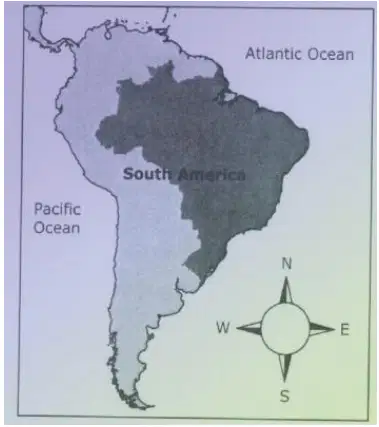
Use this map to answer the question. How did the darker-shaded area become a European colony?
French missionaries settled the area.
Explorers claimed the area for England.
The conquistadors conquered the area for Spain.
The Treaty of Tordesillas honored the claim of Portugal to the area.
What was one effect of Copernicus’ theory of a sun-centered solar system?
It required a revision of the Christian calendar.
It disputed Church teachings regarding the universe.
It allowed sailors to predict tides more accurately.
It resulted in a decline in pagan religions.
The “Triangle Trade” and “Columbian Exchange” are terms used to describe the movement of goods between Western Europe, West Africa, and
Central Asia.
the Americas.
Australia.
the Middle East.
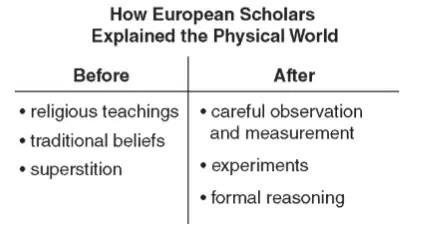
How European Scholars Explained the Physical World (Before: religious teachings; traditional beliefs; superstition. After: careful observation and measurement; experiments; formal reasoning). The changes shown in the lists above were a result of which of the following?
the Fall of the Roman Empire
the Crusades
the Scientific Revolution
the American Revolution
The environment influences the way people live and work. What is one way Incan farmers living in mountainous regions were affected by their environment?
They terraced their fields.
They created paddy fields.
They used horses for plowing.
They invented the slash-and-burn technique.
How did movements like the Protestant Reformation contribute to the rise of nation-states?
It ended the practice of serfdom.
It gave the right of self-government.
It united all Christians under one leader.
It challenged the absolute power of the pope.
How did the revolution in printing contribute to increased global interaction during the Renaissance?
by providing free books to all people
by requiring people to read scripture
by increasing profits from publishing
by making it easier to spread ideas
In the Middle Ages, European monarchs claimed to rule by “divine right”. What purpose was served by this claim?
It enabled the separation of church and state.
It enabled rulers to seize church lands.
It demonstrated that religion was stronger than political power.
It strengthened the monarch’s authority to rule.
The voyages of Columbus changed life in Europe by
introducing new foods and spices to Europe
showing Europeans a shorter route to Asia
introducing the horse to Spain
proving that the Earth was flat
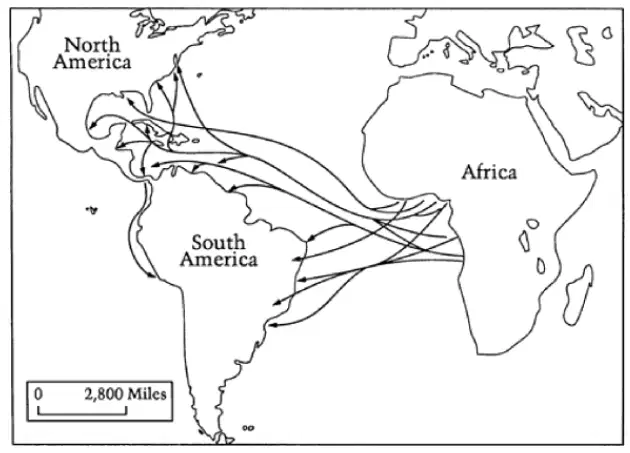
The map above shows many of the trade routes for
spices
tea
slaves
silk
At the time Columbus arrived in the Americas, most of the area that is now called Mexico was controlled by people called the
Apache
Aztecs
Iroquois
Inuit
The most powerful social class in Spain’s American colonies in the 1500s was composed of people
of mixed Spanish and Indian ancestry
of Mexican ancestry
of Spanish ancestry born in America
born in Spain
Magellan’s expedition was significant because it was the first to
circle the world
reach South America
bring horses to the Americas
sail around Africa
The first Spanish explorers who reached the Americas were looking for
a route to Alaska
a new route to Asia
proof that the world was flat
new land for farming
Indentured servants were different from slaves because indentured servants
came from the West Indies
were freed at the end of their term
were paid less money
did much easier work
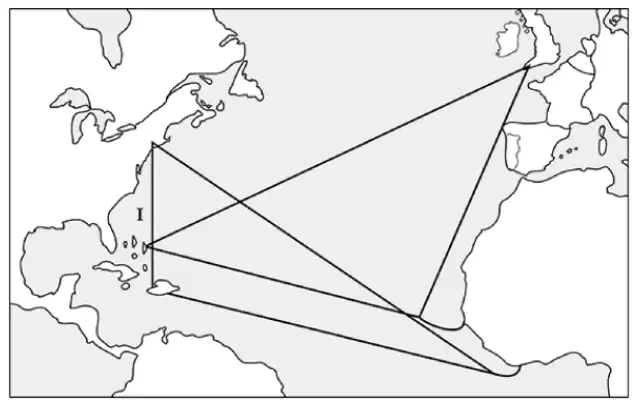
This question is based on the map below. The seventeenth-century patterns of trade represented by the lines on the map were known as the
trade deficit
tariff system
barter system
triangular trade
Confucianism stressed each of the following EXCEPT
Importance of education
Moral character
Strict, harsh laws
Social order
What method did the Chinese Song Dynasty use to choose their government officials?
They used slaves
They only selected aristocrats
They only selected foreigners
They used the civil service exam system
Each of the following were responsible for spreading Islam after 632 CE EXCEPT
Merchants
Mongols
Missionaries
Military
Which of the following best represents an accomplishment by the Islamic Empires?
Made paper
Improved agriculture by using chinampas
Made gunpowder
Spread math concepts from India
Which of the following represent the social system in South Asia (India)?
Caste system
Confucianism
Mita system
Feudalism
Which of the following belief systems spread into Northern India (Sultanate of Delhi)?
Judaism
Christianity
Islam
Buddhism
The Aztecs believed in human sacrifice because
They wanted to show people how tough they were
They believed it would please their gods
They believed it unified them with the Incas
It was part of their monotheistic belief system
The Aztecs built chinampas that were
Pyramids
Floating gardens
Walls
Mexican food
How did the Incas manage such a remote empire?
People were completely free to govern themselves
They had a pony express
They used a complex road system
They used pigeons to carry messages
Which of the following languages was commonly spoken on the East Africa coast?
Spanish
Hindi
Chinese
Swahili
Which of the following was NOT true about Feudalism in Western Europe?
Social mobility was common
Knights followed a code of chivalry
Exchanges of land for loyalty and protection
System was based on agriculture
Which of the following is FALSE about the Crusades?
Christians gained long-term control over the Holy Land
An effect was increased cultural exchange between Europe and the Middle East
A goal was to reclaim the Holy Land
The Pope wanted to increase control/power
What did the Bantu-speaking people spread across Sub-Saharan Africa?
Christianity
Islam
Language
Gunpowder
The Renaissance in Europe
Created one common language
Was a rebirth and creativity in the arts
Moved Europe further away from the cultures of Greece and Rome
Brought Europe back to feudal times
Which 2 belief systems often clashed in South Asia?
Christianity and Judaism
Hinduism and Christianity
Hinduism and Islam
Confucianism and Buddhism
Which of the following was NOT a participant in the Silk Roads trade network?
Middle Eastern empires
Europeans
China
Aztecs
Which empire/country was known for their production/trade of porcelain and silk?
Europe
Aztecs
China
Middle East
Each of the following was true about the Mongols EXCEPT
They were skilled horse riders
They revived the Silk Roads
They forced their religion on conquered peoples
They brutally conquered population that resisted
The Yuan Dynasty was a Mongol led dynasty in
China
Europe
North Africa
Mesoamerica
Which of the following most impacted trade/travel on the Indian Ocean in the period 1200–1450?
Monsoon winds
Steam engines
Camel caravans
Mongol warriors
Which part of Africa was most involved in the Indian Ocean trade?
Swahili Coast
North Africa
Mali Kingdom
Ghana Kingdom
In Southeast Asia, which modern day country became known in trade as the Spice Islands?
Vietnam
Indonesia
Japan
Swahili Coast
Which merchants were most responsible for the traveling on the Trans-Saharan trade network?
Mongolian merchants
Muslim merchants
Venetian merchants
Indonesian merchants
Which animal was key to Trans-Saharan trade?
Llama
Horse
Camel
Ox
Which 2 luxury goods were dominant as part of the Trans-Saharan trade network?
Slaves and pepper
Gold and salt
Spices and horses
Silk and porcelain
Marco Polo’s travel to which country intrigued readers about this more advanced culture?
Morocco
Americas
China
Spain
Which belief system will spread into East Asia (China, Japan, Koreas) and blend with indigenous beliefs?
Hinduism
Christianity
Buddhism
Islam
Which of the following is NOT true about the Bubonic Plague?
Travelled by fleas
Led to a shortage of workers
Origins in China
Was cured by plague doctors
The Mongols conquered parts of each of the following regions EXCEPT
Central Asia
Western Europe
Iran
Middle East
Each of the following are true of Zheng He’s (China) voyages EXCEPT
Travelled all the way to Western Europe
The voyages opened up new trade markets for Chinese goods
They were ended by the government as they turned to isolation
Main purposes of the voyages were to display the might of the Ming Dynasty
Which belief system focuses on the divine forces in nature?
Dar al Islam
Animism
Confucianism
Sikhism
The head of the Roman Catholic Church is the
Patriarch
Shaman
Pope
Brahman
A single spiritual power that Hindus believe lives in everything is the
Brahman
Shaman
Pope
Patriarch
The combination or mix of different forms of beliefs or practices is called
Urbanization
Tribute
Factions
Syncretic
The founder of Buddhism is
Siddhartha Gautama
Sahara
Laozi
Sharia
Judging another culture by standards of one’s own culture is called
Metallurgy
Hereditary
Ethnocentrism
Archaeology
The region of “Middle America” extending from Mexico through Central America is called
Spice Islands
Sub-Saharan Africa
Mesoamerica
Gran Columbia
The fulfillment of one’s social and religious duties in Hinduism is called
4 Noble Truths
Dharma
Alms
Sacraments
Which of the following is NOT an effect of the agricultural revolution?
Larger settlements
Decreasing population
Surplus food
Increased specialization
Where did most early civilizations develop?
Along bodies of water
In the mountains
In northern territories away from the heat
Inland areas away from water
Which of the following best describes Daoism?
Harmony with government
Harmony with nature
Harmony with the emperor
Harmony with Samurai
The social class in Japan that served as warriors were called
Knights
Daimyo
Samurai
Shogun

