
 Worksheets
Early Medieval Europe
Total questions: 80
Worksheet time: 40mins
Which civilization fell and began the Middle Ages in Europe?
Carthagenian
Roman
Greek
Chinese

What was typically the subject of Medieval art and literature?
Hellenistic Art
Roman Art
Folklore and Fairy Tales Art
Christian/Religious(Pietistic) Art
The political and social system of the Middle Ages in Europe, in which lords gave land to vassals in exchange for service and loyalty
Monarchy
Democracy
Socialism
Feudalism

Powerful land-owners, that would live in the Manor House
Nobles/Lords
Knights/Vassals
Peasants/Serfs
King/Monarch

Worked the land for nobles and performed back breaking tasks
Nobles/Lords
Knights/Vassals
Peasants/Serfs
King/Monarch
The Noble’s house and the villages on his land where peasants lived was collectively called the ____?
Town
Village
Castle
Manor
The code by which knights lived
Code of Chivalry
Honor Code
Monarch Code
Code of the Military

Who won the Battle of Tours- defeated the Muslim (Spanish Moors) who were invading Europe
William the Conqueror
Joan of Arc
Charles "the Hammer" Martel
Henry V
This organization united the people of Western Rome after its fall to Germanic tribes.
Eastern Orthodox Church
Knights Templar
Germanic Tribes
Roman Catholic Church
Heresy is ____?
A Knight's code of Chivalry
The Pope's right to excommunicate members of the Catholic church
The call to a Holy War against the enemies of God
Beliefs that conflict or go against church teachings
Monasteries were ______
Places where monks lived, worked, & worshipped
Places where nuns lived, worked, and worshipped
Training facilities for Knights and Men-in-arms
Storage facilities for grain within a castle keep
What did Japan and Europe have in common in the Middle Ages?
They were both industrial societies
They were both feudal societies
They both explored the world by sea
They both fought the Koreans

According to the Feudal Pyramid, which group was responsible for farming the land?
Lords
Knights
Serfs
Jesters
According to the Feudal Pyramid, which group was given land in return for fighting and providing protection for the peasants?
Lords
Knights
Serfs
Squires

According to the image, who would be working at locations 9, 10, and/or 5?
Lord
Priest
Knight
Serf
According to the image, who would be working at location #2?
Lord
Priest
Knight
Serf

Who was the Frankish king that stopped the Moors (muslims) from entering France and established Christianity as the religion of Europe.
Richard the Lionhearted
Harold II
Charles III
Charlemagne

Which of the following is true of monks in monasteries during the Middle Ages?
They provided education to the rest of the world; training even the nobility
They were some of the only people in the Middle Ages who knew how to read and write
They wrote books and recorded events; without which we would know very little about what happened during the Middle Ages
All of the above
What king was crowned the first Holy Roman Emperor by the pope?
Pepin the Short
Charlemagne
Henry V
Zelenskyy
What were the heavily armored soldiers of the Frankish cavalry called?
Barons
Knights
Earls
None of the Above
What was the land called that a king gave to his knight or lord in return for his loyalty?
Fief
Bailiwick
Muggle
Precinct
Acre

Using the map above what which Group of Mountain ranges are presented ?
Ural
Alps
Rocky
Appalachian
What is Feudalism?
a social system where vassals swear loyalty to lords in return for land
a social system where kings rule absolutely
a social system where lords swear loyalty to vassals and vassals give lords land
a social system where Kings rule but with the help of government
What is a Manor System
a large city that uses imports and exports to make money
a farming community, that will eventually turn into towns
the sails that help a ship pick up speed
the process of changing religions, without the permission of the pope

Using the Image above, Who is a direct vassal to the Nobles/Lord?
the King
Knights/Vassals
Serfs/Peasants
government
What is a vassal?
someone who pledges loyalty to a lord
someone who works for the king
a clown who performs for a king
someone who runs a manor and lives in a large house
What was the Concordat of Worms ?
An agreement between the King and Pope on electing church officials
an agreement on who controls the empire
an agreement on how much land each king gets
a system where vassals swear loyalty to kings in return for land
Which king was responsible for signing the Concordat of Worms?
King Henry V
King Henry II
King Henry IV
King Jon
Who was known as the most powerful germanic tribe?
Goths
Anglos
Franks
Saxons
Who created the first empire after the fall of the Roman Empire, and was crowned Roman Emperor by the Pope after protecting him from revolts?
Charles "The Hammer" Martel
Chalemagne
Pope Gregory IV
King Henry V
What were the writings decorated with beautiful lettering and miniature religious paintings called?
Illuminations
Concordants
Monasteries
Abbeys
What agreement was signed in the German city of Worms regarding the appointment of bishops?
Concordant of Worms
Carolingian Renaissance
Papal States
Battle of Tours
What happened to the Italian monk named Hildebrand in 1073?
He became Pope Gregory IV
He became king of the Franks
He created the rules of St. Benedict for the monks
Why did Gregory VII and Henry IV clash?
Henry IV believed that the Pope was evil and corrupt.
They were both related and had a fight over inheritance.
Gregory VII believed that the Emperor should have no power over the church.
What did Henry IV do to really "tick off," or anger Gregory VII?
Henry IV chose his own bishop for the city of Milan, Italy, which broke one of the Pope's rules.
Henry IV attacked the Pope's castle with an army of 14,000 men, forcing the Pope to wait outside and beg for mercy.
Henry IV married someone who Gregory VII did not like.

In 1076, Gregory VII excommunicated Henry IV. What does excommunicate mean?
To give someone extra communication in an argument
To beg someone to give you an opportunity
To exclude a person from a church or a religious community
What was the Concordat of Worms?
An agreement that solved the problems between Church and State forever, marking the first moment of peace between the 2 sides
An agreement that stated worms are good for compost and farming
An agreement that gave the Church the sole authority to appoint bishops but also allowed kings to give land to bishops to gain their loyalty
The title given to Charlemagne by Pope Leo III was
King of the Franks
Duke of Normandy
Archduke of Saxony
Holy Roman Emperor
The pope's decision to crown Charlemagne had what unintended consequence?
The pope's overall power decreased, as the Holy Roman Emperor took charge of the Christian faith
Subsequent (future) popes had the authority to crown and remove kingship from monarchs
The pope gained access to a standing military that would do his bidding
The Holy Roman Empire became a dynasty ruled by Charlemagne's descendants
The conflict between Henry IV and Gregory VII was called _________________. The conflict was eventually resolved with the ______________________.
Investiture Controversy, Concordat of Worms
Concordat of Worms, Treaty of Augsburg
War of Kappel, Treaty of Paris
Coronation of Charlemagne, Diet of Worms
A monastery is
a government post used in the administration of early European kingdoms
a building dedicated to printing and spreading Biblical texts
A religious community that served as schools, hospitals, and religious centers
an aristocratic farm dedicated to the production of agricultural goods
Other than serving as a devout Christian, monks also
preserved Christian and classical texts by copying and storing them
took charge in political affairs
dedicated their life to creating the denominations of Christianity
served as commanders of small religious militias in times of need
The lowest of the feudal classes was ________. Their job in society was to _________
knights, serve as the military class
lords, to own land
serfs/peasants, farm on the manor
serfs/peasants, serve as the military class
The center of medieval life and agricultural production was called
the manor
the demesne
the fief
the castle
The military class in society was the _________. They received land in exchange for their _____________ _____________.
kings, land
lords, land
knights, military service
serfs, labor
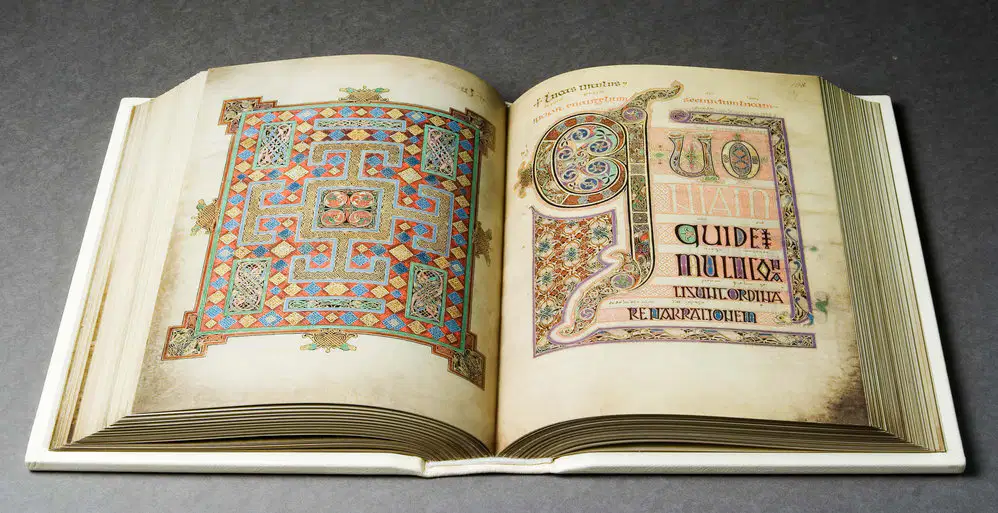
Who made Illuminated Manuscripts?
Christian monks
Christian nuns
Roman Priests
Viking Priestesses
Illuminated Manuscripts produced during what period?
The Renaissance
The Late Dynastic
The Medieval
The Post-Impressionism
The art of decorative lettering is called
Scribology
Letterology
Iconography
Calligraphy
Illuminated Manuscripts were made by a team of workers.
True
False
Illuminated means
fancy
decorated with gold /silver
decorated with pictures
there is writing
Pictures were important in in books because
many people could not read
the pictures entertained people
the pictures made the book more expensive
the pictures took up space
The pages of Illuminated Manuscripts were made of
Rice Paper (from rice starches)
Paper (from wood pulp)
Papyrus (from reeds)
Vellum (from calf skin)
The books would be made for and owned by
peasants
the church
the monastery
royalty
What was the subject of much of the writing during the Middle Ages?
Christianity
Mythology
Science
Buddhism
What is an illuminated manuscript?
Digital book created during the Middle Ages
Handwritten book created during the Middle Ages
Printed book created during the Middle Ages
Who were the main people to write illuminated manuscripts?
The Pope
priests
monks
librarians

What is the name of the Illuminated Manuscript in Ireland that consists of the four Gospels of the New Testament?
Old Manuscripts
The Book of Kells
The Golden Book
Duncanistic Manuscripts

What is an ILLUMINATED manuscript?
A manuscript decorated with colors and gold or silver
A manuscript decorated with lights
A manuscript with clear explanations


What physical feature is at 1?
Mediterranean Sea
Danube River
English Channel
Rhine River
Alps Mountains

What Physical Feature is located at 7?
Alps Mountain
Ural Mountains
Pyrenees Mountains
North European Plain
Danube River

Where are the Alps located on the map?
Location A
Location B
Location C
Location D
warm ocean current that produces warm winds and rains across Europe
North Atlantic Drift
East Atlantic Current
South Saharan Breeze
South Pacific Drift

Arabian Peninsula
Iberian Peninsula
Korean Peninsula
Italian Peninsula

Asia
Africa
Europe
Australia

Great Plains
Iberian Peninsula
European Plain
Ural Mountains
What impact did Charlemagne have on feudalism?
He strengthened feudalism by implementing a strict hierarchy
He had no impact on feudalism
He abolished feudalism completely
He introduced new laws to regulate feudal relationships
What did Charlemagne create?
The Byzantine Empire
The British Empire
The Ottoman Empire
The Holy Roman Empire
Which religion did Charlemagne establish as the religion of the Empire?
Islam
Judaism
Christianity
Buddhism
Which term best describes the social structure during Charlemagne's time?
Capitalism
Socialism
Feudalism
Communism
What was the significance of the Holy Roman Empire?
It brought together the Germanic tribes under one ruler
It established a strong centralized government in Europe
It promoted the spread of Islam throughout Europe
It had no significant impact on medieval Europe
What was the significance of Christianity in Charlemagne's Empire?
It led to conflicts and divisions within the Empire
It had no significant impact on the Empire
It promoted the spread of other religions in the Empire
It brought unity and a common belief system to the Empire
What's the difference between a monk and a nun in medieval Europe?
Social status: monks are in charge of nuns
Economic status: nuns are rich, monks are poor
Gender: monk (male), nun (female)
Religion: monk (Christian), nun (Muslim)

How did monks maintain 'classical' knowledge
Translated and maintained classical books.
They ran schools about Greece and Rome.
They made sure that all Europeans could read.
They traveled to other civilizations, collecting books.

By providing stability and help to the people living near them, monks...
helped spread Muslim ideas.
encouraged the worship of kings.
encouraged religious diversity in Europe.
helped promote and maintain Christianity in Europe.
How did monks help people?
They gave them money.
They cared for the sick and poor.
They travelled with people
They grew their own food.
St. Benedict
How many times a day did Monks and nuns pray?
1
3
8
100

