
 Worksheets
Honors Econ EOY Review
Total questions: 75
Worksheet time: 57mins
The condition that results from society not having enough resources to produce all the things people would like to have
Scarcity
Opportunity Cost
Economics
Private Property
The term "land" means:
The natural resources used to produce goods or services.
Work the people do to produce goods and services.
Goods not created for their own use, but to make other goods/services.
Person who organizes the factors of production to produce goods/services; business owners.
The term "labor" means:
Work the people do to produce goods and services.
The natural resources used to produce goods or services.
Person who organizes the factors of production to produce goods/services; business owners.
Goods not created for their own use, but to make other goods/services.
Iron, minerals, coal, and plants are examples of which productive resource?
land
labor
entrepreneurship
capital

A company can use its current resources to produce hats and boots as shown in this production possibilities curve. Which of the following represents a movement from inefficiency to efficiency in this PPC?
From T to S
From V to T
From S to V
From S to R
From S to U

Based on the production possibilities curve shown here, what is the opportunity cost of a T-Rex costume?
0.4
0.25 of a T-Rex costume
4 velociraptor costumes
0.25 T-Rex costumes
10 velociraptor costumes
Based on the production possibilities curve shown here, what is the opportunity cost of a T-Rex costume?
0.4
0.25 of a T-Rex costume
4 velociraptor costumes
0.25 T-Rex costumes
10 velociraptor costumes
Opportunity cost is your ____.
first choice
second best alternative
trade-off of a choice
allocation of a good or service
_______ alternatives that must be given up when one is chosen rather than another.
opportunity cost
trade-off
need
want
The three basic economic questions are
when, where and how
for whom, when and where
for whom, what and how
why, where and when
What is an economic system where only the government makes the economic decisions?
traditional economy
free enterprise
mixed economy
command economy
What type of economy do most countries in the world have?
Market economy
Command economy
Traditional economy
Mixed economy
The government has little to no role in the production of goods in this type of economy.
Traditional
Mixed
Command
Market
Role of government in a mixed economy
regulate the market
own the market
reject the market
You normally buy a Starbucks Double Mocha Frappuccino with extra whipped cream, extra chocolate drizzle, and extra sprinkles on your way to school every day. You receive a 20% decrease in pay due to a recession and start buying QT coffee instead. What would this make QT coffee?
A normal good
An inferior good
A complement for higher income people
A better cup of coffee than Starbucks

A product that is used or consumed jointly with another product; tennis rackets and tennis balls are one example.
Demand
Supply
Complementary Good
Substitute Good
For the law of supply, as price rises, what happens to the quantity supplied?
it goes up
it goes down
it stays the same
it is not affected
If a price is above the equilibrium price, it creates a...
shortage
surplus
market price
demand
If a price is below the equilibrium price, it creates a...
shortage
surplus
market price
supply

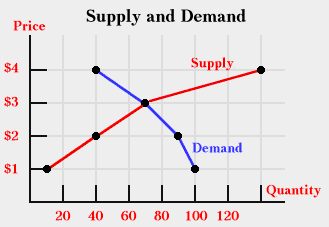
What is the equilibrium price?
1
2
3
4

The difference between scarcity and shortage is:
Scarcity is a natural & re-occurring condition; shortage is a man-made condition.
Shortage only happens with new products.
Shortage is a natural & re-occurring condition; scarcity is a man-made condition.
Shortage is the fundamental, universal economic problem.
All of the following can change the supply curve EXCEPT
cost of labor
change in demand for the product
expectation that prices are about to increase
# of sellers
A ________ is a business entity that is owned by its shareholders.
monopoly
oligopoly
corporation
sole proprietorship
An ___________ is when a few companies have significant control over a given market.
partnership
oligopoly
monopoly
revenue
In March 2020, due to Covid, toilet paper, paper towels, and Lysol wipes were extremely difficult to find in stores. This is an example of:
Scarcity
Shortage
Which of the following two goods is more likely to be inelastically demanded?
Demand for Exxon gasoline at the corner of 7th and Grand
Demand for gasoline in the entire city
Price ceilings are set by the government to...
protect producers by setting a minimum price
protect consumers by setting a maximum price
protect producers by setting a maximum price
protect consumers by setting a minimum price
The change in total product or output
increasing product
marginal product
profit
The rise in the general level of prices reduces the "purchasing power" of money.
Inflation
Price Indices
Real Wage
Inflation Rate
1. Promote economic growth
2. Limit unemployment
3. Keep prices stable (limit inflation)
Major Economic Goals for Every Country
factors of productivity
components of GDP
Income approach adds up
What is the price for labor?
value
labor productivity
wages
human capital
The lowest legal wage allowed for one hour of work.
wage floor
wage ceiling
glass ceiling
minimum wage
Piece of ownership in a company, mutual fund or other investment
Share/stock
401K
Bond
What federal organization insures banks?
FDCI
FDOC
FDIC
FDDC
Profit from the sale of an investment is known as...
collateral gains
Cash
Sales margin
Capital gains
Stocks ________________.
ownership in a company
the sale item on Amazon
papers that are invalid
a sounds a bird makes
Has been at the same job for 5 years?
Collateral
Capital
Character
Capacity
Credit History
Pays bills on time
Collateral
Capital
Character
Capacity
Credit History
Collateral is:
required for all personal loans
only required if a credit score is not high enough
used with unsecured loans
property that can be seized by the lender if a loan is unpaid
Which of the following is an IMPACT of a regressive tax?
Lower income groups are negatively impacted.
Everyone is impacted the same.
Lower income groups benefit.
What type of tax system is described as "everyone pays the same percentage"?
Progressive
Regressive
Proportional
Arbitrary
What is a budget?
A budget is a type of fruit
A budget is a type of animal
A budget is a type of car
A budget is a financial plan that outlines expected income and expenses over a specific period.
What is Inflation?
Money being able to buy more products
is rising general level of products and it reduces the “production power” of money.
is rising general level of prices and it reduces the “purchasing power” of money.
is lowering general level of prices and it raises the “purchasing power” of money.
Who is in charge of Monetary Policy
The Government
The Federal Reserve System
The states
The Department of the Treasury
A _____________ consists of checks, currency, or coins put into a bank account.
direct deposit
ATM
deposit
checking account
What are the effects of bankruptcy?
The effects of bankruptcy include the discharge of certain debts, the liquidation of assets to pay off creditors, damage to credit score, and limitations on obtaining credit in the future.
Bankruptcy allows for unlimited access to credit in the future
Bankruptcy has no effect on debts or credit score
Bankruptcy results in immediate forgiveness of all debts
What are the three main objectives of the Federal Reserve Board?
Maintain full employment, control inflation, and set interest rates
Regulate international trade, enforce antitrust laws, and protect consumer rights
Stimulate exports, reduce imports, and balance the budget
Increase government spending, reduce taxes, and print more money
What is the main job of the Chairman of the Federal Reserve Board?
Regulate the U.S. economy
Enforce tax laws
Manage foreign relations
Control the military
What are the 3 functions of money?
Measure of Gold
Store of Value
Medium of Exchange
Store of Bank Notes
Measure of Value

When one country is good at producing in a particular commodity, they have a(n) _____ .
Comparative advantage
Complete specialization
Absolute advantage
None of the above
The producer with the lowest opportunity cost.
Comparative Advantage
Trade Off
Absolute Advantage
Opportunity Cost
a trade surplus means
value of exports = value of imports
value of exports < value of imports
value of exports > value of imports
What occurs when a country's imports exceed its exports?
Fiscal deficit
Trade deficit
Budget surplus
Trade surplus
Situation in which a nation buys more goods than it sells.
Trade surplus
Trade deficit
Trade barrier
Reserve requirement

