wayground logo

Free Printable Worksheets

NEW

Font size

S
M
L
XL
Worksheets

Semester 2 Final Review

Total questions: 65

Worksheet time: 5hrs 25mins

Name
Class
Date
1.
Would the octagon and the equilateral triangle tessellate?
a)
Yes; two octagons and one triangle meet at each vertex; 150+150+60=360
b)
Yes; two octagons and one triangle meet at each vertex
135+135+60=360
c)
Yes; one octagon and two triangles meet at each vertex
135+60+60=360
d)
No; there is no combination of 135 and 60 that adds up to exactly 360
2.
In a tessellation, the measures of the angles that meet at each vertex must add up to 360 degrees.
a)
True
b)
False
3.

The base of the triangle is 5 inches. The length of the rectangle is 15 inches. The height of the triangle is 10 inches. Find the surface area.

a)

300 inches

b)

200 inches

c)

275 inches

4.

Find the lateral surface area of the following shape:

a)

378

b)

216

c)

504

d)

324

5.

Find the lateral surface area of the following shape:

a)

40

b)

1374

c)

480

d)

205.36

6.
Solve for x. SIMPLIFY your radical answer completely.
a)
2√6
b)
6√2
c)
4√6
d)
6√4
7.

√243 =

a)

3√3

b)

9√3

c)

81√3

d)

3√81

8.
What shape is the base? What is the area of the base (B)?
a)
Rectangle; 60in2
b)
Triangle; 12 in2
c)
Rectangle; 32 in2
d)
Triangle; 6 in2
9.

Chloe colors a border around a drawing. The height of the drawing is 2 in. greater than the 6-in. base. What is the area of the border?

a)

51 in2

b)

99 in2

c)

54 in2

d)

48 in2

10.
Find the area of the trapezoid
a)
20
b)
21
c)
19
d)
22
11.
Solve for the missing angle
a)
32°
b)
44°
c)
61°
d)
50°
12.
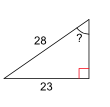
Find the measure of the indicated angle (?) round to the nearest tenth.
a)
9.4
b)
55.2
c)
20.15
d)
19.4
13.
Which of the following sentences would belong in the proof that describes this image?
a)
The sum of the areas of the two smaller squares is equal to the area of the large square.
b)
The sum of the side lengths of the two smaller squares is equal to the side length of the large square.
c)
The difference of the areas of the two smaller squares is equal to the area of the large square.
d)
The differences of the side lengths of the two smaller squares is equal to the side length of the large square.
14.
Find the area
a)
96 cm2
b)
48 cm2
c)
36 cm2
d)
48 cm
15.

The outside wall of a dollhouse has the shape of this polygon. What is the area of the polygon?

a)

646 in2

b)

594 in2

c)

600 in2

d)

650 in2

16.
Find the area of the compound shape
a)
32 ft2
b)
76 ft2
c)
56 ft2
d)
120 ft2
17.
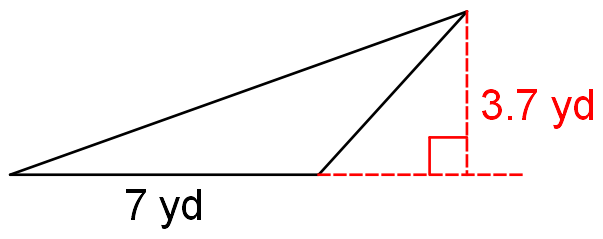
Find the area.
a)
25.9 yd2
b)
12.95 yd2
c)
6.475 yd2
d)
12.95 m2
18.

Find the volume of the solid shown in the figure and answer in terms of pi.

a)

480π m3

b)

1440π m3

c)

360π m3

d)

120π m3

19.
Find the total surface area of the figure.
a)
500 ft2
b)
515 ft2
c)
525 ft2
d)
510 ft2
20.
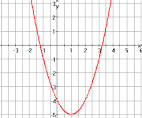
What is the equation of this graph?
a)
f(x) = (x -5)2 + 1
b)
f(x) = (x - 1)2 - 5
c)
f(x) = (x + 1)2 - 5
d)
f(x) = (x + 5)2 +1
21.
If given the equation
y = 3(x + 5)2 - 4,
what is the vertex of the parabola?
a)
(5, -4)
b)
(-5, -4)
c)
(-15, -4)
d)
(15, -4)
22.

Find the Vertex: y= x2 +6x + 4

a)

(-3, -5)

b)

(5, 3)

c)

(3, 5)

d)

(5, -3)

23.

Convert to Vertex Form

4a2+16a-39 = y

a)

4(a2+16a)-39

b)

4(a+2)2-55

c)

(a+2)2-16

d)

4(a+2)2-43

24.
Factor: x2 – 5x – 24
a)
(x - 5)(x + 19)
b)
(x - 8)(x + 3)
c)
(x - 3)(x + 8)
d)
(x - 19)(x + 5)
25.
Factor
n2 + 16n + 63
a)
(n-7)(n+4)
b)
(n+7)(n-9)
c)
(n-3)(n-10)
d)
(n+7)(n+9)
26.
Factor
3a2 + 4a + 1
a)
(7a-10)(a-8)
b)
Not factorable
c)
(3a+1)(a+1)
d)
(3a-1)(a-1)
27.
Factor
3v2 - 4v - 7
a)
(3v-7)(v+1)
b)
3(v-7)(v-1)
c)
(3v+1)(v-9)
d)
(3v+1)(v-10)
28.
factor:x- 25
a)
( x + 5 ) ( x - 5 ) 
b)
( x - 5 ) ( x - 5 ) 
c)
( x + 5 ) ( x + 5 ) 
d)
Prime
29.
Solve by factoring:  2x2+ 7x + 6 = 0
a)
x= 3/2 and x = 2
b)
x = -3/2 and x = -2
c)
x = 6 and x = 7
d)
x = -6 and x = -7
30.
The discriminant is
a)
aX2  + bX  +  c
b)
b - 4ac
c)
b2 - 4ac
d)
b2 + 4ac
31.
What does the discriminant tell us?
a)
The maximum or minimum
b)
The y-intercept
c)
The number and type of solutions
d)
The axis of symmetry
32.
a)
A
b)
B
c)
C
d)
D
33.
The profit from selling local ballet tickets depends on the ticket price.  Using past receipts, we find that the profit can be modeled by the function p= -15x2 +600x +60 , where x is the price of each ticket.  What is the maximum profit you can make from selling tickets?
a)
$6060
b)
$20
c)
$600
d)
$10,250
34.
Evaluate the expression using the quotient rule.
a)
214 z13
b)
22/z7
c)
214/ z7
d)
2z7
35.
a)
2a2b6
b)
1/2a2b6
c)
b6/2a2
d)
2b6/a2
36.
(34x5y6z-7)0
a)
34x5y6 / z7
b)
34x5y6 / x-7
c)
0
d)
1
37.
a)
x8
b)
x-5
c)
x-8
d)
x-13
38.
Convert
 f(x) = ⅔ (x + 3)2 
to standard form.
a)
f(x) = ⅔x2 + 4x + 6
b)
f(x) = ⅔x2 + 6x + 9
c)
f(x) = ⅔x2 + 6
d)
f(x) = ⅔x2 + 2x + 4
39.
Solve by elimination:
4x+9y=28
-4x-y=-28
a)
(-7,0)
b)
(6,0)
c)
(-6,0)
d)
(7,0)
40.
Solve by elimination:
7x-9y=29

7x+2y=-15
a)
(-4,-1)
b)
(-1.-4)
c)
(-1,4)
d)
(-1,6)
41.

Match the system to the graph.

a)

y ≥ -x - 1 and y < x + 4

b)

y < -x - 1 and y ≥ x + 4

c)

y > -x - 1 and y ≥ x + 4

d)

y > -x - 1 and y ≥ x - 4

42.
Factor
49a2- 36
a)
(7a - 6)(7a - 6)
b)
(7a - 6)(7a + 6)
c)
(7a - 18)(7a + 18)
d)
(7a - 18)(7a - 18)
43.
What would you do first to factor 
f2+3f -28   most efficiently?
a)
take f2 times -28
b)
find paired factors of +3f
c)
Find paired factors of -28 that add up to equal +3
d)
replace the 3f with 7f-4f
44.
What is the first question you ask yourself when factoring a polynomial? 
a)
How many terms does it have? 
b)
Is there a GCF? 
c)
What strategy should I use? 
d)
Why do I have to learn this?!?!?!
45.
Fully Factor the Following
16x2+25
a)
Prime
b)
(4x-5)(4x+5)
c)
(4x+5)(4x-5)
d)
(4x+5)2
46.
a)

y < x² - 4x + 4

b)

y > x² - 4x + 4

c)

y ≥ x² - 4x + 4

d)

y ≤ x² - 4x + 4

47.
a)

y > x² + 5

b)

y < x² + 2

c)

y > x² + 2

d)

y ≥ x² + 2

48.

How many solutions does this system of equations have?

a)

one solution

b)

two solutions

c)

three solutions

d)

no solutions

49.
Does the graph of this equation widen or narrow from the parent function?
g(x) = 3/4 (x - 5)2 + 12
a)
widen
b)
neither
c)
narrow
50.
Probability is ...
a)
the chance that some event will occur.
b)
a game that involves coins.
c)
a guarantee.
51.
A likely chance event is closer to what number?
a)
0
b)
1
c)
.5
d)
100
52.
An unlikely chance event is closer to what number?
a)
0
b)
1
c)
2
d)
3
53.
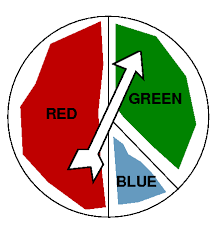
What is the probability of spinning the spinner and having it land on RED?
a)
33%
b)
50%
c)
12%
54.
A bag contains 5 quarters, 2 dimes, and 4 pennies. What is the probability of picking a quarter?
a)
5/11
b)
5/6
c)
1/3
d)
5
55.
What is the probability of drawing a red card from a standard deck of cards?
a)
1/52
b)
13/52
c)
1/2
d)
4/52
56.
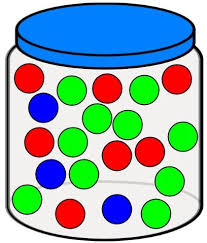
What is the probability of pulling a red marble out of a jar of marbles that have 10 green marbles, 7 red marbles and 3 blue marbles?
a)
1/7
b)
7/20
c)
7/10
d)
3/10
57.
What is the probability of the spinner landing on red?
a)
5/12
b)
1/5
c)
5/5
d)
3/5
58.

Marvin has a standard deck of cards.


P (Ace or 5)

a)

1/13

b)

2/13

c)

1/26

d)

8/50

59.
Experimental Probability is:
a)
What Will happen 
b)
What actually happens
c)
What should happen
d)
What I think Happens
60.
Theoretical Probability is?
a)
What Should happen
b)
What does happen
c)
What Will Happen
d)
What I want to Happen
61.
Ricardo has the spinner pictured here and a bag of marbles filled with 2 red marbles, 3 green marbles, and 3 blue marbles. What is the probability that Ricardo spins red on the spinner and picks a red marble out of the bag?
a)
1 ⁄ 16
b)
1 ⁄ 2
c)
1 ⁄ 4
d)
1 ⁄ 8
62.
What is the probability of rolling a dice and landing on a 4, and then rolling the dice again and landing on any even number?
a)
1 ⁄ 6
b)
1 ⁄ 8
c)
1 ⁄ 2
d)
1 ⁄ 12
63.
Is the event INDEPENDENT or DEPENDENT?
You have a jar with 24 pieces of chocolate candy and 14 pieces of orange candy.  We take one piece of candy at random from the jar, put it back, and then take a second piece of candy at random from the jar.
a)
Independent
b)
Dependent
64.

Is the event INDEPENDENT or DEPENDENT?

Amy plays card games. She picks a card at random. Then without putting the first card back, she picks a second card at random.

a)

Independent

b)

Dependent

65.

Timmy's dad has 3 daughters: the first one is Jimmy, the second is Jonny, what is the third?

a)

Slonny

b)

Monni

c)

Clonni

d)

Timmy