
 Worksheets
Final Exam Review
Total questions: 58
Worksheet time: 4hrs 40mins
Name
Class
Date
1.
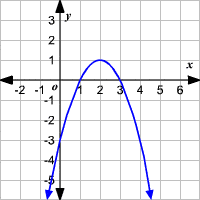
Use the graph to determine the solutions.
a)
-1 and -3
b)
1 and -3
c)
1 and 3
d)
-1 and 3
2.
Does y = -4x2 have a maximum or minimum value?
a)
maximum
b)
minimum
3.
What's the axis of symmetry of y=3x2-6x+4
a)
x=1
b)
x=-6
c)
x=2
d)
x=-1
4.
Which transformation maps the graph of
f(x) = x2 to the graph of g(x) = (x + 4)2?
f(x) = x2 to the graph of g(x) = (x + 4)2?
a)
a reflection across the line x = -4
b)
a reflection across the line y = -4
c)
a translation shifting f(x) 4 units to the left
d)
a translation shifting f(x) 4 units to the right
5.

Match the description to its equation.
Reflected over the x-axis
Stretched by a factor of 2
Reflected over the x-axis
Stretched by a factor of 2
a)
A
b)
B
c)
C
d)
D
6.

Match the description to its equation.
Moves up 2
Moves left 4
Moves up 2
Moves left 4
a)
A
b)
B
c)
C
d)
D
7.
Solve Using the Quadratic Formula
x2 + 4x - 40 = -8
x2 + 4x - 40 = -8
a)
-10 & -4
b)
-4 & 10
c)
-8 & 4
d)
8 & -4
8.
In the equation
y = x2 +5x +7, match each leading coefficient with its correct letter
y = x2 +5x +7, match each leading coefficient with its correct letter
a)
a=0, b=5, c=7
b)
a=1, b=5, c=7
c)
a=7, b=5, c=1
9.
If the discriminant is zero you will have
a)
no real solutions
b)
two real solutions
c)
1 real solution
d)
1 imaginary solution
10.
If the discriminant is not a perfect square, then you will have
a)
two real solutions
b)
two irrational solutions
c)
two imaginary solutions
d)
one solution
11.

Simplify:
a)
9n3 + 4n
b)
7n3 + 6
c)
-3n3 + 2
d)
7n6 + 6
12.

Simplify:
a)
0
b)
-3n3 +8n
c)
-3n6
d)
-6n3
13.

Simplify:
a)
-4x - 3
b)
x2 - 3
c)
-4x2 - 6x
d)
-4x - 6
14.
Simplify the expression.
-3x2( 7x2 - x + 4)
-3x2( 7x2 - x + 4)
a)
-21x4 + 3x3 -12x2
b)
7x2 - x + 4 (-3x2)
c)
21x4 + 3x3 + 12x2
d)
-12x2 + 3x3 -21x4
15.
(4x + 2)(2x - 2)
a)
8x2 - 4
b)
8x2 + 6x - 4
c)
8x2 - 4x - 4
d)
8x2 - 4x + 4
16.
Which of the following is a difference of perfect squares?
a)
x2 - 18
b)
4x2 + 36
c)
9x2 - 100
d)
x2 + 4
17.
Factor completely.
k2 -2k - 24
k2 -2k - 24
a)
(k+4)(k-6)
b)
(k+4)(k+6)
c)
(k+6)(k-1)
d)
(k-4)(k+6)
18.
Factor completely:
3x² + 5x - 12
3x² + 5x - 12
a)
(3x + 4)(x-3)
b)
(3x - 4)(x + 3)
c)
(3x + 3)(x -4)
d)
(3x - 3)(x + 4)
19.
Factor completely: 2x2+22x+60
a)
(2x+10)(x+6)
b)
(x+5)(x+6)
c)
2(x+1)(x+30)
d)
2(x+5)(x+6)
20.
Factor completely: x2-13x+40
a)
(x-5)(x-8)
b)
(x+5)(x+8)
c)
(x-4)(x-10)
d)
(x-2)(x-20)
21.
Factor completely: x2+16x+64
a)
(x+4)(x+16)
b)
(x-8)(x-8)
c)
(x+2)(x+32)
d)
(x+8)(x+8)
22.
Factor
n2 + 5n - 6
n2 + 5n - 6
a)
(n - 2)(n - 3)
b)
(n - 1)(n + 6)
c)
(n + 1)(n - 6)
d)
(n + 2)(n - 3)
23.

When do you use the plus or minus symbol?
±
±
a)
After taking the square root of both sides
b)
After adding the square to both sides
c)
After taking half of b
d)
After setting the equation equal to zero
24.
What is one of the solutions to this equation?
(2x - 1)2 = 49
(2x - 1)2 = 49
a)
7
b)
-7
c)
-4
d)
-3
25.
Complete the square.
x2 + 14x + ____
x2 + 14x + ____
a)
x2 + 14x - 196
b)
x2 + 14x + 49
c)
x2 + 14x - 49
d)
x2 + 14x + 196
26.
Rewrite in vertex form
y=x2+2x-3
y=x2+2x-3
a)
y=(x+1)2-4
b)
y=(x+1)2-2
c)
y=(x+1)2+4
d)
y=(x+1)2+2
27.
Rewrite in vertex form
y=x2+6x+3
y=x2+6x+3
a)
y=(x+3)2-12
b)
y=(x+3)2+6
c)
y=(x+3)2-6
d)
y=(x+3)2+12
28.
Classify by degree of polynomial:
3x3 – 6x
3x3 – 6x
a)
Constant
b)
Linear
c)
Quadratic
d)
Cubic
29.
Classify by number of terms:
2x – 9
2x – 9
a)
Monomial
b)
Binomial
c)
Trinomial
d)
4-Term Polynomial
30.
Classify by number of terms:
3x2 – 8x + 1
3x2 – 8x + 1
a)
Monomial
b)
Binomial
c)
Trinomial
d)
4-Term Polynomial
31.
Classify by degree of polynomial:
3x2 – 8x + 1
3x2 – 8x + 1
a)
Constant
b)
Linear
c)
Quadratic
d)
Cubic
32.
Simplify the following radical: √24
a)
2√6
b)
4√6
c)
2√12
d)
3√8
33.
Simplify the following radical: √300
a)
3√10
b)
2√150
c)
100√3
d)
10√3
34.
Simplify the following radical: √275
a)
5√5
b)
5√11
c)
11√5
d)
5√55
35.
Simplify the following radical: √150
a)
5√15
b)
5√2
c)
5√6
d)
15√5
36.

The y-intercept for this exponential function is
a)
3
b)
6
c)
1
d)
9
37.
Classify the model as Exponential GROWTH or DECAY.
A=1200(.85)6
A=1200(.85)6
a)
Growth
b)
Decay
38.
Classify the model as Exponential GROWTH or DECAY.
A=10(1.01)3
A=10(1.01)3
a)
Growth
b)
Decay
39.
Write an equation that models the following situation:
Samantha's hair was known to grow very rapidly. It began at a length of 6 in and grew at a rate of 14% a week.
Samantha's hair was known to grow very rapidly. It began at a length of 6 in and grew at a rate of 14% a week.
a)
y=6(0.14)x
b)
y=6(1+14)x
c)
y=6(1.14)x
d)
y=6(0.86)x
40.
A population of fish starts at 8,000 and decreases by 6% per year. What is the population of fish after 10 years?
a)
14327
b)
4309
c)
839
d)
7680
41.
Daniel’s Print Shop purchased a new printer for $35,000. Each year it depreciates at a rate of 5%. How much will the printer be worth in 8 years?
a)
$23,219.72
b)
$136.72
c)
$51,710.94
d)
$16,710.94
42.
How do you find the area of a rectangle?
a)
Length + Length + Length + Length
b)
Length + Width
c)
Length x Width
d)
Width x Width
43.
Express (x + 5)(x + 4) in standard form.
a)
x2 + x + 20
b)
x2 + 20x + 9
c)
x2 + 9x + 20
d)
x2 - 9x + 54
44.
Find the area of a rectangle with length (x-5) and width (3x+1).
a)
3x2+16x-5
b)
3x2-14x+5
c)
3x2-14x-5
d)
3x2+16x+5
45.
Simplify (x+5)2
a)
x2+25
b)
2x+10
c)
x2+10x+25
d)
12x
46.
What is (2x+3)2 the same thing as?
a)
(2x+3)(2x+3)
b)
2(2x+3)
c)
(2x)(+3)
d)
(x+2)(2x+3)
47.

Express the area of the rectangle above in terms of x. (click on the image to enlarge)
a)
8x2+28x+11
b)
8x2-4x+11
c)
8x2+4x-24
d)
8x2+28x+24
48.
The discriminant is
a)
aX2 + bX + c
b)
b - 4ac
c)
b2 - 4ac
d)
b2 + 4ac
49.

____________
For the function above, is the discriminant positive, negative, or zero?
For the function above, is the discriminant positive, negative, or zero?
a)
Positive
b)
Negative
c)
Zero
d)
Not Sure
50.

____________
For the function above, is the discriminant positive, negative, or zero?
For the function above, is the discriminant positive, negative, or zero?
a)
Positive
b)
Negative
c)
Zero
d)
Not Sure
51.
For the function below, is the discriminant positive, negative, or zero?
___________
y = x² + 4x + 4
a)
Positive
b)
Negative
c)
Zero
d)
Not Sure
52.
A function has a discriminant of 25.
______________
How many solutions does it have?
______________
How many solutions does it have?
a)
0
b)
1
c)
2
d)
5
53.

a)
A
b)
B
c)
C
d)
D
54.

a)
A
b)
B
c)
C
d)
D
55.

a)
A
b)
B
c)
C
d)
D
56.

a)
A
b)
B
c)
C
d)
D
57.

a)
A
b)
B
c)
C
d)
D
58.

a)
A
b)
B
c)
C
d)
D
100 %

