wayground logo

Free Printable Worksheets

NEW

Font size

S
M
L
XL
Worksheets

SHM

Total questions: 20

Worksheet time: 32mins

Name
Class
Date
1.
For a system in simple harmonic motion, which of the following is the number of cycles or vibrations per unit of time?
a)
amplitude
b)
period
c)
frequency
d)
revolution
2.
The angle between the string of a pendulum at its equilibrium position and at its maximum displacement is the pendulum’s
a)
period.
b)
frequency.
c)
vibration.
d)
amplitude.
3.
For a system in simple harmonic motion, which of the following is the time required to complete a cycle of motion?
a)
amplitude
b)
period
c)
frequency
d)
revolution
4.

When the mass reaches point x = +A its instantaneous velocity is?

a)

Maximum and positive

b)

Maximum and negative

c)

Zero

d)

Less than maximum and positive

5.

When the mass reaches point x = 0 its resorting force?

a)

Maximum and positive

b)

Maximum and negative

c)

Zero

d)

Less than maximum and negative

6.

When the mass reaches point x = 0 its resorting force?

a)

Maximum and positive

b)

Maximum and negative

c)

Zero

d)

Less than maximum and negative

7.

When the mass reaches point x = +A its acceleration is?

a)

Maximum and positive

b)

Maximum and negative

c)

Zero

d)

Slightly less than maximum and positive

8.
What is the equation for frequency?
a)
f = t/n
b)
f = 1/T
c)
f = 2 T
9.

You observe that a pendulum completes 45 complete cycles in ninety seconds. What is the frequency of this pendulum?

a)

100 m

b)

1 Hz

c)

0.5 Hz

d)

1m/s

10.
A tennis coach paces back and forth along the sideline 10 times in 60 seconds.  The frequency of her pacing is:
a)
0.167 Hz
b)
6.0 Hz
c)
0.167 s
d)
6.0 s
11.

At which point is this pendulum swinging the fastest?

a)

A

b)

B

c)

O

d)

A and B

e)

Same speed at all points

12.

At which point does this pendulum have the most kinetic energy?

a)

A

b)

B

c)

O

d)

A and B

e)

Same speed at all points

13.

At which point does this pendulum have the most potential energy?

a)

A

b)

B

c)

O

d)

A and B

e)

Same speed at all points

14.

A pendulum swinging with a maximum amplitude of π/3 has a period of T. If the maximum amplitude is decreased to π/6, what is the new period of the pendulum?

a)

T/4

b)

T/2

c)

T

d)

2T

15.

What is represented by A in the picture?

a)

Period

b)

Amplitude

c)

Wavelength

d)

Frequency

16.
If a force of 20 N stretches a spring 0.5 m, what is the spring constant?
a)
10 N/m
b)
20 N/m
c)
40 N/cm
d)
40 N/m
17.
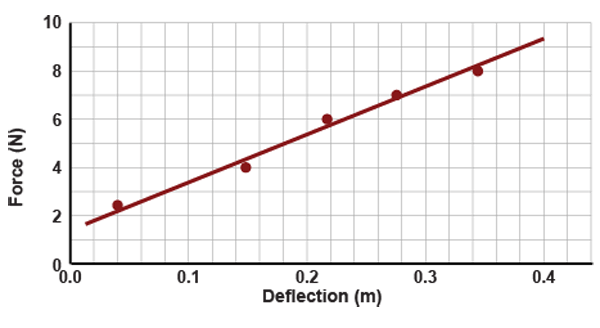
What Quantity can you calculate from the graph and give the magnitude of that quantity.  
a)
distance 4.5 m
b)
Force 15 N
c)
spring constant 20 N/m
d)
spring constant 200 N/m
18.
Convert from period to frequency.
4 sec = ______ Hz.
a)
0.25 Hz
b)
0.1 Hz
c)
2 Hz
d)
10 Hz.
19.
A cylinder hangs motionless 40 cm below its equilibrium position from a spring with a constant of 50 N/m.  What is the mass of the cylinder?
a)
.8 kg
b)
1.25 kg
c)
2 kg
d)
6 kg
20.

1. A mass-spring oscillating system undergoes SHM. Which of the following graphs represents the elastic potential energy as a function of position?

a)
b)
c)
d)
e)