Wayground logo

Free Printable Worksheets

Font size

S
M
L
XL
Worksheets

Metrics/Sci Method

Total questions: 31

Worksheet time: 1hrs 10mins

Name
Class
Date
1.

The basic unit of length in the metric system is _____.

a)

Meter

b)

Liter

c)

Gram

d)

None of these

2.

The basic unit of mass in the metric system is _____.

a)

Meter

b)

Liter

c)

Gram

d)

None of these

3.
What two parts does every scientific measurement have?
a)
mass and length
b)
ruler and unit
c)
distance and time  
d)
a value and unit  
4.

The basic unit of volume in the metric system is _____.

a)

Meter

b)

Liter

c)

Gram

d)

None of these

5.
Which of the following is the longest length?
a)
10 m
b)
10 km
c)
10 cm
d)
10 mm
6.

What is the base for the metric system?

a)

100

b)

1

c)

12

d)

10

7.

In the measurement 5.2 mm, what does the ‘mm’ represent?

a)

meter

b)

millimeter

c)

milk

d)

money

8.
3,200 cm = _____ m
a)
320 m
b)
0.32 m  
c)
32 m  
d)
3200 m
9.

A determination of the amount of something. Typically has two parts: a value and a unit.

a)

Measurement

b)

Unit

c)

Metric

d)

Resolution

10.

What should be done immediately if a fire erupts?

a)

open the windows

b)

notify the teacher

c)

throw water on it

d)

get fire extinguisher

11.

A hypothesis is a(n) _____.

a)

question

b)

educated guess

c)

observation

d)

testable statement

12.

After the experiment, scientists organize and _____ data.

a)

hypothesize

b)

analyze

c)

group

d)

conclude

13.

The __________ is the part of the experiment that is not being tested and is used for comparison.

a)

dependent variable

b)

constant

c)

one variable

d)

control group

14.

The _________ stays the same throughout the entire experiment.

a)

constant

b)

dat

c)

meter stick

d)

conclusion

15.

Using a ______, we can measure the height of an individual.

a)

meter stick

b)

thermometer

c)

graduated cylinder

d)

celcius

16.

The data collected from the experiment comes from looking at the ______.

a)

independent variable

b)

dependent variable

c)

constant

d)

control variable

17.

T/F: The first step in the scientific method is to gather information.

a)

True

b)

False

18.

T/F: A graduated cylinder measures mass/weight.

a)

True

b)

False

19.

For measuring volume, scientists often use _________ in the lab.

a)

graduated cylinders

b)

thermometers

c)

scales

d)

meter sticks

20.
The summary at the end of an experiment that explains the results. 
a)
conclusion
b)
procedures
c)
materials
d)
responding variable
21.
A series of steps used by scientists to solve a problem or answer a question. 
a)
scientific method
b)
recipe
c)
data collection
d)
metric system
22.
A list of the steps anyone could follow to conduct an experiment. 
a)
obervations
b)
question/problem
c)
materials
d)
procedures
23.
Mr. S. sets up an experiment to see how the mass of a ball affects the distance it rolls off a ramp.  Identify the independent variable.
a)
distance traveled by the ball
b)
height of the ramp
c)
mass of the ball
d)
weight of the ball
24.
Mr. S. sets up an experiment to see how the mass of a ball affects the distance it rolls off a ramp.  Identify the dependent variable.
a)
height of the ramp
b)
 distance traveled by the ball
c)
mass of the ball
d)
weight of the ball
25.

The variable that is being tested/changed by the experimenter is known as the _____.

a)

dependent variable

b)

independent variable

c)

constant

26.

Convert 17 m to cm.

a)

0.17 cm

b)

0.017 cm

c)

1,700 cm

d)

170 cm

27.
7,000 g = ____ kg
a)
70
b)
700
c)
7
d)
0.07
28.
What is the correct value?
a)
5 ml
b)
15 ml
c)
20 ml
d)
25 ml
29.
How many students take the bus to school?
a)
35
b)
20
c)
10
d)
15
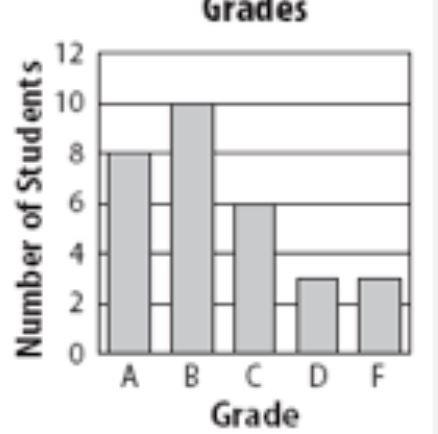
30.
How many more students scored B's than A's?
a)
3
b)
10
c)
5
d)
2
31.
What are the two main groups found in an experiment?
a)
Experimental and Control
b)
Control and no Control
c)
Experimental and Independent
d)
Independent and Dependent