wayground logo

Free Printable Worksheets

NEW

Font size

S
M
L
XL
Worksheets

biology extra credit

Total questions: 50

Worksheet time: 33mins

Name
Class
Date
1.
The main function of the digestive system is to...
a)
Protect the body from infections
b)
Store nutrients into the bones
c)
Break down food to be absorbed
d)
Support and protect the organs of the body
2.
The endocrine system communicates to the body using....
a)
electrical signals
b)
soluble gases
c)
digestive enzymes
d)
chemical hormones
3.
This system forms a protective barrier between the environment and the internal body system.
a)
Circulatory
b)
Integumentary
c)
Respiratory
d)
Endocrine
4.
The body system that transmits information inside the body using electrical impulses.
a)
Endocrine
b)
Skeletal
c)
Muscular
d)
Nervous
5.
Which body system is required in producing offspring?
a)
Reproductive System
b)
Endocrine System
c)
Digestive System
d)
Immune System
6.
What is the main function of the excretory system?
a)
Convert food into nutrients
b)
Send signals in the form of hormones
c)
Filter water and remove waste products from the body
d)
Exchange gases between the body
7.
This system brings in oxygen into the body and removes carbon dioxide...
a)
Circulatory
b)
Respiratory
c)
Excretory
d)
Digestive
8.
What three body systems get rid of waste from our bodies?
a)
Respiratory, Reproductive, and Circulatory
b)
Digestive, Excretory, and Respiratory
c)
Digestive, Reproductive, and Circulatory
d)
Excretory. Reproductive, and Endocrine
9.
The large intestine is part of the digestive system. What is the main function of the large intestine?
a)
Remove body fat
b)
Remove Urine
c)
Remove solid waste
d)
Remove water
10.
How does the endocrine system have to do with Homeostasis?
a)
Keeps system balanced with OXYGEN
b)
Keeps systems balanced with BLOOD
c)
Has Nothing to do with it
d)
Keeps systems balanced with FEEDBACK MECHANISMS
11.
What is the main function of the Endocrine System?
a)
Take in Oxygen
b)
Take Carbon into the lungs
c)
Produce Sperm Cells
d)
Produce Hormones
12.
Which body system delivers nutrients to the cells inside the body?
a)
Reproductive
b)
Circulatory
c)
Nervous
d)
Excretory
13.
Which body system produces or absorbs nutrients?
a)
Circulatory
b)
Endocrine
c)
Digestive
d)
Reproductive
14.
Where does cellular gas exchange happen first?
a)
Heart
b)
Between the Heart and Aorta
c)
Between the Lungs and Heart
d)
Between the Alveoli and Capillaries around the lungs
15.
Which of the following examples is a function of the reproductive system?
a)
Circulating blood
b)
Produce Oxygen
c)
Absorb Nutrients
d)
Produce eggs in females
16.
Needs host cell to reproduce.
a)
Virus
b)
Bacteria
c)
Fungus
d)
Protozoan
17.
What happens in the lytic cyle?
a)
Virus goes in and leaves the host cell
b)
Virus quickly kills the host cell
c)
Virus sleeps inside of the host cell
d)
Virus stay dormant for a long time
18.
What happens in the lytic cyle?
a)
Virus goes in and leaves the host cell
b)
Virus quickly kills the host cell
c)
Virus sleeps inside of the host cell
d)
Virus stay dormant for a long time
19.
What happens in the lysogenic cycle? 
a)
Virus goes in and leaves the host cell
b)
Virus quickly kills the host cell
c)
Virus inject the nucleic acid into the host cell, and the nucleic acid integrates into the host cell DNA, and stay dormant for a long time
d)
Bacteria injects DNA into a host cell
20.
The lytic cycle takes the longest out of the two viral reproductive cycles. 
a)
True
b)
False
21.
What is the lytic and lysogenic cycle have in common?
a)
The host cell dies
b)
The virus dies
c)
The virus inserts its genetic information into the host cell
d)
copies of the virus are immediately released from the host
22.
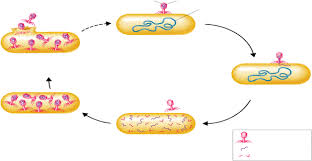
What process is this?
a)
phagocytosis
b)
lytic cycle
c)
lysogenic cycle
d)
formation of antibodies
23.
What is shown here?
a)
Lysogenic Cycle
b)
Lytic Cycle
c)
Binary Fission
d)
Conjugation
24.
This infectious viral disease has many symptoms, from chills, fever, and aching muscles to coughing and sneezing to nausea and vomiting. The symptoms show up within 2-7 days after the cell is infected.  This is an example of?
a)
Lytic Cycle
b)
Lysogenic Cycle
c)
Meiosis
25.
Symptoms of HIV do not show up immediately because the virus can 
a)
stay dormant for years
b)
mutate quickly 
c)
stay outside the cell for a long time
26.
What is the difference between the lytic and lysogenic virus reproductive cycles?
a)
lysogenic is longer
b)
they are the same
c)
Lytic is longer
d)
Both are different each time
27.
What is the 1st step of virus infection?
a)
Entry
b)
Attachment
c)
Replication
d)
Assembly
28.
The lysing of a cell occurs in which phase?
a)
1
b)
2
c)
4
d)
5
29.
Antibiotics kill viruses
a)
True
b)
False
30.
Which of the following systems protects the body from disease?
a)
Digestive System
b)
Nervous System
c)
Immune System
d)
Skeletal System
31.
What is a way to become immune to a disease without first having the disease?
a)
antibiotics
b)
Anti-retroviral drugs
c)
Vaccinations
d)
Exposure Therapies
32.

Which of the following is NOT a function of the roots?

a)

Store carbs

b)

Absorb water and minerals

c)

Anchor plant to the ground

d)

Photosynthesis

33.

Where in the plant does photosynthesis occur?

a)

Flower

b)

Leaves

c)

Stem

d)

Roots

34.

What type of cells transport water UP the stem?

a)

Xylem cells

b)

Phloem Cells

c)

Epidermal Cells

d)

Root Cells

35.

The thick waxy covering of a leaf that helps prevent water loss is known as the--

a)

Flower

b)

Cuticle

c)

Mitochondria

d)

Chloroplast

36.

Where does gas exchange occur within the plant?

a)

Flower

b)

Leaf

c)

Stem

d)

Roots

37.

Which structure of the plant is responsible for transport?

a)

Flower

b)

Leaf

c)

Stem

d)

Root

38.

Which of the following is NOT a part of the plant's SHOOT system?

a)

Flower

b)

Leaf

c)

Stem

d)

Root

39.

Which structure of a plant is responsible for anchoring it to the ground?

a)

Flower

b)

Leaf

c)

Stem

d)

Roots

40.

Which of the following is NOT a function of the flower?

a)

Be attractive

b)

Female reproductive parts

c)

Male Reproductive parts

d)

Control Hydration

41.

An organism who can make their own food from the sun is known as a-

a)

Heterotroph

b)

Eukaryote

c)

Autotroph

d)

Prokaryote

42.
Terrestrial plants have stomata on the surface of their leaves. A single stomata is surrounded by two guard cells that change shape in response to environmental factors and open or close the stoma. Which of the following best explains how the structure of the leaf is used in processes that occur in plants?
a)
Water enters the plant through the surface of the leaf for transpiration
b)
Gases for photosynthesis are exchanged through the surface of the leaf. 
c)
Energy for cellular reproduction is absorbed through the surface of the leaf.
d)
Carbon dioxide enters the plant through the surface of the leaf for cellular reproduction.
43.
If the xylem in a young tree is damaged, which process is first affected?
a)
performing photosynthesis
b)
transporting sugar to the roots
c)
 transporting water to the leaves
d)
absorbing water from the soil
44.
A plant species lives in an area with limited sunlight. Which physiological adaptation would be most useful to the plant? 
a)
colorful flowers
b)
large leaves
c)
deep roots
d)
thin cuticle
45.
What is the main function of leaves?
a)
Leaves provide support for growth and a place to store food.
b)
Leaves provide a place for photosynthesis to occur
c)
Leaves absorb water and minerals and transport nutrients to the stem.
d)
 Leaves create a barrier that prevents water in the plant's tissues from evaporating.
46.
The cambuim is a section of cells in a plant that can become either part of the xylem or phloem, depending on the growth and needs of the plant. If the cambium of a particular plant was damaged, what would be the most likely effect on the plant?
a)
The plant would lose its ability to carry out photosynthesis.
b)
the plant would have uncontrolled growth.
c)
The plant would not experience any change in physiology.
d)
The plant would not be able to transport nutrients and water.
47.
Which structure in the leaf controls the opening and closing of the stoma? 
a)
cuticle
b)
epidermis
c)
guard cell
d)
spongy mesophyll
48.
The diagram shows a cross section of a plant leaf. How does the structure marked X contribute to the survival of the plant?
a)
It allows the intake of gases necessary for photosynthesis.
b)
 It allows the intake of minerals necessary for plant growth.
c)
It allows the intake of sunlight necessary for ATP production.
d)
It allows the intake of sugars necessary for plant reproduction.
49.
Which statement describes the role of flowers in plant survival? 
a)
 Flowers can absorb carbon dioxide for sugar production. 
b)
Flowers produce oxygen through cellular respiration. 
c)
Flowers contain cells that carry out photosynthesis.
d)
Flowers contain cells that produce gametes.
50.
The diagram  represents a flower, the reproductive structure of some plants. Most flowers have both male and female structures for fertilization and reproduction. Which structure is represented by the letter A in the diagram?
a)
the stamen, a male structure which produces pollen
b)
the pistol, a female structure which collects pollen and passes it to the ovary
c)
 the sepal, a modified leaf used for protection of the flower
d)
the petals, decorative structures which attract pollinators