

wayground logo

Free Printable Worksheets

Font size

S
M
L
XL
Worksheets

Atomic Theory and Structure

Total questions: 70

Worksheet time: 51mins

Name
Class
Date
1.

Isotopes are atoms of the same element with a different amount of

a)

protons

b)

neutrons

c)

electrons

d)

charge

2.
An atom has 10 protons and a mass of 18. It has __ neutrons
a)
10
b)
18
c)
28
d)
8
3.
An ______________ is the same element, with the same number of protons, but different numbers of neutrons
a)
Atom
b)
Isotope
c)
Atomic Number
d)
Mass Number
4.
How many neutrons will an atom have it has an atomic number of 26, an atomic mass of 58 and a charge of +3?
a)
26
b)
58
c)
32
d)
3
5.
How many electrons are in an atom that has an atomic number of 34, an atomic mass of 74 and a charge of -2?
a)
34
b)
36
c)
2
d)
40
6.
How many protons are in an atom with an atomic number of 20, an atomic mass of 45, and a charge of +2?
a)
20
b)
10
c)
2
d)
18
7.
What charge does an atom have if it GAINS an electrons?
a)
Positive (+)
b)
Negative (-)
8.
Which particle does not contribute mass to the atom?
a)
Proton
b)
Neutron
c)
Electron
d)
Nucleus
9.
Most of the mass in an atom is made up of _____________________?
a)
protons and electrons
b)
protons and neutrons
c)
neutrons and electrons
d)
electrons and quarks
10.
In a correctly written symbol what would be located in the "A" position?
a)
number of neutrons
b)
atomic number
c)
number of electrons 
d)
mass number
11.
How many protons are in this element?
a)
79
b)
196
c)
117
d)
Cannot be determined
12.
Because atoms are neutral, the number of protons will be equal to the number of __________ in an atom.
a)
Positrons
b)
Neutrons
c)
Electrons
d)
Nuclei
13.
Identify letter A
a)
Nucleus
b)
Neutrons
c)
Protons
d)
Electrons
14.
Identify letter B
a)
Nucleus
b)
Neutrons
c)
Protons
d)
Electrons
15.
Identify letter C
a)
Nucleus
b)
Neutrons
c)
Protons
d)
Electrons
16.

If two atoms have the same number of protons but different number of neutrons, they will have the same...

a)

half-life

b)

mass number

c)

atomic number

d)

degree of stability

17.

True or False: Atoms of different elements have different numbers of protons.

a)

True

b)

False

18.

Particles with almost the same mass are...

a)

neutrons, electrons

b)

protons, electrons

c)

protons, electrons, neutrons

d)

protons, neutrons

19.
What is an atom mostly made up of?
a)
protons
b)
electrons
c)
empty space
d)
neutrons
20.
An atom becomes _______ when it loses electrons.
a)
Positive
b)
Negative
c)
Neutral
d)
Invinsible
21.

Valence electrons are:

a)

On the outermost shell of the electron cloud

b)

Electrons closest to the nucleus

c)

Electrons that just come and go - they don't stay with the atom

d)

Delocalized electrons

22.
Which is the correct symbol for the element with 8 protons and 10 electrons?
a)
N3-
b)
O2-
c)
O3-
d)
F-
23.

Helium (He atomic number 2) has 2 protons, 2 neutrons, and 2 electrons. Is the He element shown above an atom, or an ion?

a)

atom

b)

cation (+ ion)

c)

anion (- ion)

24.
An atom is the smallest piece of a(an) _____ you can get. 
a)
mixture 
b)
compound 
c)
molecule 
d)
element 
25.
The atomic mass is the number of _______ plus ________. 
a)
protons, electrons 
b)
protons, neutrons 
c)
electrons, neutrons 
d)
quarks, neutrons 
26.

These subatomic particles are added or removed to form ions. 

a)
neutrons 
b)
protons 
c)
electrons 
d)
nimrons 
27.
This subatomic particle has almost no mass. 
a)
electrons
b)
protons 
c)
neutrons 
d)
sigrons 
28.

The number of electrons in a neutral atom is equal to ......

a)

the number of protons

b)

the number of neutrons

c)

the atomic mass

29.
Cations are...
a)
Positive
b)
Negative
c)
Neutral
d)
Purring
30.
Anions are...
a)
Positive
b)
Negative
c)
Neutral
d)
Crying
31.
How many total electrons does Na+1 (a sodium ion) have?
a)
10
b)
11
c)
12
d)
22
32.
How many electrons are in a Li+ ion?
a)
1
b)
2
c)
3
d)
4
33.
How many electrons are in an S2- ion?
a)
10
b)
14
c)
16
d)
18
34.
If X is the symbol for an element, which of the following two symbols represent    isotopes of the same element?  
I. 7735X  II. 7733X  III. 8137X  IV. 8135 X
a)
I and II
b)
III and IV
c)
I and IV
d)
I and III
35.
What particle decides the identity of an atom/element?
a)
proton
b)
neutron
c)
electron
d)
All of the above.
36.

The average atomic mass of an element depends upon the ___.

a)

relative abundance of protons in that element

b)

mass and relative abundance of each isotope of that element

c)

mass of each isotope of that element

d)

mass of each electron in that element

37.
How did each model of the atom help to develop the atomic theory? 
a)
Each model provided opinions that were added.
b)
Each model showed different properties of the same structure. 
c)
Each model showed new particles that had been discovered.
d)
Each model built upon the other to show new particles or properties of previously discovered particles. 
38.
How many valence electrons does Chlorine have?
a)
5
b)
2
c)
7
d)

8

39.
Negative ions form when atoms _________ valence electrons.
a)
lose
b)
gain
c)
share
40.
How many total electrons does O-2 (an oxide ion) have?
a)
8
b)
10
c)
6
d)
18
41.

Which part of the atom determines the physical and chemical properties, such as how it will participate in bonding situations.

a)

protons

b)

neutrons

c)

mass

d)

valence electrons

42.
The central region of an atom where neutrons and protons are located is the __________________.
a)
nucleus 
b)
electron cloud
c)
core 
d)
center 
43.
Particles in an atom that are neutral and have no charge are 
a)
negatrons 
b)
electrons 
c)
neutrons 
d)
protons 
44.

Which part of an atom is used to identify it?

a)

number of protons

b)

number of neutrons

c)

number of electrons

45.
In order for an atom to be neutral what has to be true?
a)
The atom has more protons than neutrons
b)
The atom has more neutrons than protons
c)
The atom has the same number of protons and neutrons
d)
The atom has the same number of protons and electrons
46.
How is the number of neutrons in the nucleus of an atom calculated?
a)
Add the number of e- and p+ together
b)
Subtract the number of e- from p+
c)
Subtract the number of p+ from the mass number
d)
Add the mass number to the number of e-
47.

The atomic mass of an element is the ___.

a)

average of the mass number and the atomic number for the element

b)

weighted average of the masses of the isotopes of the element

c)

total mass of the isotopes of the element

d)

total number of subatomic particles in the nucleus

48.

The atomic mass of an element depends upon the ___.

a)

relative abundance of protons in that element

b)

mass and relative abundance of each isotope of that element

c)

mass of each isotope of that element

d)

mass of each electron in that element

49.

Chlorine has two naturally occurring isotopes, Cl-35 and Cl-37, The atomic mass of chlorine is 35.45. Which of these two isotopes of chlorine is more abundant?

a)

Cl-35

b)

Cl-37

c)

Cannot be determined from the information provided.
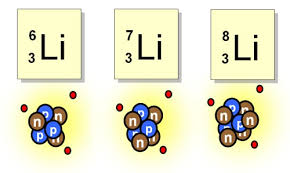
50.
which atom has  4 neutrons?
a)
Li-6
b)
Li-7
c)
Li-8
d)
they have the same # of neutrons
51.

How many neutrons are in an atom of carbon-14?

a)

6

b)

8

c)

10

d)

14

52.

Write the hyphen notation for the isotope that has 39 protons and 50 neutrons.

a)

Yttrium-11

b)

Tin-39

c)

Tin-89

d)

Yttrium-89

53.
Four isotopes of lead include lead-204, lead-206, lead-207, and lead-208.  The average atomic mass of lead is 207.2.  Which isotope of lead is likely to be the most abundant.
a)
204
b)
206
c)
207
d)
208
54.

A Bromine ion gains 1 electron, which of the following is the correct symbol for a Bromine ion?

a)

Br-1

b)

Br+1

c)

Br+7

d)

Br-7

55.

3. What electrical charge does nucleus carry?

a)

positive charged (protons) and neutrons (which have no electrical charged)

b)

Just positive charged

c)

Electrons and protons

d)

protons, electrons and neutrons

56.

What is the chemical symbol for an element with 21 protons and 19 electrons?

a)

K2+K^{2+}  

b)

KK  

c)

  Sc2+Sc^{2+}  

d)

Sc2Sc^{2-}  

57.

Which of the following is the nuclear symbol for lithium-6

a)
b)
c)
d)
58.

What is the identity of the atom?

a)

Aluminum

b)

Silicon

c)

Cobalt

d)

Zirconium

59.

An element with 11 protons, 11 electrons, and 12 neutrons is identified as

a)

sodium - 11

b)

magnesium - 12

c)

sodium - 23

d)

magnesium - 34

60.

To calculate average atomic mass, you need

a)

the atomic mass of each isotope

b)

the percent abundance of each isotope

c)

the atomic mass and percent abundance of each isotope

d)

to find the average of the atomic masses of each isotope

61.
True or False - Protons and Neutrons have about the same mass.
a)
True - They have about the same mass
b)
False - They do not have about the same mass
62.

Which subatomic particles have a relative mass of 1 atomic mass unit each?

a)

electrons only

b)

protons and neutrons

c)

protons, neutrons and electrons

d)

protons and electrons

63.
Subatomic particles that are neutral in charge
a)
Neutrons
b)
Protons
c)
Nucleus 
d)
Electrons
64.
Where electrons are likely to be found as they travel around the nucleus
a)
Nucleus
b)
Electron Cloud
c)
Within a Proton
d)
Within a Neutron
65.
The smallest particle of an element that shows all the properties of that element.
a)
Subatomic Particles
b)
Atom
c)
Quarks
d)
Gluons
66.
A tiny but very dense, positively charged portion of the atom that holds most of the atomic mass
a)
Electron Shells
b)
Orbitals
c)
Electron Cloud
d)
Nucleus
67.

What subatomic particle has a negative charge and is found outside of the nucleus?

a)

Electron

b)

Proton

c)

Nucleus

d)

Neutron

68.

True or False: Electrons are found in the nucleus.

a)

True

b)

False

69.
An element with a mass number of 11 and an atomic number of 5 has how many neutrons?
a)
11
b)
5
c)
6
d)
16
70.

This diagram represents the atom of what element?

a)

Kr (Krypton)

b)

Cd (Cadmium)

c)

Se (Selenium)

d)

Ca (Calcium)
