
 Worksheets
AP Bio-Unit 2 Quiz-Cell Structure & Function
Total questions: 50
Worksheet time: 29mins

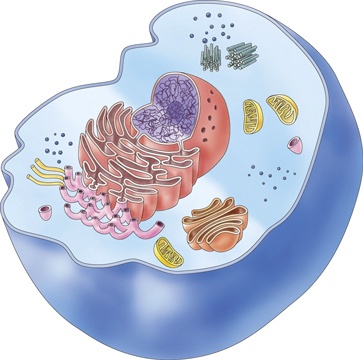


Organelles that package cellular materials and transports them within the cell or out of the cell.
Golgi Body
Endoplasmic reticulum
Large central vacuole
Lysosomes
A cell organelle that is responsible for waste removal in the cell.
Golgi Body
Endoplasmic reticulum
Large central vacuole
Lysosomes
Powerhouse of the cell, organelle that is the site of ATP ( energy production ) and cellular respiration in plants and animals.
Nucleus
Ribosomes
Mitochondria
Vacuoles
Where proteins are made in the cells.
Nucleus
Ribosomes
Mitochondria
Vacuoles
Small structures in the cytoplasm that do special jobs.
Nucleus
Ribosomes
Organelles
Vacuoles
Function of the cell membrane to block the movement of certain sizes, shapes and kinds of particles from entering the cell.
permeable
impermeable
semi-permeable
Function of the cell membrane to allow substances to flow freely through, in and out of the cell.
permeable
impermeable
semi-permeable
Function of the cell membrane to not allow the substance or substances to pass through the membrane.
permeable
impermeable
semi-permeable
This organelle contains chlorophyll, which is a green pigment. It's job is to use energy from the sun to create food molecules (glucose)
Chloroplast
Mitochondria
Vacuole
Ribosome
Cell Wall

Cell theory states that...
cells are the basic building block of life
cells are cool
cells are microscopic
cells cannot be destroyed
Cell theory also states that...
bacteria are eukaryotic cells
animals are prokaryotic cells
cells come from other cells (cell division or splitting apart)
cells are awesome!
Lastly cell theory states....
cells don't do much
cells are microscopic
all living things are made up of cells (either unicellular or multicellular)
bacteria aren't cells

Which type of cell is this?
Prokaryote
Eukaryote
All of the following are evidence of endosymbiosis EXCEPT
mitochondria and chloroplast ribosomes are similar to bacterial ribosomes
mitochondria and chloroplast are similar in size to bacteria
mitochondria and chloroplast have double membranes
mitochondria and chloroplast have a nucleus
All of the following are evidence of endosymbiosis EXCEPT
mitochondria and chloroplast ribosomes are similar to bacterial ribosomes
mitochondria and chloroplast are similar in size to bacteria
mitochondria and chloroplast have double membranes
mitochondria and chloroplast have a nucleus

This is a picture of:
Prokaryote
Eukaryote


Why can animal cells burst in a hypotonic solution and plant cells cannot?
animal cells have a cell membrane
plant cells have a cell wall
animal cells have many smaller vacuole
plant cells have one large vacuole
A type of active transport when a cell takes in large amounts of solids
pinocytosis
exocytosis
phagocytosis
osmosis

Which is NOT true about this image?
It illustrates active transport.
It shows a substance moving against the concentration gradient.
The movement of the substance show requires energy.
It illustrates facilitated diffusion.
You are alone on an island in the middle of the Atlantic Ocean. You are hot and thirsty, so you want to drink water from the ocean. You think about biology class and you decide:
to drink the ocean water because the extra salt will quench your thirst.
not to drink the ocean water because the extra salt will cause you to dehydrate.
to drink the ocean water because your cells will burn more fat due to the salt intake.
not to drink the ocean water because the extra salt will cause your cells to burst.

Why has water moved into the cell in the hypotonic solution?
The cell was deflated and needed to be inflated.
The concentration of solvent was higher inside than outside the cell.
The concentration of solute (salt) was higher outside the cell than inside.
The concentration of solute (salt) was higher inside the cell than outside.
Cystic fibrosis is a genetic condition that is associated with defects in the CFTR protein found in the membrane. Which organelle synthesized the protein?
Golgi Bodies
Rough ER
Smooth ER
Lysosome
Cystic fibrosis is a genetic condition that is associated with defects in the CFTR protein found in the membrane. After being synthesized, where does it go to be modified, packaged, and sorted?
Golgi Bodies
Rough ER
Smooth ER
Lysosome

The following data was collected by observing subcellular structures of three different types of cells. How can you determine these are eukaryotic cells?
They have ribosomes.
They have membrane bound organelles.
They have DNA.
The have a plasma membrane.
The following data was collected by observing subcellular structures of three different types of eukaryotic cells. Identify a function of cell X.
Detoxification.
Secretion of Proteins.
Mobility.
Storage.
The following data was collected by observing subcellular structures of three different types of eukaryotic cells. Identify a function of cell Y.
Detoxification.
Secretion of Proteins.
Mobility.
Storage.
The following data was collected by observing subcellular structures of three different types of eukaryotic cells. Identify a function of cell z.
Detoxification.
Secretion of Proteins.
Mobility.
Storage.
How does the location of the ribosome affect the type of protein product?
free ribosomes synthesize cytosolic proteins while bound ribosomes synthesize membrane proteins
free ribosomes synthesize membrane proteins while bound ribosomes synthesize cytosolic proteins
free ribosomes synthesize proteins for the mitochondria while bound ribosomes synthesize cytosolic proteins.
free ribosomes synthesize cytosolic proteins while bound ribosomes synthesize proteins for the mitochondria.
Where is the mRNA used for synthesis of proteins made?
nucleus
ribosome
rough ER
smooth ER
What organelle is responsible for storing calcium?
lysosome
smooth ER
rough ER
Golgi Bodies
Tay Sachs results from a build-up of fats due to an error in which organelle that is responsible for digesting macromolecules?
rough ER
smooth ER
lysosome
Golgi Bodies
Disarms dangerous free radicals by converting them to hydrogen peroxide; detoxifies harmful poisons and other substances
Mitochondria
Lysosome
Peroxisome
Centrioles
Ribosome

