wayground logo

Free Printable Worksheets

Font size

S
M
L
XL
Worksheets

CH 2: Earths Structure

Total questions: 37

Worksheet time: 55mins

Name
Class
Date
1.

Which is the innermost layer of Earth?

a)

Earth’s innermost layer is the lithosphere.

b)

Earth’s innermost layer is the lithosphere.

c)

Earth’s innermost layer is the asthenosphere.

d)

Earth’s innermost layer is the core.

2.
The three main layers of the Earth are crust, mantle, and core.
a)
True
b)
False
3.
There are two different crust: Continental and oceanic.
a)
true
b)
false
4.
Beneath the crust is the ______, a thick layer of hot but solid rock. 
a)
core
b)
mantle
c)
lithosphere
5.
What is the name of the thin layer of solid rock that makes up the outermost part of Earth?
a)
core
b)
crust
c)
mantle
d)
biosphere
6.
All living things on earth are part of the....
a)
Biosphere
b)
Geosphere
c)
Hydrosphere
d)
Cryosphere
7.
All frozen water on Earth is...
a)
Hydrosphere
b)
Geosphere
c)
Cryosphere
d)
Atmosphere
8.
Bio =
a)
Science
b)
Math
c)
Earth
d)
Life
9.
Geo = 
a)
Earth
b)
Sphere
c)
Life
d)
Water
10.
Hydro = 
a)
Sphere
b)
Earth
c)
Life
d)
Water
11.
When carbon dioxide dissolves from the air into the ocean -the interaction is between
a)
the atmosphere and atmosphere
b)
the atmosphere and hydrosphere
c)
the atmosphere and geosphere
d)
the atmosphere and biosphere
12.
All frozen water on Earth is...
a)
Hydrosphere
b)
Geosphere
c)
Cryosphere
d)
Atmosphere
13.
The atmosphere includes
a)
rocks
b)
air
c)
plants
d)
atoms
14.

Earth is divided into four different spheres. Which statement is true about the interaction between two of these spheres?

a)

Weather is an interaction between the hydrosphere and the geosphere.

b)

A plant receiving water from precipitation is an interaction between the biosphere and the hydrosphere.

c)

An ice cap providing shelter for an arctic animal is an interaction between the biosphere and the hydrosphere.

d)

The formation of the Grand Canyon is an example of an interaction between the geosphere and the atmosphere.

15.
Which of the following provides the best example of an interaction between the hydrosphere and the atmosphere?
a)
Carbon dioxide gas is released into the air by living things.
b)
Consistent patterns of wind change the shape of landforms.
c)
The oceans release heat energy that makes climate milder.
d)
Water vapor in the air is taken into plants through their leaves.
16.
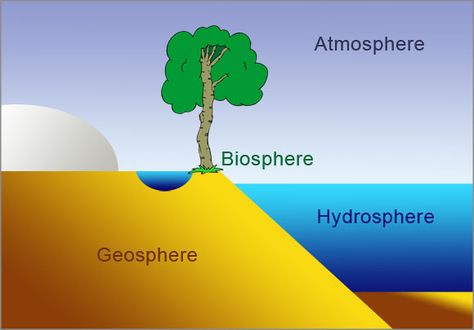
This picture best describes which connection?
a)
Atmosphere-Biosphere
b)
Hydrosphere-Atmosphere
c)
Hydrosphere-Geosphere
d)
Geosphere-Biosphere
17.

How are the materials of the Earths core different from those of the crust (in general)?

a)

They are harder

b)

They are more dense

c)

They are older

d)

They are darker in color

18.

Why is the core more dense than the mantle or crust?

a)

It has more aluminum

b)

it has more iron

c)

it has more tin

d)

it has more basalt

19.

Which things increase as depth increases into the Earth?

a)

time

b)

Pressure

c)

temperature

d)

density

20.
Which layer of Earth is solid and why?
a)
The inner core is solid because of movement of the outer core.
b)
The inner core is solid because of the freezing temperatures.
c)
The inner core is solid because of the extreme pressure from the other layers.
d)
The outer core is solid because of the extreme pressure from the other layers.
21.
Which layer is plastic and has the consistency of silly putty allowing movement?
a)
asthenosphere
b)
lithosphere
c)
mesosphere
d)
crust
22.
The deeper into Earth you go the...
a)
greater the pressure
b)
less pressure
c)
pressure remains the same
23.
Scientists think that convection currents flow in Earth's
a)
continents
b)
mantle
c)
lithosphere
d)
inner core.
24.
What are the two kinds of crust?
a)
lithospheric and asthenospheric
b)
silicon based and iron based
c)
continental and oceanic
d)
outer and inner
25.

Comes from the Greek word for "air"

a)

bio-

b)

hydro-

c)

atmo-

d)

geo-

26.
If we compare the temperature and pressure of the Earth’s mantle to the core, what differences can we expect as we move downward into the Earth?
a)
Both the temperature and pressure increase.
b)
Both the temperature and pressure decrease.
c)
The temperature increases and the pressure decrease.
d)
The temperature decreases and the pressure increases.
27.

The force that every object exerts on every other object because of their masses

a)

sphere

b)

gravity

c)

density

d)

geosphere

28.

A ball-like shape

a)

circle

b)

atmosphere

c)

sphere

29.

The nitrogen gas in the air would be part of

a)

atmosphere

b)

hydrosphere

c)

biosphere

d)

geosphere

30.

Which two objects exert the least amount or force on each other due to gravity?

a)

A

b)

B

c)

C

d)

D

31.
The formation of Earth and its shape are due mostly to what force?
a)
density
b)
gravity
c)
magnetism
d)
temperature
32.
Which layer of Earth is LIQUID?
a)
upper mantle
b)
lower mantle
c)
outer core
d)
inner core
33.

What is the rigid outermost layer of Earth that includes the crust and the uppermost mantle

a)

asthenosphere

b)

continental crust

c)

oceanic crust

d)

lithosphere

34.

What is a topographic feature formed by processes that shape the Earth

a)

mountain

b)

landform

c)

plain

d)

topography

35.

What is a landform with low relief and low elevation?

a)

mountain

b)

plain

c)

plateau

d)

rain forest

36.

What is an area with low relief and high elevation?

a)

coastal plain

b)

plain

c)

plateau

d)

mountain

37.

What is the outer part of Earth's magnetic field that interacts with charged particles

a)

magnetosphere

b)

geosphere

c)

cryosphere

d)

lithosphere