Worksheets
End of Year Cycle Test
Total questions: 41
Worksheet time: 2hrs 34mins
which of the following is a subsystem of the Earth.
geosphere
hydrosphere,
atmosphere
All of them
How does human activity impact the Earth's subsystems? Choose the best answer.
Human activity impacts the Earth's subsystems through space exploration
Human activity impacts the Earth's subsystems through activities like deforestation, pollution, and climate change.
Human activity impacts the Earth's subsystems through underwater mining
Human activity impacts the Earth's subsystems through cloud seeding
What causes the change in seasons on Earth?
The rotation speed of Earth
The tilt of the Earth's axis as it orbits the Sun
The number of clouds in the sky
The distance of Earth from the Moon
Explain the concept of day and night.
Day and night are caused by the movement of the Moon around the Earth.
Day and night is a result of the Earth's rotation on its axis
Day and night are determined by the tilt of the Earth's axis.
Day and night occur due to the Earth's orbit around the Sun.
What is gravity and how does it affect objects on Earth?
Gravity is a type of weather phenomenon that only affects certain objects.
Gravity is the force that pulls objects towards each other. On Earth, gravity pulls objects towards the center of the planet, causing them to fall towards the ground.
Gravity is a myth created by scientists to confuse people.
Gravity is a form of magnetism that repels objects from each other.
Which best describe our solar system model?
The solar system model is a heliocentric system with the Sun at the center and planets orbiting around it.
The solar system model is a binary system with two suns, and the planets orbit around it.
The solar system model is a flat system with planets arranged in a line.
The solar system model is a geocentric system with the Earth at the center, the Sun and other planets orbit around us.
How does the Earth and Sun system work together?
The Earth and Sun system works through magnetic attraction.
The Earth and Sun are connected by a physical bridge.
Through the force of gravity and the Earth's orbit around the Sun.
The Earth is stationary and the Sun revolves around it.
Which planets in our solar system are considered Earth-like?
Uranus and Neptune
Jupiter and Saturn
Mars and Venus
Mercury and Jupiter
What is the primary source of energy for the Earth?
Wind
Water
Sun
Geothermal
What is the primary source of light for the Moon?
The Sun
The Earth
The stars
The Moon itself
How does the Moon's gravity affect the Earth?
The Moon's gravity has no effect on the Earth
The Moon's gravity causes tides on Earth
The Moon's gravity makes the Earth spin faster
The Moon's gravity pulls the Earth closer to it
What is the dark side of the Moon?
The side of the Moon that is not visible from Earth
The side of the Moon that is always visible from Earth
The side of the Moon that is closest to the Sun
The side of the Moon that is covered in ice
What causes the phenomenon of high tides and low tides?
The gravitational pull of the Moon and the Sun
The rotation of the Earth on its axis
The movement of clouds in the atmosphere
The magnetic field of the Earth
What is the phase of the moon when it is directly between the Earth and the Sun?
New Moon
Full Moon
Waxing Crescent
Third Quarter
During which phase of the moon can a lunar eclipse occur?
New Moon
Full Moon
First Quarter
Waning Crescent
What causes the different phases of the moon as observed from Earth?
Clouds covering different parts of the Moon each day of the month, creating different shapes we see.
The changing distance between the Moon and Earth
Half of the Moon always reflects light from the Sun; how much of the lit part we see from Earth depends on the position of the Moon in its orbit around Earth.
The Earth's shadow covering the Moon is the new Moon; as it moves, we see more of Moon's light each night until it is full Moon. The process then goes back the other way.
What is the largest planet in our solar system?
Mercury
Venus
Jupiter
Saturn
What is the hottest planet in our solar system?
Venus
Mercury
Earth
Mars
Which of the following statements about gravity are true? Select all that apply.
There is no gravity on the Moon.
Gravity played a key role in the formation of the solar system.
If a planet has no atmosphere, it has no gravity.
Gravity keeps planets in orbit around the Sun and moons in orbit around planets.
Besides the planets, what else is in our solar system? Choose all that apply.
Kuiper belt
Dwarf planets
A second star
Asteroids and meteoroids
Air is made up of only 2 gases: oxygen and carbon dioxide. True or False?
True
False
Select all the statements about air that are TRUE
Air can be compressed (pushed into a smaller space)
Air has no mass
Air is made up of particles too small to see
Air is in many places, but not in closed containers such as jars
Air takes up space. True or False?
True
False

This diagram shows that:
Air density is lower higher in the atmosphere
Air density is higher in the lower atmosphere
Mt. Everest has the highest density air on Earth
Water creates high density air

What can be concluded from the experiment pictured?
Air has no volume
Air has mass
The mass of the black balloon is increasing
The mass of the meter stick is unreliable

Which of the following is not a property of air?
Air has weight
Air is invisible
Air is oxygen
Air is impacted by temperature
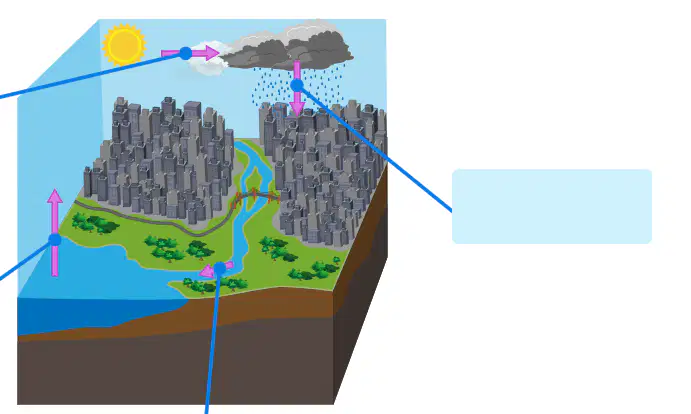
Which label should go in the box?



How would the molecules look in this beaker of water?



How would the molecules look inside these baloons?
How do particles in a solid differ from particles in a gas?
Particles in a solid are closely packed together and vibrate in fixed positions, while particles in a gas are far apart and move freely.
Particles in a solid are not fixed in position
Particles in a solid move freely like in a gas
Particles in a solid are further apart than in a gas
Describe the particle model of a liquid.
Particles in a liquid are close together but can move past each other.
Particles in a liquid are arranged in a rigid structure.
Particles in a liquid are stationary and do not move.
Particles in a liquid are far apart and do not interact with each other.
What is the water cycle and how does it work?
The water cycle is controlled by humans and not a natural phenomenon
The water cycle only involves evaporation and nothing else
The water cycle is a one-time process that does not repeat
The water cycle is the continuous movement of water on, above, and below the surface of the Earth through processes like evaporation, condensation, precipitation, and runoff.
What are the primary factors that affect climate on Earth?
Latitude, altitude, distance from the sea, ocean currents, prevailing winds, and topography (mountains/plains)
Humidity, soil composition, lunar phases
Longitude, atmospheric pressure, seismic activity
Population density, vegetation cover, solar radiation
What happens when I heat up molecules?
They move faster and further apart from each other.
They slow down and move closer together.
No relationship
They move down.
Explain how condensation occurs in the water cycle.
Condensation occurs when water evaporates into the air.
Water vapor in the air heats up and changes to a solid state, forming clouds.
Water vapor in the air cools down and changes to a liquid state, forming clouds or dew.
Condensation is caused by the Earth's rotation.
What is the significance of the Coriolis effect in weather systems?
The Coriolis effect causes earthquakes
The Coriolis effect influences the direction of winds and ocean currents, impacting the formation and movement of weather systems.
The Coriolis effect determines the color of the sky
The Coriolis effect affects the taste of food
How does the greenhouse effect contribute to global warming?
The greenhouse effect has no impact on global warming
The greenhouse effect traps heat in the Earth's atmosphere, leading to an increase in global temperatures.
The greenhouse effect causes cooling of the Earth's atmosphere
The greenhouse effect only affects certain regions, not the entire globe
What is the role of clouds in the water cycle?
Clouds have no role in the water cycle
Clouds absorb water from the ground
Clouds release water vapor into the atmosphere through evaporation
Clouds help in the condensation process and precipitation in the water cycle

Zai drops food colouring into two jars of water. One jar in filled with hot water, and the other is filled with cold. What is he most likely to observe?
The food colouring will spread quicker in the cold water
The food colouring will spread slower in the cold water
The food colouring will weigh more in the cold water
The food colouring will weigh less in the cold water
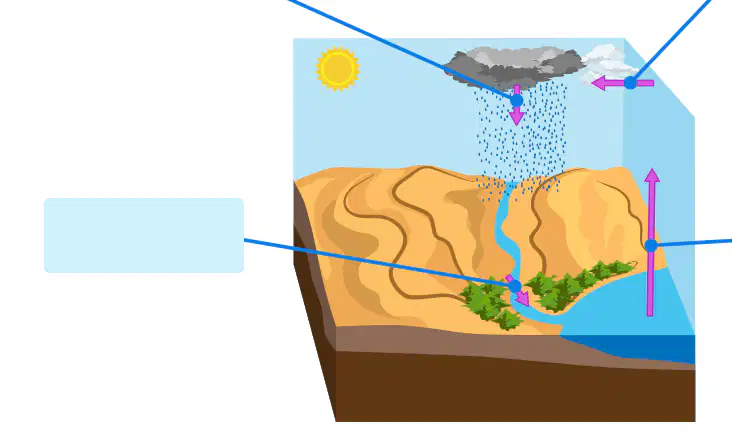
Which label should go in the box?