wayground logo

Free Printable Worksheets

NEW

Font size

S
M
L
XL
Worksheets

W.E.D. and Rocks/Minerals Review

Total questions: 41

Worksheet time: 34mins

Name
Class
Date
1.
The five characteristics that all minerals share are:
a)
Definite Chemical Composition, Color, Density, Igneous, and Solid
b)
Definite Chemical Composition,  Crystal Structure, Inorganic, Naturally Occurring, and Solid
c)
Cleavage, Faces, Hardness, Metamorphic, and Streak
d)
Cleavage, Crystal Structure, Density, Igneous, and Solid
2.
Means that a mineral cannot come from something that was once living.
a)
Inorganic
b)
Organic
c)
Naturally Occurring
d)
Not Living
3.
This is measured on  the Mohs Scale.
a)
Cleavage
b)
Density
c)
Hardness
d)
Luster
4.
The _________ of a mineral is a physical property that is easy to observe.
a)
Chemical Composition
b)
Color
c)
Hardness
d)
Streak
5.
_______ is found by rubbing the mineral against an unglazed tile called a plate.
a)
Cleavage
b)
Color
c)
Luster
d)
Streak
6.
This is how a mineral reflects light.
a)
Cleavage
b)
Density
c)
Hardness
d)
Luster
7.
________ is the mass per unit volume.
a)
Crystal Structure
b)
Density
c)
Hardness
d)
Solid
8.
_______ is a property that describes a mineral  that splits evenly along flat surfaces.
a)
Cleavage
b)
Fracture
c)
Inorganic
d)
Organic
9.
This describes how a mineral looks if it breaks in an irregular way.
a)
Cleavage
b)
Fracture
c)
Inorganic
d)
Organic
10.
The three major rock groups are:
a)
Inorganic, Metamorphic, and  Sedimentary
b)
Inorganic, Metamorphosis, and Sediment
c)
Igneous, Metamorphic, and Sediment
d)
Igneous, Metamorphic, and Sedimentary
11.
This rock  is formed from molten rock (magma/lava) that has cooled.
a)
Igneous
b)
Inorganic
c)
Metamorphic
d)
Sedimentary
12.
This rock is formed from lava on  the earth's  surface
a)
Inorganic
b)
Igneous
c)
Metamorphic
d)
Sedimentary
13.
This rock is formed by erosion (continuously broken down into small fragments) and  then is compressed and  cemented together.
a)
Inorganic
b)
Igneous
c)
Metamorphic
d)
Sedimentary
14.
This rock is formed by extreme heat and/or pressure that alters the chemical composition into a new form of rock.
a)
Inorganic
b)
Igneous
c)
Metamorphic
d)
Sedimentary
15.
When identifying minerals, _______ can be tested by scratching the surface with different materials such as your fingernail or a coin.
a)
Cleavage
b)
Density
c)
Hardness
d)
Streak
16.
Emily was looking at a rock and saw tiny crystals.  Emily should know that all rocks are made up of _____.
a)
diamonds
b)
minerals
c)
fossils
d)
dirt
17.
True or False:
A mineral is a solid, nonliving material with a definite chemical makeup.
a)
True
b)
False
18.
Which of the following is NOT a property that can be used to identify a mineral?
a)
luster
b)
color
c)
weight
d)
hardness
19.
A solid material that is made up of one or more minerals.
a)
mineral
b)
rock
c)
fossil
d)
soil
20.
The continuous series of change that rocks undergo is known as the _____.
a)
rock cycle
b)
water cycle
c)
hibernation
d)
metamorphisis
21.
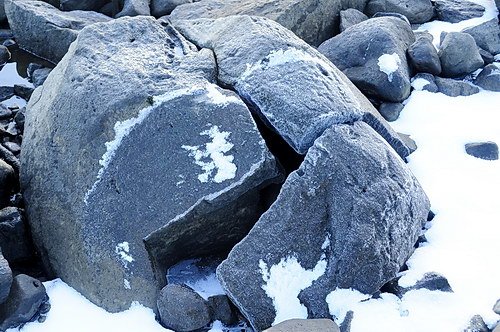
How does freezing water cause the weathering of rocks?  The freezing water—
a)
keeps the rocks in place.
b)
makes the rocks last longer.
c)
expands cracks and breaks rocks.
d)
causes rocks to fall in landslides.
22.
The process that breaks down rocks and other materials on Earth's surface is called
a)
Weathering
b)
Erosion
c)
Deposition
d)
Decomposition
23.
Over long periods of time, deposition may change the Earth’s surface by _____.
a)
forming new land features.
b)
breaking down large rocks into smaller ones.
c)
washing away beaches.
d)
moving topsoil.
24.
What is the process that picks up and moves weathered rocks?
a)
Deposition
b)
Landslide
c)
Weathering
d)
Erosion
25.
Deposition changes the Earth’s surface because bits of broken rock and soil _____.
a)
stop rivers from flowing.
b)
make rich farmlands.
c)
are dropped in new places.
d)
move very slowly.
26.
The process by which water, ice, wind, or gravity moves weathered rock and soil from one place to another.
a)
Weathering
b)
Erosion
c)
Deposition
d)
Crop Rotation
27.
Which of these is an example of erosion?
a)
Light shining onto a mountain.
b)
Rain breaking down rocks on a mountain into smaller pieces. 
c)
Wind blowing away sediment to a new place on the mountain.
d)
All of the above.
28.
What is an enormous mass of ice moving over land, causing weathering of rock and soil?
a)
A glacier
b)
An iceberg
c)
An ice wedge
d)
A sand dune
29.
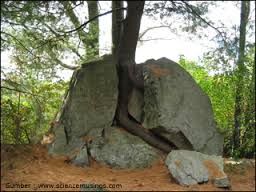
How do plants weather rocks?
a)
During photosynthesis
b)
When roots grow into cracks of rocks and expand the rock breaks.
c)
When the plant moves water from the roots to the leaves, the rock breaks.
d)
Plants don't weather rocks.
30.
Wind blows sand onto rocks and slowly breaks down the rock
a)
Mechanical Weathering
b)
Chemical Weathering
c)
Erosion
d)
Deposition
31.
Acid rain melts the features of a statue
a)
Mechanical Weathering
b)
Chemical Weathering
c)
Erosion
d)
Deposition
32.
Salt water eats away at rock
a)
Mechanical Weathering
b)
Chemical Weathering
c)
Erosion
d)
Deposition
33.
The small peices of rock that break off of a larger rock during weathering are called...
a)
Sediment
b)
Salt
c)
Erosion
d)
Deposition
34.
According to the law of superposition, the oldest fossils are found 
a)
At the top of the rock layers
b)
Near the bottom of the rock layers
c)
In the middle of the rock layers
d)
Somewhat near the surface
35.
An archaeologist made the following diagram of a dig site. What can be said about the pottery as compared to the skull found in the site?
a)
The rock layer with the pottery is more recent than the rock layer with the skull.
b)
The rock layer with the skull is more recent than the rock layer with the pottery.
c)
The rock layer with the skull is approximately the same age as the rock layer with the pottery.
d)
The rock layer with the skull has an absolute date of 17,000 years.
36.

The number of years that have passed since the rock formed is the rock's ____ age, or its actual age.

a)

relative

b)

law of superposition

c)

absolute

d)

index fossil

37.

The age of a rock compared to the ages of other rocks is the rock's

a)

absolute age

b)

geologic age

c)

sedimentary age

d)

relative age

38.

The Law of Superposition helps scientists to determine what?

a)

The absolute age of rock layers

b)

The age of fossils

c)

The relative age of rock layers

d)

the super powers of squirrels

39.

What is the relative age of a rock?

a)

The age determined by the things around it.

b)

The age of an igneous rock.

c)

The age determined by radioactive dating.

d)

The time it takes for 1/2 of the radioactive atoms to decay in an element.

40.

What is the absolute age of a rock?

a)

The age determined by the things around it.

b)

The age of an igneous rock.

c)

The age determined by radioactive dating.

d)

The age of the scientist studying it.

41.

How old do Paleontologists believe the Earth is?

a)

2023 years old

b)

20,230 years old

c)

4.6 billion years old

d)

4.6 million years old