Wayground logo

Free Printable Worksheets

Font size

S
M
L
XL
Worksheets

Feeling Forceful

Total questions: 61

Worksheet time: 2hrs 2mins

Name
Class
Date
1.
What force holds the planets in motion around the sun?
a)
Magnetic
b)
Electrical
c)
Gravitational
d)
Air Resistance
2.
What is a force?
a)
a push or pull
b)
speed or acceleration 
c)
potential or kinetic energy
d)
balanced or unbalanced force
3.
When objects remain in the same place, it is called...
a)
gravity
b)
friction
c)
balanced force
d)
unbalanced force
4.
When an object has potential energy, it is not moving.
a)
true
b)
false
5.
What is the force that causes everything to be pulled down to the Earth?
a)
friction
b)
gravity
c)
balanced
d)
unbalanced
6.
Kinetic energy is when....
a)
energy is stored up in an object
b)
energy is released and the object moves
7.
An unbalanced force is when objects move in one direction because the force is greater from that direction.
a)
true
b)
false
8.
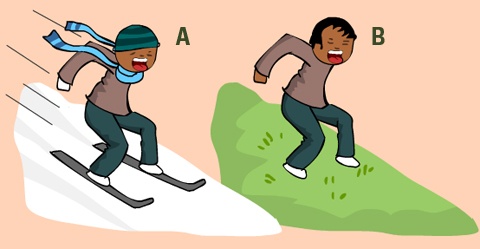
Why is it harder for the boy in Image B to get down the hill?
a)
Motion
b)
Friction
c)
Work
d)
Displacement
9.

Some students wanted to find out if a tennis ball and a baseball dropped from the same height hit the ground at the same time. This investigation tests the effect of which of the following?

a)

wind

b)

friction

c)

gravity

d)

magnetism

10.

Students are investigating motion with a rubber band car. They want to know how the number of winds of the rubber band affects how the car moves. They will record the number of winds of the rubber band. What other data will they need to collect?

a)

The distance the car travels when released

b)

The length of the rubber band during each trial

c)

The amount of time it takes to wind the propeller

d)

The width of the surface on which the car moves

11.

If a student has two magnets, how might it be determined which magnet is stronger?

a)

Count how many paper clips each magnet can lift.

b)

Submerge each magnet in a bowl of water.

c)

Examine each magnet to determine the north pole.

d)

Measure the length and the mass of both magnets.

12.

Students create balloon rockets by taping drinking straws to balloons and running a thick string through the straw. The ends of the string are held tightly apart. When the balloon is inflated and released, it moves along the string. What should the student do to change the amount of friction that slows the motion of the balloon rocket?

a)

Try different color balloons.

b)

Use a different type of tape.

c)

Replace the string with thin wire.

d)

Hold the string ends closer together.

13.

A student makes a swing move by pushing it. If a student pushes the swing harder, the swing will most likely---

a)

stop moving

b)

slow down

c)

go higher

d)

get bigger

14.

When the rope is pulled, in which direction will the bricks move?

a)

Outward

b)

Upward

c)

Inward

d)

Downward

15.
Edward kicks a soccer ball across the backfield. What force works to slow the ball down?
a)
pushes and pulls
b)
friction
c)
magnetism
d)
gravitation
16.
How does friction help us move from place to place?
a)
Friction does not help us.
b)
Friction keeps us from slipping and sliding.
c)
Friction only helps cats.
d)
Friction makes us slip and fall.
17.
What is the force that causes objects to fall to Earth?
a)
Air resistance
b)
Gravity
c)
Water resistance
d)
Pressure
18.
Which of these is NOT a force?
a)
Friction
b)
Air resistance
c)
Water resistance
d)
Electrical resistance
19.
In which direction does gravity act?
a)
Downwards
b)
Upwards
c)
In all directions
d)
Towards the centre of the Earth
20.
Which is the correct definition of a 'force'?
a)
An influence, which cannot be measured, that causes something to move, stop moving or change direction.
b)
An influence, which can be measured, that causes something to move, stop moving or change direction.
c)
Something which has power.
d)
An influence, which can be measured, that causes something to move.
21.
What force does a parachute use to slow things down before hitting the ground?
a)
Friction
b)
Air resistance
c)
Water resistance
d)
Wind
22.
What type of force is air resistance?
a)
Contact
b)
Non-contact
23.
When two objects rub together, what force do they produce
a)
Gravity
b)
Air resistance
c)
Friction
d)
Water resistance
24.
What force does an aeroplane have to try to overcome so it is not slowed down too much?
a)
Gravity
b)
Air resistance
c)
Water resistance
d)
Friction
25.
Which of these uses friction?
a)
A parachute
b)
A ball falling through the sky
c)
Brakes on a bike
d)
A wind turbine
26.
What affect does water resistance have on a boat?
a)
Just slows it down
b)
Slows it down AND helps it keep afloat
c)
Makes it sink
d)
Just makes it float
27.
Which of these would you not find in a 'simple machine'?
a)
A lever
b)
A micochip
c)
A pulley
d)
A gear
28.
Simple machines allow...
a)
...a smaller force to have a greater effect
b)
....a bigger force to have a smaller effect
c)
... a force to be stopped
d)
...a force to be used in a useful way.
29.

What type of force is this man using to push his grocery cart?

a)

Normal Force

b)

Gravity

c)

Air Resistance

d)

Applied Force

30.

Is this an example of a balanced or unbalanced force?

a)

Balanced force

b)

Unbalanced force

c)

I don't know

31.

In this force diagram, which arrow is representing Friction?

a)

A

b)

B

c)

C

d)

D

32.

In this force diagram, which arrow is representing the Normal Force?

a)

A

b)

B

c)

C

d)

D

33.

Which force is having the greatest impact on this object currently?

a)

Applied force

b)

Normal force

c)

Frictional force

d)

Gravitational force

34.
How does friction affect speed?
a)
more friction decreases speed
b)
more friction increases speed
c)
less friction decreases speed
35.
The rougher the surface, the faster an object will travel over the surface.
a)
True
b)
False
36.
When most objects with smooth surfaces rub, there is less friction.
a)
True
b)
False
37.
Friction is a force that acts in an ___________ direction of movement.
a)
similar
b)
opposite
c)
parallel
d)
west
38.
What does friction produce?
a)
light
b)
sound
c)
heat
d)
gravity
39.

Which of the following answers is the most scientific answer for the question:


What is friction?

a)

The random force between two solids, liquids, or gases.

b)

The contact force between two solids, liquids, or gases that slide past one another.

c)

The thing that creates static electricity

d)

A force that is random

40.

When there is friction, the energy of an object's motion is converted into _______ energy

a)

heat

b)

kinetic

c)

stronger

d)

friction

41.

Which of the following is NOT an example of friction?

a)

using the brakes on your bike to slow you down

b)

putting your hand out the window

c)

a satellite traveling through deep space

d)

a hockey puck going across an ice rink

42.

This car is turning, but there’s a puddle of water in the road. Which diagram best shows how the puddle will affect the path of the car after it hits the puddle?

a)
b)
c)
d)
43.
A puck slides along an icy surface. What makes it slow down?
a)
It runs out of push
b)
It rubs against the ice
c)
It runs out of electricity
44.
On which surface will a toy car travel the furthest?
a)
Carpet
b)
Polished Wood
c)
Ice
45.
Magnets have a north and a south ___________
a)
shape
b)
color
c)
pole
d)
region
46.
Where is the strongest attraction force of the magnet?
a)
at the poles
b)
in the middle
c)
above the magnet
d)
below the magnet
47.
Which object would a magnet attract?
a)
a glass bottle
b)
a piece of paper
c)
a metal paper clip
compass
d)
a rubber eraser
magnetic field
48.
What happens when two north poles of a magnet are placed together?
a)
they repel
b)
they attract
c)
they cancel each other out
d)
the strength of the magnet is doubled
49.

An objects resistance to sinking is...

a)

buoyancy.

b)

density.

c)

weight.

d)

material.

50.
Griff made a foil boat. Griff's boat is hard to push down in the water. Your inference is?
a)
It will hold more marbles than the others.
b)
It will hold fewer marbles than the others.
c)
It will sink when loaded with marbles.
d)
It will never sink when loaded with marbles.
51.
Why do some clay objects float?
a)
Their bottoms are flat.
b)
Their shapes are open.
c)
Their sizes are small.
52.

The upward force which is exerted against a falling object is

a)

gravity

b)

terminal velocity

c)

air resistance

d)

intertia

53.

A force which causes objects to fall is

a)

weight

b)

gravity

c)

air resistance

d)

absorbency

54.

The frictional force air exerts against a moving object...

a)

Friction

b)

Gravity

c)

Air Resistance

55.

The resistance of motion when two objects rub together....

a)

Gravity

b)

Friction

c)

Air Resistance

56.

A push or a pull.

a)

Gravity

b)

Force

c)

Motion

57.

Choose the one that is NOT a force.

a)

Friction

b)

Gravity

c)

Energy

d)

Air Resistance

58.

A person would weigh less on the moon because...

a)

The moon has more gravity than the Earth.

b)

The moon has less gravity than the Earth.

c)

The moon has no Air Resistance

59.

Complete the sentence.

It is not the difference in gravity that causes objects to fall at different speeds, it’s the difference in the amount of__________________.

a)

Gravity

b)

Friction

c)

Air

60.

Is Air Resistance friction?

a)

Yes

b)

No

61.

What force keeps the body on the Earth?

a)

Friction

b)

Gravity

c)

Energy