
 Worksheets
Lewis Dot Structures, Bohr Models, & Ionic vs. Covalent
Total questions: 20
Worksheet time: 14mins
Name
Class
Date
1.
Isotopes are elements with a different amount of
a)
protons
b)
neutrons
c)
electrons
d)
atoms
2.

What element is represented in this Bohr Model?
a)
Carbon
b)
Hydrogen
c)
Aluminum
d)
Lithium
3.

What is the name of this element?
a)
Lithium
b)
Boron
c)
Carbon
d)
Neon
4.

What is the atomic number of this atom?
a)
2
b)
4
c)
6
d)
none of the above
5.

How many electrons does potassium K contain? (click to see image)
a)
19
b)
39
c)
20
d)
40
6.

This is a correct dot diagram for oxygen (O)
a)
true
b)
false
7.

This is the correct dot diagram for sodium (Na)
a)
true
b)
false
8.

This is the correct dot diagram for nitrogen (N)
a)
true
b)
false
9.

This is a correct dot diagram for fluorine (F)
a)
true
b)
false
10.
Covalent bonds are between...
a)
Metal and Non-metal
b)
Non-metal and Non-metal
c)
Metal and Metal
11.
Ionic bonds are between...
a)
Metal and Non-metal
b)
Non-metal and Non-metal
c)
Metal and Metal
12.
Covalent bonds actually "share" electrons?
a)
true
b)
false
13.
Why do elements bond?
a)
To be friends
b)
To create a new element
c)
To become stable
14.
What is a valence electron?
a)
The sum of neutrons and protons.
b)
The # of electrons in the last shell.
c)
A type of bond.
d)
A popular compound.
15.
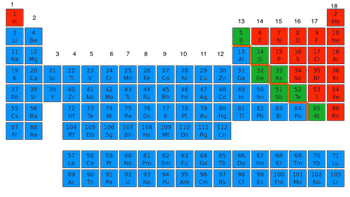
Where are metals located on the periodic table?
a)
Blue
b)
Green
c)
Red
16.
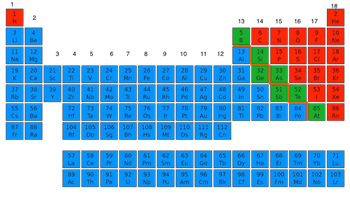
Where are the nonmetals located on the periodic table?
a)
Blue
b)
Red
c)
Green
17.

Where are the metalloids located on the periodic table?
a)
Blue
b)
Red
c)
Green
18.

Name this element.
a)
Neon
b)
Magnesium
c)
Sodium
d)
Manganese
19.

How many valence electrons?
a)
2
b)
3
c)
4
d)
5
20.

How many valence electrons?
a)
2
b)
3
c)
4
d)
5
100 %

