wayground logo

Free Printable Worksheets

Font size

S
M
L
XL
Worksheets

Phy. Sci. Chapter 2 Test Review

Total questions: 75

Worksheet time: 1hrs 26mins

Name
Class
Date
1.
An object is _____ if its position changes relative to another object.
a)
in motion
b)
at reset
c)
a frame of refence
d)
magical
2.
A place or object used for comparison to determine if another object is in motion is called a
a)
comparison point
b)
reference point
c)
point of view
d)
motion detector
3.
All motion is described as relative because
a)
how do you ever really know if something is in motion
b)
motion means different things to different people
c)
everything in the universe is constantly in motion, so it depends on your frame of reference
4.
Velocity is
a)
speed and acceleration
b)
constant speed
c)
a frame of reference
d)
speed in a given direction
5.
Acceleration is
a)
increasing speed
b)
decreasing speed
c)
changing direction
d)
all of the above
6.
A car driving 100 miles per hour hits the brakes and slows to 50 miles per hour. This is an example of negative acceleration. True or False?
a)
True
b)
False
7.
What is another word used for negative acceleration?
a)
speeding up
b)
accelerating
c)
deceleration
d)
velocity
8.
The difference between speed and velocity is
a)
Velocity involves time, speed does not
b)
Velocity has direction while speed does not
c)
Speed involves time while velocity does not
d)
 Speed involves direction while velocity does not
9.
Which of the following is the closest match to the definition of motion?
a)
An objects change in position relative to a reference point
b)
The change in position of an object
c)
Constant speed
10.
An object traveling in a circular motion is always changing its ______ and ______.
a)
rotation, velocity
b)
direction, velocity
11.

The starting point you choose to describe the position an object.

a)

reference point

b)

south

c)

spot

d)

position

12.
Acceleration is
a)
increasing speed
b)
decreasing speed
c)
changing direction
d)
all of the above
13.
A child rides a bike around the block.
a)
Speed
b)
Velocity
c)
Acceleration
14.
Describe the speed of the rocket in the speed vs. time graph.
a)
Constant speed
b)
Decreasing speed
c)
Increasing speed
d)
Not moving
15.
A dog runs on the sidewalk 9 mi/hr.
a)
Speed
b)
Acceleration
c)
Velocity
16.

Describe the speed of the object from 4-6 seconds using the distance vs. time graph.

a)

Increasing speed

b)

Decreasing speed

c)

Not moving

d)

Constant speed

17.
While going to school, a student walks an average of 5 km/hr west for 12 blocks.
a)
Speed
b)
Acceleration
c)
Velocity
18.

Describe the speed of the object from

0-2 seconds using the distance vs. time graph.

a)

Constant

b)

Speeding up

c)

Slowing down

d)

Not moving

19.
While on a trip, a family travels east from San Antonio to Houston going 70 mph.
a)
Speed
b)
Acceleration
c)
Velocity
20.
Describe the speed of the object from
2-5 seconds using the speed vs. time graph.
a)
Increasing speed
b)
Not moving
c)
Decreasing speed
d)
Constant speed
21.
A bicyclist takes a curved, scenic ride through the park going 4.5 m/s.
a)
Speed
b)
Acceleration
c)
Velocity
22.

Describe the speed of the object from

5-6 seconds using the speed vs. time graph

a)

Speeding up

b)

Slowing down

c)

Not moving

d)

Constant speed

23.
Some motorcycles can go from 0 mi/hr to 60 mi/hr in under 4 seconds.
a)
Speed
b)
Acceleration
c)
Velocity
24.
An airplane flying northwest takes a turn, and flies west.
a)
Speed
b)
Velocity
c)
Acceleration
25.
47 mph
a)
Speed
b)
Velocity
c)
Acceleration
26.
88 m/s2
a)
Speed
b)
Velocity
c)
Acceleration
27.
47 mph southeast
a)
Speed
b)
Velocity
c)
Acceleration
28.
20 m/s west
a)
Speed
b)
Velocity
c)
Acceleration
29.
88 m/s north
a)
Speed
b)
Velocity
c)
Acceleration
30.
88 m/s
a)
Speed
b)
Velocity
c)
Acceleration
31.
When an object’s distance from another object is changing,
a)
it is in motion.
b)
it is speeding. 
c)
it is accelerating.
d)
it is moving at a high velocity.
32.
Speed equals distance divided by
a)
time
b)
velocity
c)
size
d)
motion
33.
When you know both the speed and direction of an object's motion, you know the
a)
average speed of the object
b)
acceleration of the object
c)
distance the object has traveled
d)
velocity of the object
34.
The rate at which velocity changes is called
a)
speed
b)
direction
c)
acceleration
d)
motion
35.
Which of these is an example of negative acceleration (or deceleration)?
a)
a bird taking off for flight
b)
a baseball released by a pitcher
c)
a car approaching a red light
d)
an airplane following a straight flight path
36.
A place or object used for comparison to determine if something is in motion is called 
a)
a position
b)
a reference point
c)
a constant
d)
velocity
37.
The moon accelerates because it is
a)
in a vacuum in space.
b)
continuously changing direction.
c)
a very large sphere.
d)
constantly increasing its speed of orbit.
38.

The shortest path between an object's starting and ending point is its:

a)

Distance

b)

Disturbance

c)

Disenfranchisement

d)

Displacement

39.

Which of these objects is NOT accelerating?

a)

A plane slowing down to land

b)

A rocket taking off into space

c)

A hiker moving at the same speed for hours

d)

A rollerblader heading downhill

40.

If you rode your bike from Point A to Point B to Point C, what would be the DISTANCE you travelled?

a)

3 miles

b)

4 miles

c)

5 miles

d)

7 miles

41.

If you traveled from Point A to Point B to Point C, what would your DISPLACEMENT be?

a)

3 miles

b)

4 miles

c)

5 miles

d)

7 miles

42.

A helicopter flies west 99 miles in 3 hours. What is its velocity?

a)

99 mph

b)

33 mph west

c)

99 mph south

d)

297 mph south

43.

Assume the letters label each point shown on the graph. The last point should be labelled F. Between which two letters is this object accelerating the most?

a)

A to B

b)

B to C

c)

E to F

d)

A to F

44.

Assume the letters label each point shown on the graph. The last point should be labelled F. Between which two letters is this object seeing the most negative acceleration?

a)

A to B

b)

C to E

c)

E to F

d)

B to C

45.

Assume the letters label each point shown on the graph. The last point should be labelled F. Between which two letters is this object moving at a constant speed?

a)

A to B

b)

B to C

c)

C to D

d)

E to F

46.
A car accelerates from a standstill to 70 m/s in 10 seconds.  What is the acceleration?
a)
0.7m/s2
b)
7m/s2
c)
14m/s2
d)
none of the above
47.
A car accelerates from 15 m/s to 60 m/s in 30 seconds.  What is its acceleration?
a)
2 m/s2
b)
3 m/s2
c)
1.5 m/s2
d)
0.75 m/s2
48.
A dog runs with an initial speed of 7.5 m/s on a waxed floor.  It slides to a stop in 15 seconds.  What is the acceleration?
a)
-7.5 m/s
b)
-7.5 m/s2
c)
-0.5 m/s2
d)
7.5 mi//hr
49.
A snail can move approximately 0.30 meters per minute. How many meters can the snail cover in 15 minutes?
a)
4.5 m
b)
50 m
c)
0.02 m
d)
14 m
50.
A ball rolls 144 cm in 12 sec. What is its speed in meters per second?
a)
12 cm/sec
b)
12 m/s
c)
1.2 m/s
d)
0.12 m/s
51.
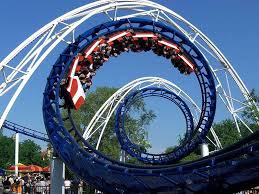
A roller coasters accelerates from an initial velocity of 6.0 m/s to a final velocity of 70 m/s over 4 seconds.  What's the acceleration?
a)
24 m/s2
b)
18 m/s2
c)
16 m/s2
d)
16 m/s
52.
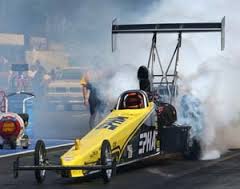
A drag racer accelerated from 0 m/s to 200 m/s in 5 s.  What was the acceleration?
a)
0 m/s
b)
40 m/s2
c)
-40 m/s2
d)
40 m/s
53.
a)
Object not moving
b)
Object accelerating
c)
Object slowing down
d)
Object at a constant speed
54.
a)

Green object is moving at a faster constant speed than Red

b)

Red object is moving at a faster constant speed than Green

c)

Green object is moving at a slower constant speed than Red

d)

Red object is moving 2 times faster than Green

55.
Which graph shows: A car travelling at a constant speed.
a)
A
b)
B
c)
C
d)
D
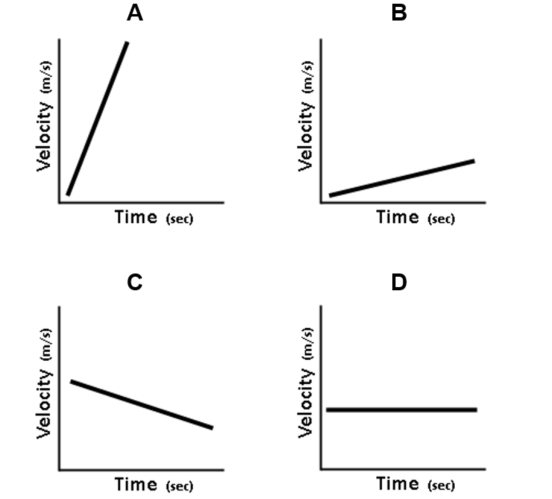
56.

Which graph represents slowing down?

a)

A

b)

B

c)

C

d)

D

57.
Which graph represents the greatest acceleration?
a)
A
b)
B
c)
C
d)
D
58.
The graph below represents
a)
Speed
b)
Velocity
c)
Acceleration
d)
Deceleration
59.
In which time interval was the object speeding up?   
a)
between 0 s and 2 s
b)
between 2 s and 4 s
c)
between 6 s and 8 s
d)
between 8 s and 10 s
60.
What is the person doing from 5 seconds to 10 seconds?
a)
Walking 
b)
Running
c)
Standing Still 
d)
Walking Fast
61.
A ball of clay is thrown at a wall at a velocity of 28.0 m/s.  After it hits the wall, it takes 0.020 s to stop.  What is the acceleration of the clay when it hits the wall?
a)
1400 m/s2
b)
-1400 m/s2
c)
0.56 m/s2
d)
-0.56 m/s2
62.
A ball of clay is thrown at a wall at a velocity of 28.0 m/s.  After it hits the wall, it takes 0.020 s to stop.  What is the acceleration of the clay when it hits the wall?
a)
1400 m/s2
b)
-1400 m/s2
c)
0.56 m/s2
d)
-0.56 m/s2
63.
A box sliding down an inclined plane attains a velocity of 27 m/s in 3 seconds from rest.  Find the acceleration.
a)
30 m/s
b)
24 m/s2
c)
9 m/s2
d)
81 km/hr
64.
A dog runs with an initial speed of 7.5 m/s on a waxed floor.  It slides to a stop in 15 seconds.  What is the acceleration?
a)
-7.5 m/s
b)
-7.5 m/s2
c)
-0.5 m/s2
d)
7.5 mi//hr
65.
Which graph represents zero acceleration (constant velocity)?
a)
A
b)
B
c)
C
d)
D
66.
Which graph demonstrates the greatest positive speed?
a)
A
b)
B
c)
C
d)
D
67.

Is this object accelerating?

a)

Yes

b)

No

68.

Is this object accelerating?

a)

Yes

b)

No

69.

Is this object accelerating?

a)

Yes

b)

No

70.

Is this object accelerating?

a)

Yes

b)

No

71.
A golf ball starts with a speed of 2 m/s and slows at a constant rate of 0.5 m/s2, what is its velocity after 2 s?
a)
0 m/s
b)
0.5 m/s
c)
1 m/s
d)
1.5 m/s
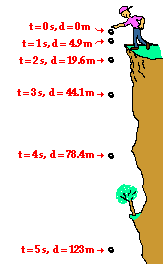
72.
What happens to the velocity of a ball as it is dropped off a cliff? 
a)
It decreases at a uniform rate 
b)
It increases at a uniform rate 
c)
It is constant 
d)
It increases at a non-uniform rate
73.

Looking for some good old-fashioned fun, Andrew decides to slide down the hill on a toboggan. Calculate the time it takes him to reach the bottom of the hill if he accelerates at a rate of 4 m/s2 to achieve a speed of 32 m/s.

a)

8 s

b)

2 s

c)

7s

d)

4 s

74.

Fred has joined the school ping pong team. On his serve, the ping pong ball is accelerated at 4.6 m/s2. After 2.0 s, how fast would it be traveling?

a)

10.2 m/s

b)

7.1 m/s

c)

4.9 m/s

d)

9.2 m/s

75.

A car moving at 4.5 m/s accelerates at 2.5 m/s2. After 7 s, how fast will it be moving?

a)

22 m/s

b)

18.3 m/s

c)

4.9 m/s

d)

7.6 m/s