
 Worksheets
Review for Periodic Table Quiz
Total questions: 15
Worksheet time: 23mins

The vertical (up and down) columns in the Periodic Table are called
groups
towers
periods
atomic numbers

The horizontal (side to side) rows in the Periodic Table are called
groups
families
periods
atomic numbers
What are valence electrons?
Any of an atom's electrons
Electrons located on the first energy level
Electrons not attached to any atom
electrons located on the outer energy level
Why are Group 17 halogens so reactive?
They want to get rid of their only valance electron
They only need one more electron
They are non reactive, they have a full shell
What do the vertical columns on the periodic table tell us?
The number of orbitals
The number of valence electrons (electrons on the outer most shell)
What do the horizontal rows on the periodic table tell us?
The number of orbitals
The number of valence electrons (the electrons on the outer most shell)
How many valence electrons and energy levels does (Pb) lead have?
4 valence electrons and 6 energy levels (orbitals)
6 valence electrons and 4 energy levels (orbitals)
5 valence electrons and 5 energy levels (orbitals)
5 valence electrons and 10 energy levels (orbitals)

Silicon, used in computer chips, is a semiconductor and has properties of both metals and nonmetals. What type of element is Silicon?
Metal
Nonmetal
Metalloid
Pretty
Which group of the periodic table is composed of inert (not reactive) gases?
Group 1 (alkali metals)
Group 2 (alkaline earth metals)
Group 17 (halogens)
Group 18 (noble gases)
Why are Group 1 (alkali metals) so reactive?
They want to get rid of their only valance electron
They only need one more electron
They are non reactive, they have a full shell
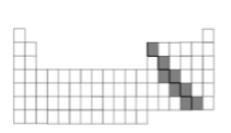
Elements in this area can best be described as -
Semiconductors
Malleable
Nonmetals
Insulators

