Worksheets
Chapter 2 Test Review
Total questions: 31
Worksheet time: 20mins
A vial of CuSO4 (aq) contains _________.
a colorless gas
a colored solution
a clear liquid
solid chunks
How many different elements are included in the compound ZnNO3 (s)?
4
1
2
3
Na is an example of ___________.
an element
a compound
a solution
a mixture
MgBr2 is an example of _________.
a phase
an element
a compound
a metal
Which statement is NOT a sign of a chemical reaction?
A solid is dropped into a beaker of liquid and a gas is released.
A solid is heated in a beaker and becomes a liquid.
A solid is dropped into a beaker of liquid and an explosion occurs.
Two solutions are mixed and a solid forms at the bottom of the container.
When solid sodium, Na (s), is added to liquid water, H2O (l), the result is a clear liquid and bubbles of H2. Where is the sodium after the change?
in a solid chemical compound
it is no longer present
in the bubbles
in the aqueous solution
When aqueous copper (II) chloride, CuCl2 (aq), is added to a beaker with solid zinc, Zn (s), the result is a clear, colorless solution and solid copper. Where is the zinc when this reaction is complete?
Zinc has disappeared from the container as a gas.
Zinc is now dissolved in the clear, colorless solution.
Zinc is destroyed by the copper solution.
Zinc is unchanged and is still a solid in the beaker.
Which statement does NOT provide a reasonable explanation about why the penny turned gold-colored when it was placed on the hot plate in the gold penny demonstration in Lesson 2?
The zinc and the copper reacted when heated.
Perhaps the penny is coated with copper on top of a gold-colored metal.
The heat formed a brass coating on the penny.
The copper disappeared because it was destroyed.
Methane, CH4 (g), reacts with oxygen, O2 (g). Only two products are formed. One is water, H2O (l). The second is a gas. Identify this gas from the list below.
CO2 (g)
CF4 (g)
C (s)
H2 (g)
The copper cycle is a demonstration of what principle of chemistry?
Elements exist as gases, liquids, or solids.
Mass is conserved in chemical reactions.
Metals are excellent conductors.
Most elements are metallic solids.
How can you demonstrate the law of conservation of mass in the laboratory using the copper cycle?
Measure the mass of copper before and after the experiment. You should have more copper after than you did before.
Measure the mass of copper before and after the experiment. You should have less copper after than you did before.
Measure the mass of copper before and after the experiment. They should be equal.
You cannot do use this experiment to prove it because some of the copper is destroyed in the cycle.
The element calcium, Mg, reacts with oxygen, O, to form magnesium oxide, MgO. What compound do you predict for the reaction of Mg with sulfur, S?
MgS
Mg2S
MgS2
MgS3
Which of the following elements has the largest atomic number?
zinc, Zn
zirconium, Zr
tungsten, W
tantalum, Ta
Which of the following elements has the largest average atomic mass?
cobalt, Co
nickel, Ni
scandium, Sc
titanium, Ti
Use a periodic table to answer the question. Which groups of elements would you expect to have the most similar properties?
fluorine, F, nitrogen, N and silicon, Si
cadmium Cd, zinc, Zn and iodine, I
nitrogen, N, oxygen, O, and fluorine, F
argon, Ar, krypton, Kr and xenon, Xe
Bromine can be found in what group in the periodic table?
transition metals
halogens
alkali metals
alkaline earth metals
At room temperature, most of the elements in the periodic table are ______________.
solids
radioactive
gases
nonmetals
Use a periodic table to answer the question. What is the correct ordering of the groups from RIGHT TO LEFT in the periodic table?
noble gases, alkali metals, alkaline earth metals, halogens
alkali metals, alkaline earth metals, halogens, noble gases
noble gases, halogens, alkaline earth metals, alkali metals
alkali metals, noble gases, alkaline earth metals, halogens
Order these metals from most to least reactive? transition metals alkali metals alkaline earth metals lanthanide metals
alkali metals > transition metals > alkaline earth metals
transition metals > alkaline earth metals > alkali metals
alkaline earth metals > transition metals > alkali metals
alkali metals > alkaline earth metals > transition metals
Which of the following statements is NOT true?
Element is simplest form of matter to have an identity.
Compounds cannot be broken down any further.
Compound is made of two more more elements combined.
Elements cannot be broken down any further.
Which of the following is considered to be a form of matter but not a state of matter?
aqueous
solid
liquid
gas
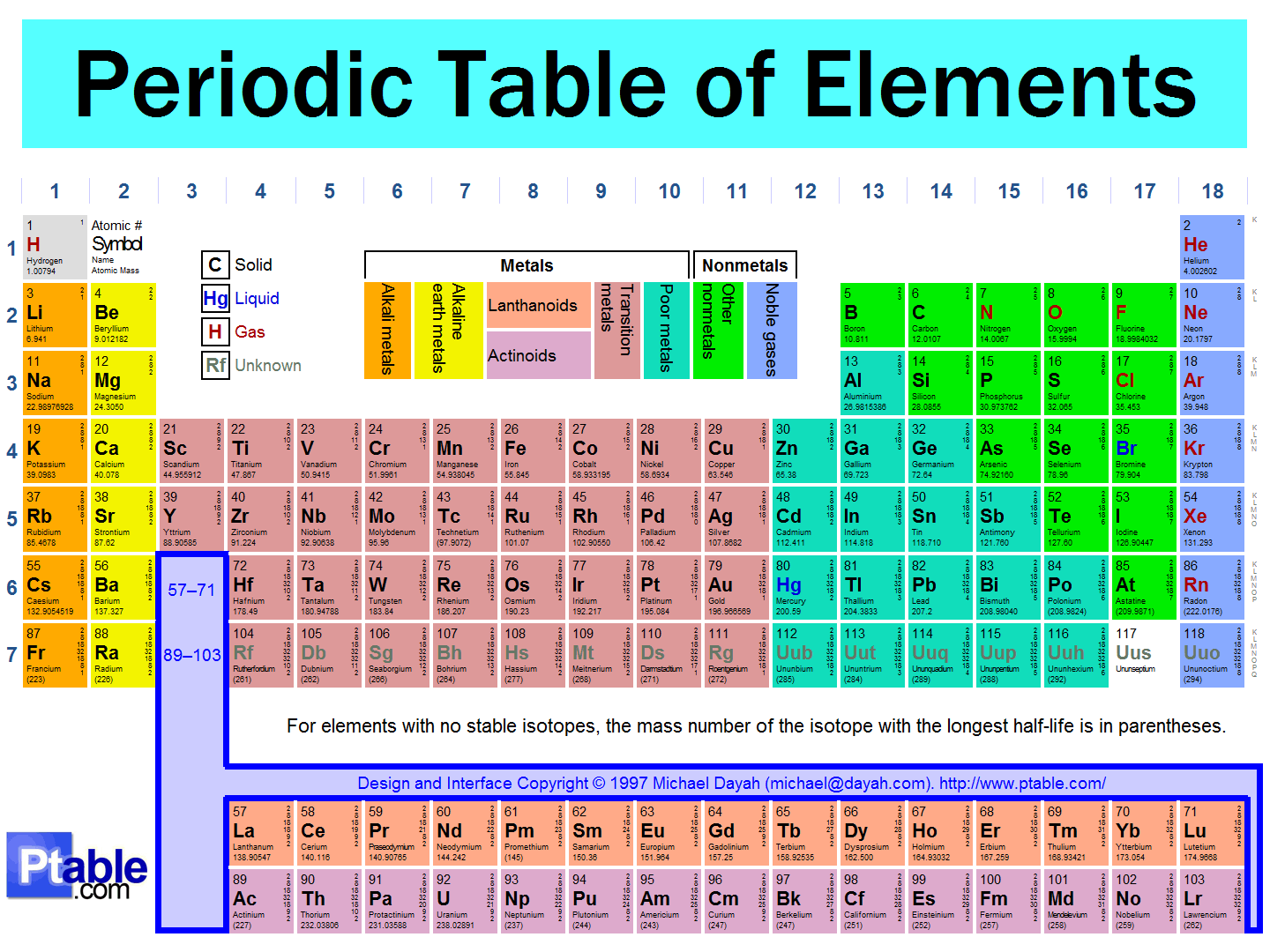
The vertical (up and down) columns in the Periodic Table are called
groups
towers
periods
atomic numbers
What tool might a scientist use to demonstrate the Law of Conservation of Matter?
ruler
beaker
thermometer
electronic scale