wayground logo

Free Printable Worksheets

Font size

S
M
L
XL
Worksheets

Unit 1 REVIEW

Total questions: 40

Worksheet time: 26mins

Name
Class
Date
1.
The mass of a toy spoon is 7.5 grams, and its volume is 3.2 mL, what is the density of the toy spoon?
a)
2.3 g/mL
b)
0.43 g/mL
2.
Pure gold has a density of 19.32 g/cm3. How large would a piece of gold be if it had a mass of 318.97 g?
a)
6162 cm3
b)
0.06060 cm3
c)
16.51 cm3
3.
What is the mass of a 350 cm3 sample of pure silicon with a density of 2.336 g/cm3?
a)
820 g
b)
0.0067 g
c)
150 g
4.
Jack has a rock. The rock has a mass of 14g and a volume of 2cm3. What is the density of the rock?
a)
7 mL
b)
7 g/cm3
c)
28 g/cm3
d)
1/7 g/cm3
5.

Which units of measurement are used for volume?

a)

grams

b)

centimeters

c)

grams/milliliter

d)

milliliter

e)

centimeters3

6.
Which lab tool might you use to measure the volume of a liquid?
a)
electric scale
b)
bunsen burner
c)
test tube
d)
graduated cylinder
7.
What is the volume of Object X?
a)
10.0 cm3
b)
15.0 cm3
c)
20.0 cm3
d)
25.0 cm3
8.
An empty beaker has a mass of 60 grams.  When mercury is added to the beaker, it has a mass of 200 grams. What is the mass of the mercury?
a)
140 grams
b)
200 grams
c)
140 mL
d)
260 g
9.
Find the volume of this piece of brass.  
a)
50 g
b)
10 cm
c)
6 cm3
d)
12 cm3
10.
This is a measurement of the amount of matter, or 'stuff', in an object or substance.
a)
volume
b)
density
c)
mass
d)
length
11.

What is the volume of the fish?

a)

18.0 mL

b)

6.0 mL

c)

38.0 mL

d)

7.0 mL

12.
Which box has a higher density?  
a)
Box A
b)
Box B
c)
cannot be determined
d)
they are the same
13.
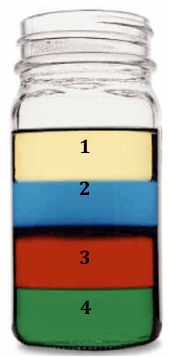
Put the liquids in order from most dense to least dense?
a)
4, 3, 2, 1
b)
1, 2, 3, 4
c)
3, 4, 2, 1, 
d)
4, 3, 1, 2
14.
Helium balloons rise on earth because
a)
helium is less dense than air
b)
helium is more dense than air
c)
helium is cooler than air
d)
helium is warmer than air
15.
A student knows the mass of an object. What other variable does the student need to know to calculate the object's density?
a)
Color
b)
Weight
c)
Volume
d)
Length
16.
Why do some substances float on water?
a)
they are warmer than water
b)
they are cooler than water
c)
they are more dense than water
d)
they are less dense than water
17.
What is the density of water?
a)
0 g/ml
b)
1 g/ml
c)
10 g/ml
d)
100 g/ml
18.

Which of these would be correct UNITS to put at the end of a density answer?

a)

g/cm

b)

cm3

c)

g/mL

d)

g/cm3

19.

Scientific questions have to be...

a)

Measurable

b)

Easy

c)

Interesting

d)

Right

20.
True or False: Your hypothesis can never be wrong.
a)
True
b)
False
21.
This variable in an experiment is the one being deliberately changed by the scientist. 
a)
dependent variable
b)
independent variable
c)
data
d)
control group
22.
What step does every scientific experiment begin with?
a)
hypothesis
b)
question/problem
c)
procedures
d)
conclusion
23.
The summary at the end of an experiment that explains the results. 
a)
conclusion
b)
procedures
c)
materials
d)
responding variable
24.
A student wants to test the effects of type of exercise on heart rate.  What is the dependent variable?
a)
heart rate
b)
type of exercise
c)
amount of exercise
d)
time of day exercise occurs
25.
Observations made during an experiment are called:
a)
data
b)
problems
c)
conclusions
d)
questions
26.
Squidward found new reeds to tryout for his clarinet.  He used an APPLAUSOMETER to measure applause after playing  Under the Sea with each reed.  The results were put in the table.
What was the independent variable?
a)
The Song
b)
The Reed
c)
The Applause
27.
Squidward found new reeds to tryout for his clarinet.  He used an APPLAUSOMETER to measure applause after playing  Under the Sea with each reed.  The results were put in the table.
What was the dependent variable?
a)
The Song
b)
The Reed
c)
The Applause
28.

Shannon is wondering why her skin is red and itchy after taking her bubble bath. Which stage of the scientific method is she in?

a)

Question or Problem

b)

Forming a Hypothesis

c)

Drawing a Conclusion

d)

Analyzing Data

29.

Brian is measuring the weight of each rat and writing it down on a chart. Which stage of the scientific method is this?

a)

Hypothesis

b)

Collecting Data

c)

Question or Problem

d)

Conclusion

30.
When you set up a test to see if your hypothesis is true. 
a)
Record Data
b)
Research 
c)
Experiment
d)
Conclusion 
31.
When you analyze your data and see if you can answer your original question.
a)
Research 
b)
Conclusion 
c)
Communicate Results
d)
Observe
32.

What is a hypothesis?

a)

An observation

b)

A prediction about the results of an experiment

c)

A guess

d)

A question

33.
The __________ variable is located on the y-axis.
a)
Independent
b)
Dependent
c)
Control
d)
Constant
34.

What is a dependent variable? (hint: measured)

a)

the variable that causes the change

b)

the variable that remains the same

c)

the variable that we expect to change

d)

the manipulated variable

35.

What is a control group in an experiment?

a)

a factor in an experiment that remains unchanged for purpose of comparison

b)

a factor in an experiment that changes and measured

c)

the manipulated group

36.

Which is the following is NOT Metric measurement?

a)

inches

b)

centimeters

c)

milliliters

d)

celcius

37.

What is a conversion from liters to milliliters?

a)

1000mL/ 1L

b)

1L / 1000mL

c)

100mL / 1L

d)

10L / 1mL

38.

What is a conversion from inches to meters?

a)

2.54cm / 1inch

b)

1inch / 2.54cm x 100cm / 1m

c)

2.54cm / 1inch x 1m/100cm

d)

1m / 100inches

39.

What is the conversion from Fahrenheit to Celsius?

a)

1.8 x __oC + 32

b)

(oC - 32) / 1.8

c)

oC + 273

40.

What is the conversion from foot to meters?

a)

1ft / 0.3m

b)

0.3m / 1ft

c)

12inches / 1ft

d)

30.5cm / 1ft