
 Worksheets
Waves
Total questions: 41
Worksheet time: 33mins
Name
Class
Date
1.
Waves move ___ through vibrations
a)
Energy
b)
Matter
c)
Mass
d)
Weight
2.

Which is the wavelength?
a)
1
b)
2
c)
3
d)
4
3.
If the wavelength gets longer, the frequency gets
a)
higher
b)
lower
4.
If the frequency gets higher, the wavelength gets
a)
longer
b)
shorter
5.
The pitch of the sound depends on
a)
frequency
b)
amplitude
c)
wavelength
6.

Which EM wave has the lowest frequency?
a)
radio
b)
xray
c)
gamma
d)
infrared
7.
A blue tshirt looks blue because of ___.
a)
reflection
b)
refraction
c)
diffraction
8.
Rainbows are ______ light.
a)
Refracting
b)
Reflecting
c)
Diffracting
d)
Absorbing
9.

Which color has the lowest frequency?
a)
red
b)
green
c)
blue
d)
violet
10.

Which color has the highest frequency?
a)
blue
b)
yellow
c)
orange
d)
violet
11.
How often a wave occurs is the wave's __________________
a)
crest
b)
frequency
c)
wavelength
d)
resting point
12.
Mechanical waves are created when a source of energy causes a medium to _________________.
a)
vibrate
b)
expand
c)
move
d)
compress
13.
Any material that a wave travels through is called a ____________________.
a)
vibration
b)
compression
c)
medium
d)
crest
14.
What are the highest parts of a transverse wave called?
a)
amplitude
b)
trough
c)
resting point
d)
crest
15.

What number represents the wavelength?
a)
1
b)
2
c)
3
d)
4
16.
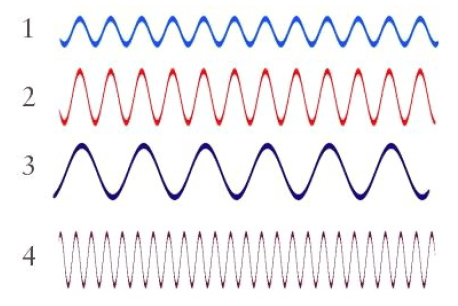
Which wave in the diagram has the greatest frequency?
a)
1
b)
2
c)
3
d)
4
17.
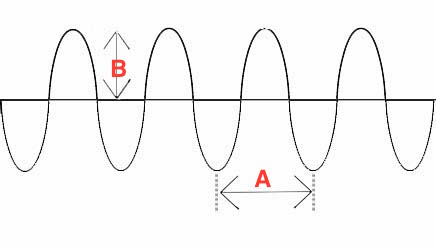
What property of the wave is represented by the letter "A"?
a)
amplitude
b)
crest
c)
trough
d)
wavelength
18.

Which of the following is NOT a mechanical wave?
a)
sound
b)
light
c)
ocean
d)
seismic
19.

The highest point on a wave is:
a)
the crest
b)
the trough
c)
the top
d)
the coast
20.
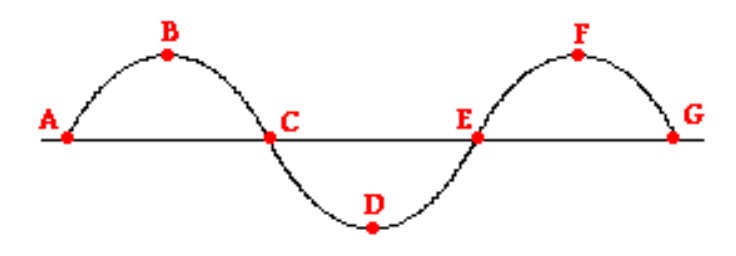
Which letter(s) represent the trough of the wave?
a)
A
b)
B & D
c)
D
d)
C & G
21.

Which wave has a greater frequency?
a)
A
b)
B
22.

How would a person measure the wavelength on this sound wave?
a)
dense to less dense
b)
trough to crest
c)
compression to compression
d)
beginning of illustration to the end
23.

You can't hear sounds in outer space because there is no
a)
medium
b)
light
c)
energy
d)
heat
24.

All waves carry ________ as they travel from one place to another.
a)
matter
b)
space
c)
energy
d)
water
25.
Which wave in the diagram has the greatest frequency?
a)
1
b)
2
c)
3
d)
4
26.
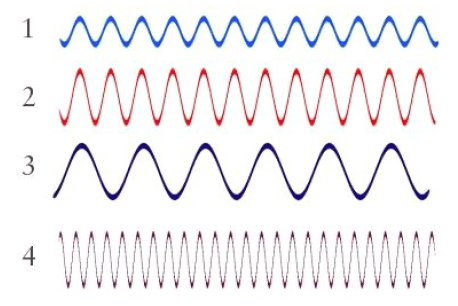
Which wave in the diagram has the greatest wavelength?
a)
1
b)
2
c)
3
d)
4
27.

What kind of wave is pictured?
a)
Transverse
b)
Longitudinal
c)
surface
d)
none of the above
28.
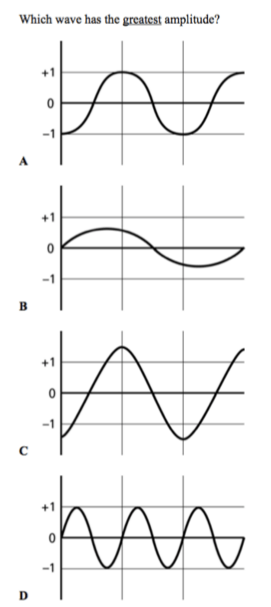
Which wave has the greatest amplitude?
a)
A
b)
B
c)
C
d)
D
29.

What is the wavelength of this wave?
a)
4
b)
8
c)
3.3
d)
6.3
30.
Sound needs a medium to travel through. What is a medium?
a)
solid, liquid, gas
b)
open space
c)
waves
d)
nothing
31.
What does a wave carry from place to place?
a)
energy
b)
matter
c)
people
32.

Which of the figures represents reflection?
a)
A
b)
B
c)
C
d)
D
33.

Which of the following represents refraction?
a)
A
b)
B
c)
C
d)
D
34.
When a wave strikes an object and bounces off
a)
medium
b)
refraction
c)
reflection
d)
interference
35.
When a wave bends as it passes through at an angle from one medium to another.
a)
medium
b)
refraction
c)
reflection
d)
interference
36.
When a sound wave experiences reflection, we hear
a)
a louder sound
b)
an echo
c)
a quieter sound
d)
nothing
37.
Which diagram best represents the shape and direction of a series of wave fronts after they have passed through a small opening in a barrier?
a)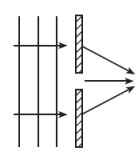
b)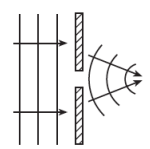
c)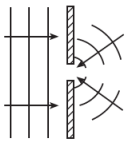
d)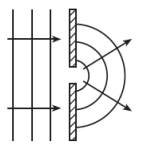
38.
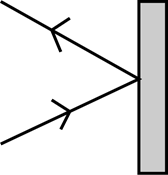
The illustration shows a light ray striking an object.
In the illustration, the light ray striking the object is-
In the illustration, the light ray striking the object is-
a)
absorbed
b)
stopped
c)
reflected
d)
refracted
39.

a)
Reflection
b)
Refraction
40.

This shows the phenomenon known as....
a)
reflection
b)
refraction
c)
mirrors
d)
focal point
41.
What is a medium?
a)
something between a small and a large?
b)
the substance through which a wave can travel
c)
a pattern of vibration that simulates when a wave is standing still
d)
the distance from any point on a wave to an identical point on the next wave
100 %

