
 Worksheets
Moving Man Graphing Lab Review
Total questions: 50
Worksheet time: 27mins
The rate at which velocity changes is called:
motion
average speed
instantaneous speed
acceleration
Acceleration of an object happens when an object:
increases its velocity
decreases its velocity
changes its direction
All choices are correct.

What is happening between 2 and 3 seconds?
The object is not moving.
The object is not accelerating.
The object is slowing down.
The object is speeding up.


The object represented by the red line is:
at rest.
experiencing constant velocity.

Which object(s) is/are slowing down?
Both the orange and green objects.
Both the blue and pink objects.
Only the orange object.
Only the green object.

Which object(s) is/are experiencing a change in direction?
The green object only.
Both the blue and red objects.
Both the orange and pink objects.
Both the green and pink objects.

Which object(s) is/are experiencing positive velocity with negative acceleration for at least a portion of the recorded time?
The pink, blue and red objects.
The green and orange objects.
The orange objects.
The pink object.
A value with both magnitude and direction is known as a:
scalar
speed
velocity
vector
A measurement of how fast an object is moving without regard to direction is known as:
velocity
speed
vector
acceleration
A description which includes both the speed and direction of an object's motion is known as:
velocity
speed
acceleration
vector
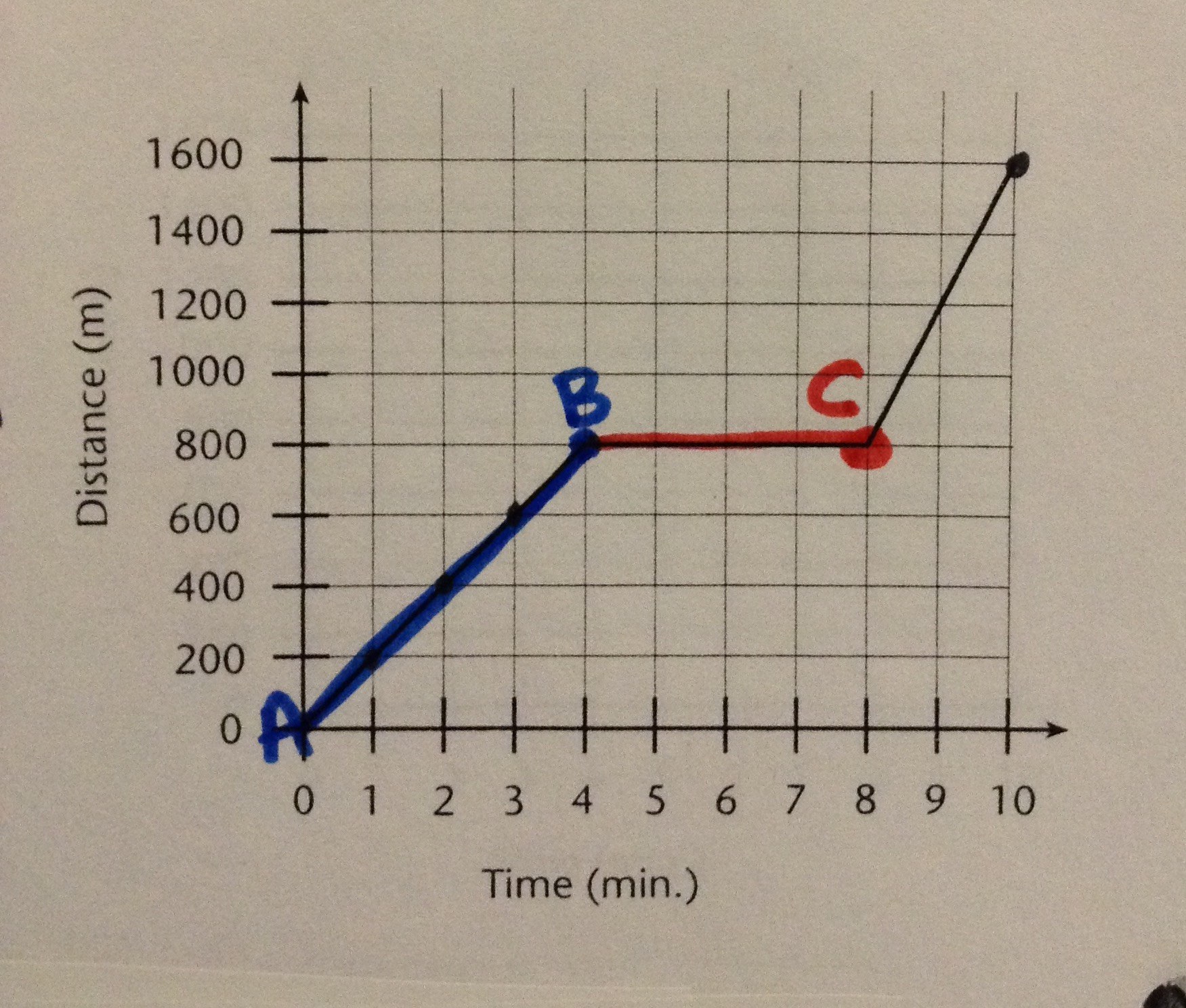
The graph shows Ashley riding her bike to Maria's house. What is occurring from point A to point B?
they are traveling at a constant speed
they are decreasing in speed
they stopped to take a break
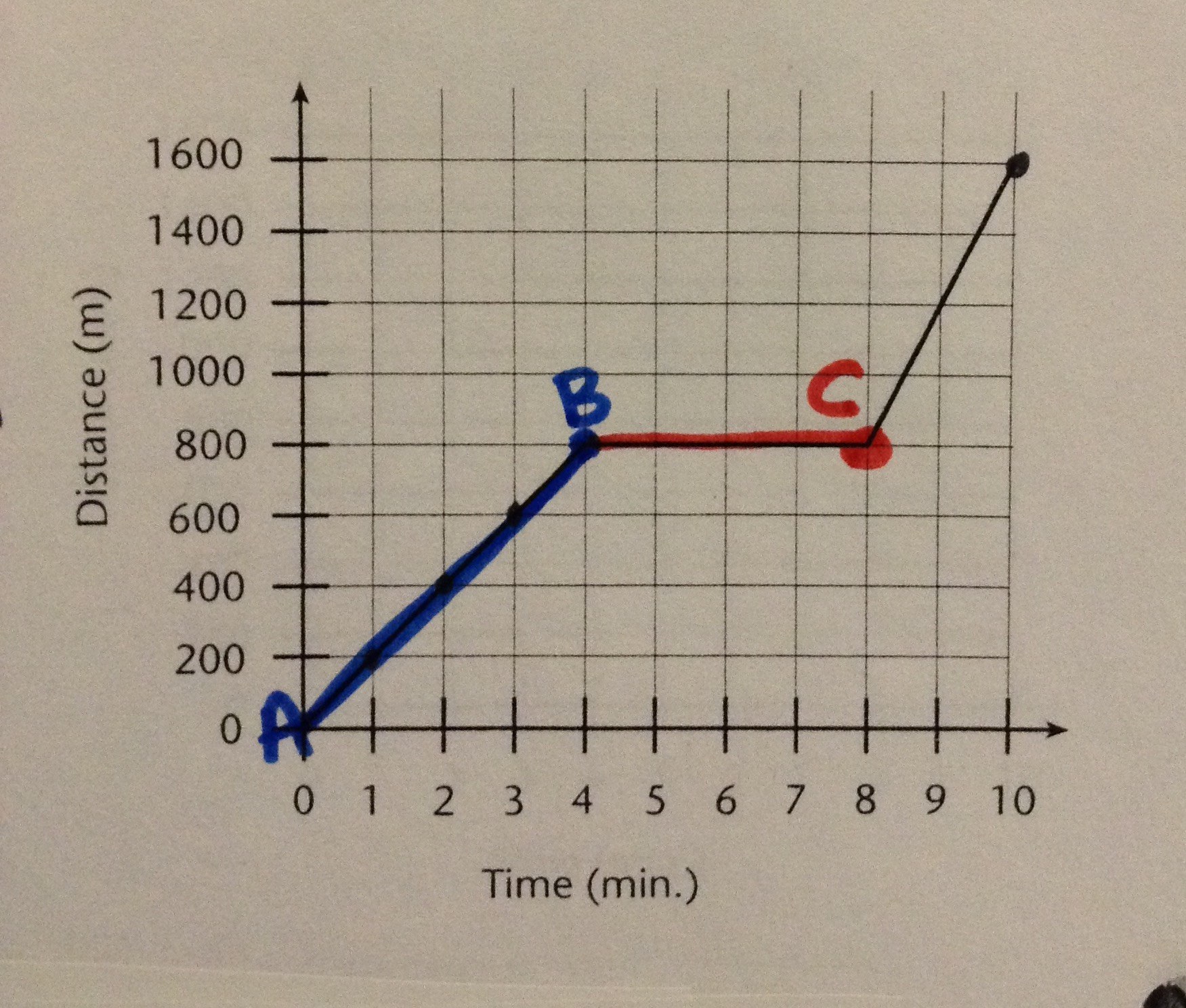
The graph shows Ashley riding her bike to Maria's house. What was occurring from point B to point C?
She was increasing her speed.
She stopped for 4 minutes
She was decreasing in speed
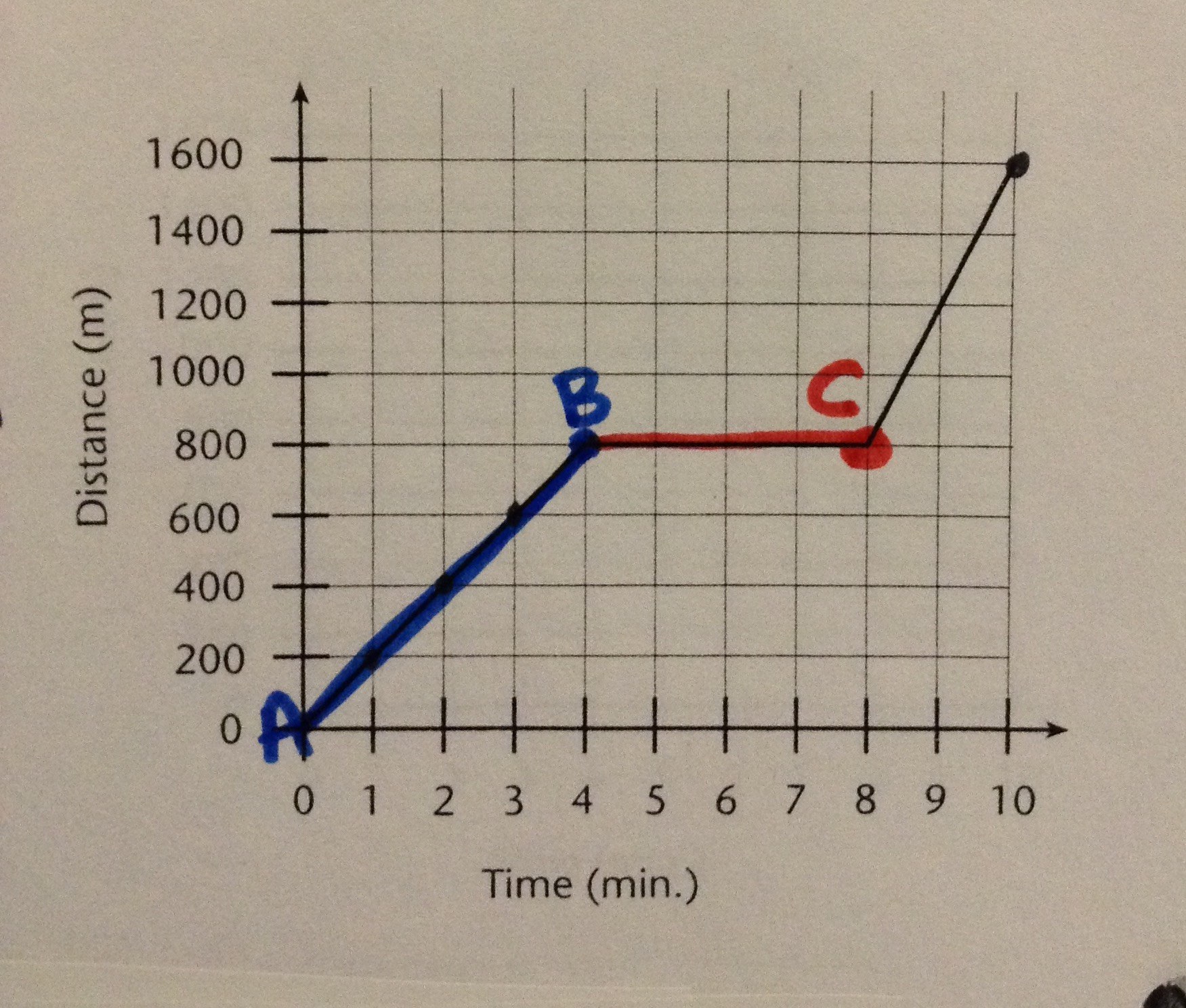
The graph shows Ashley riding her bike to Maria's house. What was Ashley's average speed for the ENTIRE trip?
1600 m/min
200 m/min
160 m/min
A place or object used for comparison to determine if another object is in motion is known as a:
comparison point
reference point
point of view
motion detector
Speed =
distance/time
time/distance
distance x time

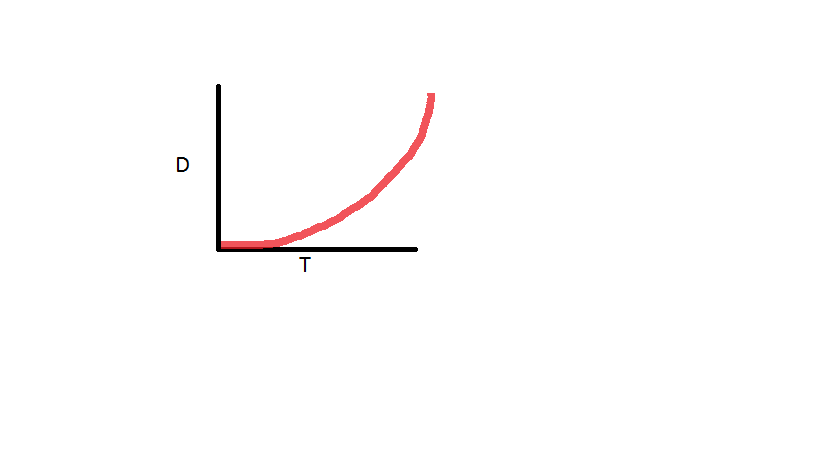
The graph below represents:
speed
velocity
acceleration
negative acceleration
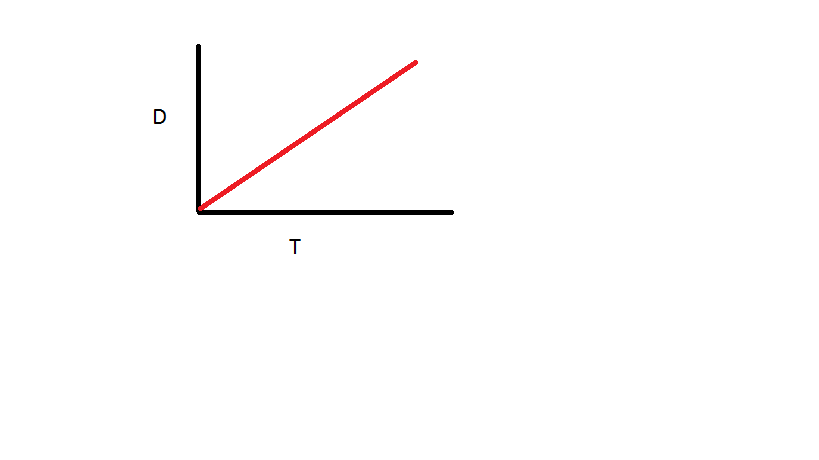
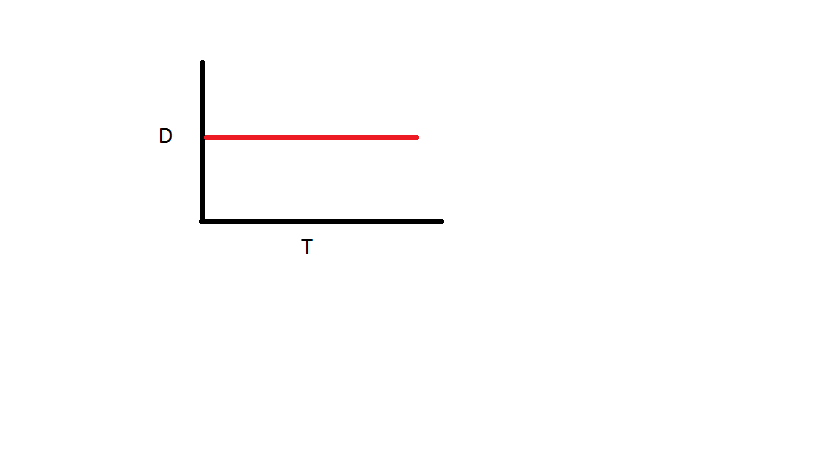
The graph represents:
acceleration
an object at rest.
negative acceleration.
constant velocity

Which quantity shown is a vector?
displacement
distance

A straight blue line is drawn on a P-T graph recording the motion of an object. What is this line called?
Distance line
Slope line
Uniform line
Best-fit line


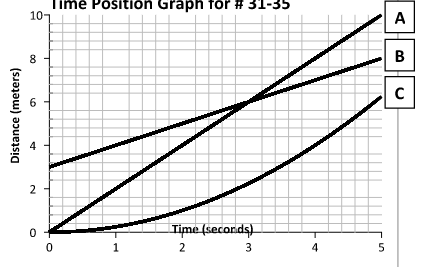
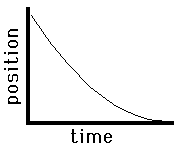

What graph shape is this?
hyperbolic
parabolic
square root
linear
An example of a vector is:
speed
velocity
mass
time
Wind speed during the storm was measured at 20 mph. Is this a vector or a scalar?
Scalar
Vector
30 m/s to the East. Is this an example of a vector or scalar?
Scalar
Vector
Neither
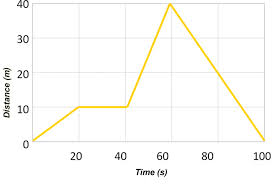
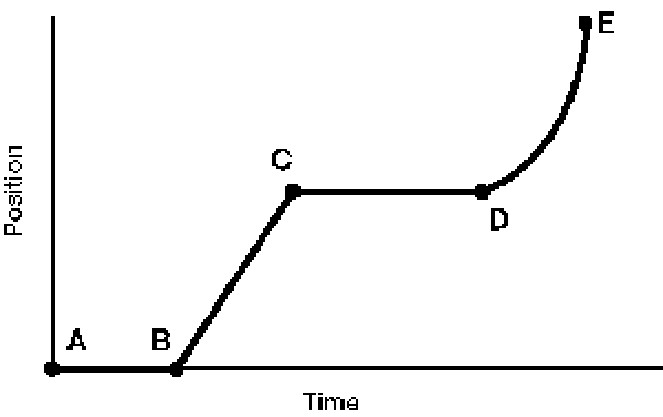

Jermaine runs exactly 2 laps around a 400 meter track, finishing exactly where he started. What is the displacement?
800 meters
400 meters
0 meters
200 meters
The statement, “The car was traveling at 55 mph due west,” best describes
Acceleration
Motion
Speed
Velocity
If a car is moving forward and the driver slams on the brakes, its acceleration is
zero
positive
constant
negative
If a car goes around a curve at a constant 25 m/s, its ___ does not change
direction
position
speed
velocity
On a position time graph, the slope represents the
velocity
time
distance
direction
acceleration
On a velocity time graph, the slope represents the
velocity
time
distance
direction
acceleration
What is the acceleration of an object that has a constant velocity?
a. 0.0 m/s
0.0 m/s2
1.0 m/s
c. 1.0 m/s2
When a car’s velocity is negative, it is moving . . .
forward
in reverse.
sideways
straight up.
What is the speed of an object at rest?
0.0 m/s
0.0 m/s2
1.0 m/s
1.0 m/s2

The slope of the graph represents:
velocity.
distance
time
directoin
acceleration
What is the equation for acceleration?
Acceleration = Change in Velocity x Time
Acceleration = Change in Velocity / Time
Acceleration = Time / Change in Velocity

