wayground logo

Free Printable Worksheets

Font size

S
M
L
XL
Worksheets

AP Physics - Unit 3

Total questions: 46

Worksheet time: 56mins

Name
Class
Date
1.
Which would have a greater linear velocity?
a)
Kid near the center of the merry go round
b)
Kid near the outside of the merry go round
c)
neither
2.
The graph respresents
a)
no motion
b)
constant velocity
c)
increasing velocity
d)
decreasing velocity
3.
A person has a mass of 24 kg on Earth. What is the persons mass on the Moon (1/6 of Earth's gravity)?
a)
24 kg
b)
144 kg
c)
6 kg
d)
4 kg
4.
What determines the strength of gravitational attraction between two objects?
a)
mass and distance
b)
size and mass
c)
density and mass
d)
density and size
5.

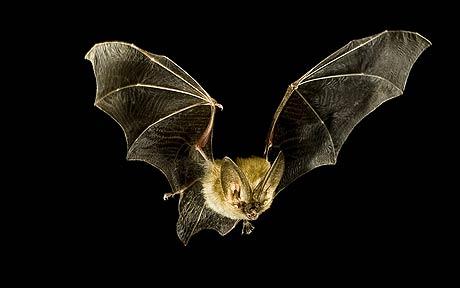
Bruno the bat has a mass of 0.58 kg and flies at a speed of 0.8 m/s in circle of radius 0.5 m. What is his acceleration?

a)

0.25 m/s2

b)

1.3 m/s2

c)

1.6 m/s2

d)

0.74 m/s2

6.
Centripetal acceleration always points
a)
in the direction of the object's motion
b)
in the opposite direction of the object's motion
c)
towards the center of the circle
d)
towards the outside of the circle
7.
Calculate the centripetal force required to make a 5 kg ball move 4 m/s in a circle with a radius of 2 m.
a)
10 N
b)
20 N
c)
30 N
d)
40  N
8.

An object sliding across a surface will experience ______ friction.

a)

static

b)

potential

c)

kinetic

d)

no

9.
Which statement is true about an object that is traveling in uniform circular motion?
a)
The speed of the object varies.
b)
The net force on the object is directed toward the center of the circular path.
c)
The direction of the object's velocity is constant.
d)
The net force on the object is directed away from the center of the circular path.
10.
The Earth pulls downward on a pingpong ball with a force  of 1N. If this is the "action" force, what is the "reaction" force?
a)
The ground exerts a force of 1N on the ping pong ball
b)
The ping pong ball exerts a force of 1 N on the Earth
c)
The ping pong ball pushes down on the earth with a force of 1N
d)
The is no reaction force when a gravitational force is involved
11.
What is the coefficient of static friction if it takes 44 N of force to move a box that weighs 86 N? 
a)
0.78
b)
0.51
c)
0.78 N
d)
0.58 N
12.

When dealing with circular motion, the time that it takes to make one revolution of the circle is called the:

a)

rotation.

b)

orbit.

c)

period.

d)

segment.

13.

A car moves with a constant speed of 17 m/s on a circular track of 200 m radius. Calculate the acceleration of the vehicle. HINT: a = V2 / R

a)

1.45 m/s2

b)

0.76 m/s2

c)

1.98 m/s2

d)

2.34 m/s2

14.

A pendulum bob is released from rest in a horizontal position with the string taut. Which of the following statements is correct when the pendulum reaches its vertical position at point P?

a)

The tension attained its least value

b)

The tension depends only on the length of the pendulum

c)

The tension depends on the mass and length of the pendulum bob.

d)

The magnitude of tension equals the weight of the pendulum bob
15.
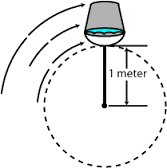
You swing a bucket of water attached to a string in a circle above your head. What keeps the water in the bucket?
a)
Friction
b)
Centripetal Force
c)
Gravity
d)
Inertia
16.

The term centripetal means

a)

circular motion

b)

center accepting

c)

center seeking

d)

center fleeing

17.

A curved groove is place on the top of a level table as shown in the diagram. A ball is pushed in the groove at P so that it leaves at Q. Which picture shows how the ball will move when it leaves the groove at Q?

a)
b)
c)
d)
18.

At the instant shown in the diagram, the car's centripetal acceleration is directed-

a)

toward E

b)

toward N

c)

toward W

d)

clockwise

19.
Bruno the bat flies at a speed of 0.5 m/s in circle of radius 1 m. What is his acceleration?
a)
0.25 ms-2
b)
0.5 ms-2
c)
1 ms-2
d)
2 ms-2
20.
What object experiences uniform circular motion?
a)
A car speeding up as it turns left
b)
A car traveling around a roundabout at a constant speed
c)
A car slowing down as it crests a tall hill
d)
A car traveling down the road at a constant speed
21.
The velocity is always _____ to the line of a circle. 
a)
outwards
b)
towards the center
c)
tangent
d)
faster
22.
What happens to an object's speed as the radius decreases?
a)
It increases.
b)
It decreases.
c)
It remains unchanged.
23.
Calculate the velocity of an object moved around a circle with a radius of 1.65 m and an acceleration of 3.5 m/s2.
a)
2.4 m/s
b)
3.6 m/s
c)
3.9 m/s
d)
4.2 m/s
24.
Calculate the centripetal force required to make a 5 kg ball move 4 m/s in a circle with a radius of 2 m.
a)
10 N
b)
20 N
c)
30 N
d)
40  N
25.
Calculate the velocity of an object moved around a circle with a radius of 1.65 m and an acceleration of 3.5 m/s2.
a)
2.4 m/s
b)
3.6 m/s
c)
3.9 m/s
d)
4.2 m/s
26.
A horse gallops around a circular arena.  The centripetal force on the horse is ___.
a)
directed outward
b)
tension
c)
directed toward the center of the arena
d)
9.8 N
27.
Calculate the mass of an object if it took 20 N of force to rotate it in a circle with a radius of 2 meters with a velocity of 4 m/s
a)
4.1 kg
b)
3.6 kg
c)
2.5 kg
d)
1.8 kg
28.
Why do objects experience centripetal acceleration?
a)
Because they are speeding up as they move in a circle
b)
Because they are constantly changing direction and the net change is directed inward
c)
Because they are constantly changing both speed and direction
d)
Because when you have 100 people pedaling, you can speed up more easily.
29.

If a ball is swinging at the end of a rope and the rope is suddenly cut, assuming there is no gravity, what best describes the path it will take?

a)

It will fly in a straight line forward from where it was cut

b)

It will fly in a curved line away from the circle

c)

It will fly inward toward the circle

d)
30.

A toy train moves in a circular track with a velocity of 2.2 m/s, the axis of rotation is 1.8 m. What is its centripetal acceleration?

a)

1.22 m/s2

b)

0.81 m/s2

c)

2.69 m/s2

d)

1.47 m/s2

31.

What is the tangential velocity if the centripetal force is 150 N when a 3 kg toy plane flies in a 2 m radius circle?

a)

10 m/s

b)

100 m/s

c)

225 m/s

d)

15 m/s

32.
Which of the following is the unit for centripetal force?
a)
J
b)
m/s2
c)
kg⋅m/s
d)
N
33.
What states that "every object in the universe attracts every other object"?
a)
Law of Universal Gravitation
b)
Newton's First Law of Motion
c)
My mother
d)
Inertia & gravity
34.
If Earth's mass was cut in half, what would happen to your mass?
a)
increase because gravitational force increases
b)
decrease because gravitational force decreases
c)
decrease because gravitational force increases
d)
nothing, mass is not affected by gravitational force
35.
What is the SI unit for circumference?
a)
meter
b)
pi
c)
inches
d)
kilometer
36.
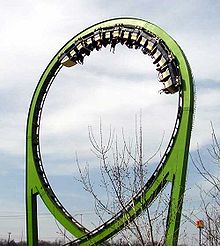
Where is the net force when the rollercoaster is at the top of the loop?
a)
Towards the sky
b)
Towards the Right
c)
Towards the left
d)
Towards the ground
37.

A car is doing donuts in a parking lot. It completes 5 circles in 35 seconds. What is the period of rotation, in seconds?

38.

A object is traveling in uniform circular motion. It has a period of 6 seconds. The radius of the circle is 3 meters. What is the tangential velocity, in m/s?

(round to a whole number)

39.

The circumference of a circle is...

a)

2πr

b)

πr

c)

πr2

d)

2πr2

40.

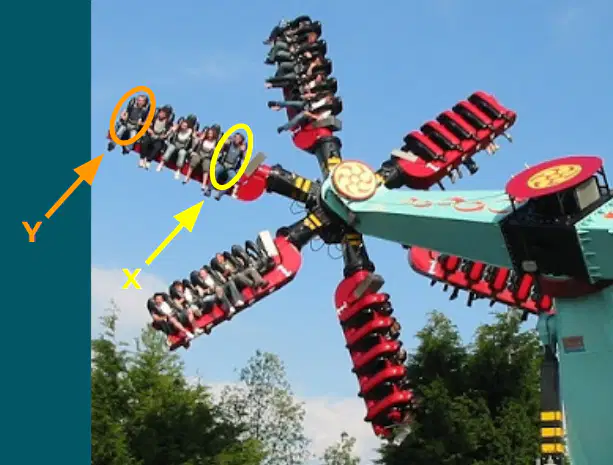
Two riders sit at positions X and Y. Do they have different periods of rotation and why / why not?

a)

No, because they have the same tangential velocity.

b)

No, because they take the same amount of time to complete 1 loop.

c)

Yes, because they have different tangential velocities.

d)

Yes, because they have different masses probably.

41.

Two riders sit at positions X and Y. With every loop, do they travel the same distance?

a)

Yes, since they are on the same ride

b)

No, rider Y travels a greater circumference

42.

Imagine a child on a merry-go-round, spinning as it turns. If the child is holding a ball, then reaches out and releases the ball off the side of the merry-go-round, in what direction will it travel?

a)

Toward the center of the merry-go-round

b)

Directly opposite the center of the merry-go-round

c)

In a straight line tangential to the circular path of the merry-go-round

d)

Around in a circular path identical to how it was traveling prior to release

43.

In what direction does the child feel herself being pulled while on the merry-go-round?

a)

Toward the center of the merry-go-round

b)

Directly opposite to the center of the merry-go-round

c)

Tangentially along the path of the circular motion

d)

None of these

44.

The Gravitron at the local carnival spins around, doing a full loop every 8.0 s. If a rider is against the wall, 6.5 m from the center, what is their tangential velocity?

Let's work this problem step-wise. First, we must identify given values, the desired unknown, and any other unknowns.

a)

8.0 s

1.

T

b)

6.5 m

2.

r

c)

desired unknown

3.

v

d)

other unknown

4.

a

e)

other unknown

5.

F

45.

An Olympic athlete can throw a 2.00 kg discus with a release velocity of 25.7 m/s. If the athlete releases the discus coming out of a circular rotation with the object at 1.01 m from the center of rotation, what force was required to hold the discus through the rotation? Start by matching the known and desired unknown values to their corresponding variables.

a)

2.00 kg

1.

m

b)

25.7 m/s

2.

v

c)

1.01 m

3.

r

d)

desired unknown

4.

F

e)

other unknown

5.

a

46.

The Colossus ferris wheel outside St. Louis, MO has a diameter of 50.3 m and travels a full loop every 35.4 s. What is the centripetal acceleration experienced by the riders on the Colossus? Don't forget your units and sig figs!

(a)