wayground logo

Free Printable Worksheets

NEW

Font size

S
M
L
XL
Worksheets

light in mirrors and lenses

Total questions: 43

Worksheet time: 29mins

Name
Class
Date
1.
Which window is opaque?
a)
Window 1
b)
Window 2
c)
Window 3
d)
None
2.
___________ is a from of energy that we can see with our eyes.
a)
shadow
b)
light
c)
energy
d)
reflection 
3.
When light bends through a new medium, what is happening?
a)
reflection
b)
refraction
c)
absorption
d)
translucent
4.
Light rays bend when they go from air to water  because of a change in ___________.
a)
color
b)
wavelength
c)
density
d)
speed
5.
This diagram best represents 
a)
reflection
b)
refraction
c)
absorption
d)
diffusion
6.
How does light travel
a)
It curves around corners
b)
Really slow
c)
In a straight line
d)
In circles
7.
What is the ray of light that strikes the surface.
a)
Incident ray
b)
reflected ray
c)
normal ray
d)
normal
8.
....................... - the imaginary line perpendicular to the surface.
a)
Normal
b)
Angle of incidence 
c)
Angle of reflection
9.
........... – the angle between the normal and the reflected ray.
a)
Angle of incidence
b)
Angle of reflection
c)
Angle of coincidence
d)
Angle of direction
10.
Law of reflection state that - The angle of incidence is .................. to the angle of reflection.
a)
equal
b)
double
c)
half
11.
What is B?
a)
Angle of incidence
b)
Angle of reflection
c)
Incident ray
d)
Reflected ray
12.
What is C?
a)
Angle of incidence
b)
Angle of reflection
c)
Incident ray
d)
Reflected ray
13.
What is E?
a)
Angle of incidence
b)
Angle of reflection
c)
Normal
d)
Reflect ray
14.
What is X?
a)
22.5°
b)
45°
c)
67.5°
d)
90°
15.
What does the word "converging" mean?
a)
to separate
b)
to come together
c)
parallel 
d)
perpendicular
16.
A converging lens is also known as a ____ lens.
a)
convex
b)
concave
c)
double
d)
refracted
17.
a flat sheet of glass that has a smooth, silver-colored coating on one side
a)
plane mirror
b)
concave mirror
c)
convex mirror
d)
solid mirror
18.
What does it mean to reflect?
a)
bounce off
b)
bend
c)
refract
d)
energy
19.
An image that you can see when you look into a mirror, but does not really exist is called which of the following?
a)
Real Image
b)
Fake Image
c)
Virtual Image
d)
Digital Image
20.
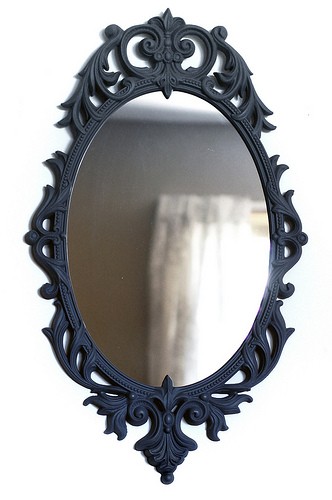
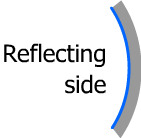
The following is a picture of what type of mirror? 
a)
Convex (diverging) mirror
b)
Concave (converging) mirror
c)
Plane Mirror
d)
Flat Mirror
21.
The following is a picture of what type of mirror? 
a)
Convex (diverging) Mirror
b)
Concave (converging) Mirror
c)
Plane Mirror
d)
Flat Mirror
22.
This is an example of a __________ mirror.
a)
Concave
b)
Convex
c)
Plane
d)
Magnifying
23.
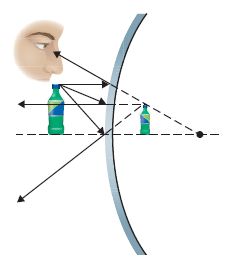
Convex mirrors cause light to spread out.
a)
True
b)
False
24.
What kind of mirror is shown here?
a)
plane
b)
concave
c)
convex
d)
diffuse
25.
Which of the mirrors is used as rear view mirror in vehicles?
a)
Concave
b)
Convex
c)
Plane
26.
The following is a picture of what type of mirror? 
a)
Convex Mirror
b)
Concave Mirror
c)
Plane Mirror
d)
Flat Mirror
27.

In the ray diagram shown, which set of descriptions of the image formed is completely accurate?

a)

The image is minimized, inverted, and real.

b)

The image is magnified, inverted, and real.

c)

The image is minimized, inverted, and virtual.

d)

The image is magnified, inverted, and virtual.

28.

In the ray diagram shown, which set of descriptions of the image formed is completely accurate?

a)

The image is minimized, upright, and real.

b)

The image is magnified, inverted, and real.

c)

The image is minimized, upright, and virtual.

d)

The image is magnified, inverted, and virtual.

29.

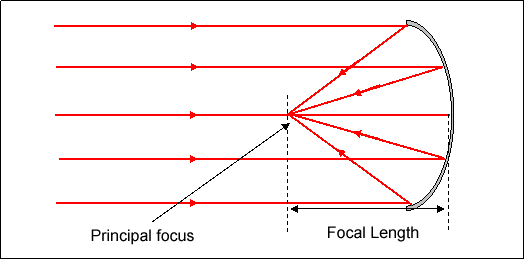
In ray diagram for concave mirrors, if an incident ray passes through the focal point, how does the reflected ray look like?

a)

It reflects back on itself.

b)

The reflected ray bounces vertically upward.

c)

The reflected ray will be parallel to the principal axis.

d)

The reflected ray gets projected vertically downward.

30.

Which of the following correctly describes the image characteristics formed in plane mirrors?

a)

virtual, upright, diminished

b)

virtual, upright, same size

c)

real, inverted, diminished

d)

real, upright, same size

31.

In ray diagrams for spherical mirrors, which term refers to the distance between the mirror and the focal point?

a)

focal length

b)

principal axis

c)

radius of curvature

d)

vertex

32.

For convex mirrors, what will be the resulting reflected ray an incident ray that that travels parallel to the principal axis?

a)

The reflected ray will pass through the focal point.

b)

The extension of the reflected ray will pass through the focal point.

c)

The reflected ray will pass through the center of curvature.

d)

The extension of the reflected ray will pass through the center of curvature.

33.

For concave mirrors, what are the image characteristics for an object placed between the center of curvature and focal point?

a)

enlarged, inverted, real

b)

enlarged, inverted, virtual

c)

diminished, inverted, real

d)

diminished, upright, virtual

34.

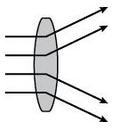
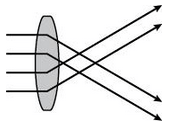
Which lens represents the path light takes through a diverging lens?

a)
b)
c)
d)
35.

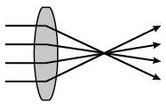
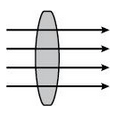
Which figure represents the path light takes through a converging lens?
a)
b)
c)
d)
36.
A converging lens is also known as a ____ lens.
a)
convex
b)
concave
c)
double
d)
refracted
37.
When an object is placed on the focal point in front of a convex lens, the image produced is ___.
a)
real, reduced, and inverted
b)
real, enlarged, and inverted
c)
real, true, and inverted
d)
There is no image
38.

What type of image is formed?

a)

virtual and inverted

b)

virtual and upright

c)

real and upright

d)

real and inverted

39.
This image is...
a)
Inverted and smaller
b)
inverted and bigger
c)
not inverted and smaller
d)
not inverted and bigger
40.
a real image...
a)
is produced by virtual rays and can be projected on a screen
b)
is produced by real rays and cannot be projected on a screen
c)
is produced by virtual images and cannot be projected on a screen
d)
is produced by real rays and can be projected on a screen
41.

The diagram shows an object placed in front of a concave lens. What are the characteristics of the image formed?

a)

Real, inverted, magnified

b)

Real, inverted, diminished

c)

Virtual upright, magnified

d)

Virtual, upright, diminished

42.

Which of the following is a correct ray diagram for convex lens?

a)
b)
c)
d)
43.

Which ray diagram is correct for convex lens?

a)
b)
c)
d)