
 Worksheets
Laws of Motion
Total questions: 40
Worksheet time: 40mins


The picture shows an aerialist walking on a tightrope and holding a balancing bar. An action-reaction pair of forces exists between -
the aerialist's feet and the rope
the rope and the balancing bar
the two ends of the rope
the aerialist's arms and legs
Four boxes are sliding with constant speed before each box experiences an unbalanced force of 8 N. Which box would experience the greatest acceleration when the unbalanced force is applied?
The box with a mass of 2 kg
The box with a mass of 4 kg
The box with a mass of 6 kg
The box with a mass of 8 kg

Two forces applied to a 17 kg box, as shown. The box is on a smooth surface. Which statement best describes the acceleration of the box?
The box accelerates at 1.0 m/s2 to the right because the net force is 17 N to the right.
The box accelerates at 1.9 m/s2 to the right because the greater the force is to the right.
The box accelerates at 3.0 m/s2 to the combined forces cause the box to accelerate.
The box does not accelerate, because neither force is large enough to move the box.

The list includes six situations. Which objects in the list experience an unbalanced force?
The book, the ball, and the car
The ball, the car, and the bird
The can, the swing, and the bird
The book, the ball, the can, and the swing

During a demonstration of Newton's laws of motion, a student used the setup shown in Figure 1. The student flicked the index card with a fingertip, and the coin fell straight down into a plastic cup as shown in Figure 2. Which of these best explains why the coin fell straight down into the cup instead of remaining on the index card?
The coin was at rest until the card was removed, so it tended to remain in the same location. Once the card was gone, the unbalanced force of gravity caused the coin to fall.
Moving the card applied an action force on the coin. Since the card was gone, gravity applied a reaction force on the coin.
The card had less mass than the coin, so a smaller force of gravity acted on the card. The larger force of gravity on the coin made it fall.
The acceleration of the coin following into the cup was equal and opposite to the acceleration of the card.

The diagram below shows two different forces acting on a cyclist riding a bicycle. The total mass of the cyclist and the bicycle is 100.0 kg. Based on this information, what is the acceleration of the cyclist?s2
0.66 m/s2 backward, because the force of the air slows the cyclist down
0.66 m/s2 forward, because the applied force is greater than the force of the air
2.33 m/s2 backward, because the forces are opposite and not equal
2.3 m/s2 forward, because the cyclist's inertia is greater than the force of the air

A student lets a toy car roll four times down a ramp that is 1 m long. Each time the student covers the surface of the ramp with a different material. The student measures the time it takes the car to roll down the ramp and records the results in the table below. Which of these would be the best conclusion based on the data in the table?
Different surfaces affect how fast a toy car accelerates.
Different toy cars travel at different speeds.
Gravity has little effect on the speed of toy cars on different surfaces.
Air resistance is the greatest factor in limiting the acceleration of different toy cars.

Four students raced toy cars on a track. The mass and the acceleration of each car is recorded in the table below. Which toy car had the greatest applied force?
1
2
3
4
Two cars with different masses travel at the same speed down a hill toward a stop sign. What will happen when both cars apply brakes at the same time to stop?
The car with the smaller mass will require less force to stop than the car with the larger mass.
The car with the larger mass will maintain its velocity while traveling down the hill.
The car with the smaller mass will take longer to stop than the car with the larger mass.
The car with the larger mass will have less inertia than the car with the smaller mass.

The masses of four vehicles and the net forces acting on them as they enter a highway are recorded in the table below. Which vehicle has the greatest acceleration as it enters the highway?
Sedan
Coupe
SUV
Truck
If Jack is pushing a box 19 Newtons to the right and Jill is pushing the same box 87 Newtons to the left which direction will the box go?
68 Newtons to the left
68 Newtons to the right
69 Newtons to the left
69 Newtons to the right

Lily and Billy are moving houses. Lily is pushing a box 28 Newtons to the right while Billy is pushing the same box 55 Newtons to the right. Which direction is the box moving?
83 newtons to the left
73 newtons to the right
93 newtons to the right
83 newtons to the right
Newton's First Law States........
Objects at rest tend to stay at rest unless acted on by an outside force.
Objects accelerate often and it is difficult to know when or how they will accelerate.
Objects in motion tend to stay in motion unless acted on by an outside force.
Both A & C
What is inertia?
An object that is accelerating
Gravitational force
An objects tendency to stay at rest or in motion
An unbalanced force
Inertia depends on __________.
Weight
Velocity
Mass
Acceleration
Newton's third law states.......
For each action there is a larger reaction associated with it.
None of these choices
For each action there is an equal and opposite reaction.
For each action there is a smaller reaction associated with it.
When 2 equal forces act on an object and the object doesn't move, it is considered what?
balanced
unbalanced

A book pushes down on a table with a force of 5N, the table..
Pushes back with a force of 5N
Pushes back with a force less than 5N
Pushes back with a forcec greater than 5N
Does nothing. A table has no force.

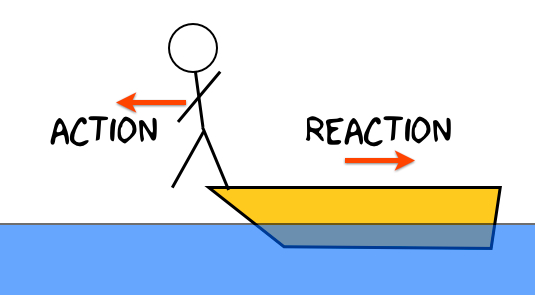
According to Newton’s Third Law, if someone jumps off a skateboard, the skateboard will roll backward because -
the mass of the skateboard is the same as the mass of the person jumping off.
the pull of gravity on the person is the same as on the skateboard, regardless of size.
the air resistance on the person is great and the friction on the skateboard is small.
for the force that sent the person forward, there is an equal force pushing back on the skateboard.
Newton's are the unit used to measure...
energy
force
weight
mass

If I apply the same force to a ping pong ball and a bowling ball, which one will have greater acceleration?
ping pong ball
bowling ball


Acts on an object as it travels through air
Normal force
Air resistance
Spring force

Force exerted to an object by a person or another object
Applied force
Gravity
Normal force
What is the notation for the force that the earth exerts on you and is directed downwards?
Fs
Fb
Fg

When you are sitting down, the 2 forces acting on you are gravity and ______
normal force
tension
air resistance

Force that is transmitted through strings/ropes/cables
Spring force
Tension
Friction

Which of the following describes the direction of friction?
always to the left
same direction as the direction of motion
opposite the direction of motion

